

Cardinal numbers: The complete guide to counting numbers

Cardinal numbers are the numbers we use for counting. Whether you are counting the apples in a basket, the students in a classroom, or the stars in the sky, you are using cardinal numbers.
In mathematics, this concept was formalized by mathematician Georg Cantor. Simply put, cardinal numbers answer the question: “How many?” Unlike ordinal numbers (which show position), cardinal numbers represent a specific quantity or amount.
Quick summary: What are cardinal numbers?
- Definition: Cardinal numbers are counting numbers (1, 2, 3…) that answer the question “how many?”
- Key difference: Unlike ordinal numbers (first, second), cardinal numbers show quantity, not position or rank.
- Zero and negatives: 0 is a cardinal number (representing an empty set), but negative numbers are not.
- Writing rule: Generally, spell out numbers one through nine and use numerals for 10 and above.
- Place value: The position of a digit (ones, tens, hundreds) determines its total value.
Key characteristics of cardinal numbers
To understand how these numbers function in English and mathematics, keep these three rules in mind:
- They indicate quantity: They tell us the total amount of something.
- They are whole numbers: Cardinal numbers do not include fractions or decimals ($1/2$ or $0.5$ are not cardinal numbers).
- They start from zero: While we usually begin counting at 1, zero is also considered a cardinal number because it represents a quantity of “none.”
Cardinal vs. ordinal numbers: What is the difference?
It is common to confuse cardinal numbers with ordinal numbers. The table below clarifies the primary differences to help you use them correctly in writing.
| Feature | Cardinal numbers | Ordinal numbers |
| Purpose | To count a total quantity | To show a position or rank |
| Question answered | How many? | Which one? |
| Examples (Digits) | 1, 2, 3, 10 | 1st, 2nd, 3rd, 10th |
| Examples (Words) | One, two, three | First, second, third |
List of cardinal numbers (1 to 100)
In English, we often write out numbers from one to nine in sentences, while using numerals for 10 and above. However, knowing the correct spelling is essential for formal writing.
Cardinal numbers 1–20
- 1 – One
- 2 – Two
- 3 – Three
- 4 – Four
- 5 – Five
- 6 – Six
- 7 – Seven
- 8 – Eight
- 9 – Nine
- 10 – Ten
- 11 – Eleven
- 12 – Twelve
- 13 – Thirteen
- 14 – Fourteen
- 15 – Fifteen
- 16 – Sixteen
- 17 – Seventeen
- 18 – Eighteen
- 19 – Nineteen
- 20 – Twenty
If you’re setting up a learning space, this set of primary math posters includes a dedicated cardinal vs. ordinal number chart.
Counting by tens to 100
When forming numbers between these multiples (like 21 or 65), we use a hyphen: twenty-one, thirty-two, or sixty-five.
- 30 – Thirty
- 40 – Forty (Note: no “u” in forty!)
- 50 – Fifty
- 60 – Sixty
- 70 – Seventy
- 80 – Eighty
- 90 – Ninety
- 100 – One hundred
Large cardinal numbers: Hundreds, thousands, and millions
As numbers grow larger, they can become difficult to write out. In American English, we typically exclude the word “and” when writing large numbers (e.g., “one hundred twenty-five” instead of “one hundred and twenty-five”).
| Numeral | Word form | Common abbreviation |
| 1,000 | One thousand | 1K |
| 10,000 | Ten thousand | 10K |
| 1,000,000 | One million | 1M |
| 1,000,000,000 | One billion | 1B |
| 1,000,000,000,000 | One trillion | 1T |
Pro tip: Use abbreviations like “K” for thousands or “B” for billions in casual contexts or data visualizations. However, in formal essays, it is best to write the full numeral or word form to ensure clarity.
Understanding place value in cardinal numbers
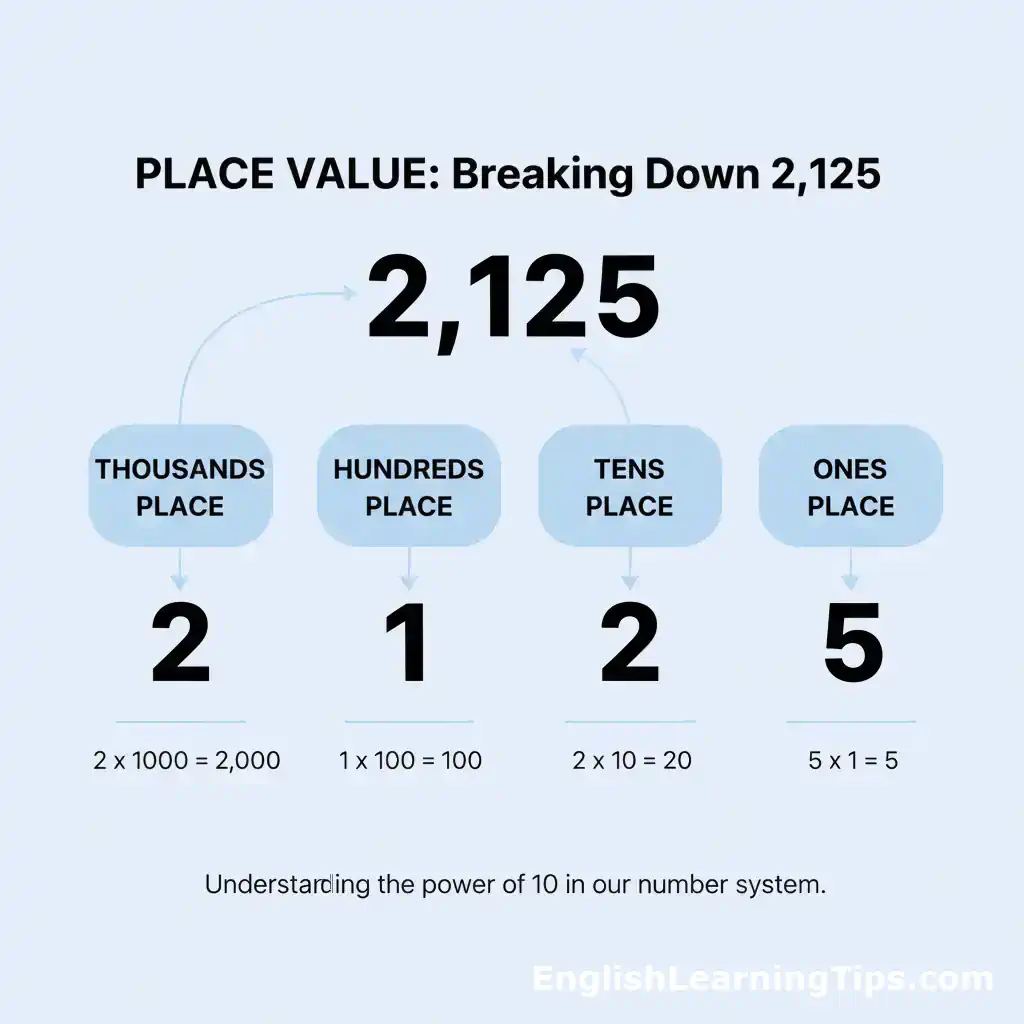
The “place” of a digit determines its value within the number. Our system is based on powers of 10. For example, in the cardinal number 2,125, each digit represents a different magnitude:
- Ones place: The 5 represents 5 ones.
- Tens place: The 2 represents 2 tens (20).
- Hundreds place: The 1 represents 1 hundred (100).
- Thousands place: The 2 represents 2 thousands (2,000).
To help students visualize the powers of 10, many educators use physical base ten blocks to represent thousands, hundreds, tens, and ones.
Frequently asked questions about cardinal numbers
Visual tools to help you learn
Speaking practice
This video simply shows you the numbers and how to say them in an interactive way.
Cardinal numbers 1-100
This video will help you learn to pronounce every number from 1 to 100 in an American accent.
Mastering cardinal numbers: Your next steps
Cardinal numbers are more than just digits on a page; they are the foundation of how we communicate quantity, from the change in your pocket to the distance between stars. By understanding the clear distinction between cardinal, ordinal, and nominal numbers, you improve both your mathematical literacy and your English writing precision.
Whether you are a student tackling place value for the first time or an English learner perfecting your hyphenation of “twenty-five,” remember that these counting numbers are the “essential” building blocks of the language.
Join the conversation
Did this guide help clear up the difference between cardinal and ordinal numbers for you? Or is there a specific number rule that always trips you up (like why we don’t put a “u” in forty)?
Drop a comment below with your biggest “aha!” moment or a question you still have. If you found this breakdown helpful, share it with a friend or a classmate who might be struggling with their math or English homework. Your feedback helps us create better resources for everyone!
Discover more from English Learning Tips
Subscribe to get the latest posts sent to your email.


