


Infinitives: A complete guide to understanding and using the base verb form

Ever wondered why we say “I want to go” but “I can go“? That tiny “to” is the difference between a full infinitive and a bare infinitive, and getting it wrong is one of the quickest ways to sound like a non-native speaker.
Infinitive verbs are the “neutral” DNA of the English language. They allow you to describe actions without being trapped by a specific tense or subject. Whether you’re trying to pass a grammar exam or just want your professional emails to flow more naturally, mastering these “verbals” is your next big step.
This guide breaks down the rules, the common traps (like the “Split Infinitive” myth), and the specific verbs that change meaning entirely when you swap an infinitive for a gerund.
Also included:
What is an infinitive?
An infinitive is the base form of a verb, typically preceded by the word “to.” It functions as the “neutral” version of a verb because it is not conjugated; it isn’t tied to a specific tense (past, present, or future) or a specific subject.
The term originates from the Latin modus infinitivus, meaning “unlimited.” This is because the infinitive expresses the action of the verb without the limits of person or number.
Common examples of infinitives include:
- To run
- To eat
- To think
- To be
Pro Tip: Think of the infinitive as the “DNA” of the verb. It contains all the potential of the action before it’s limited by a subject or a specific time.
The two types of infinitives
- Full infinitive (to-infinitive): The verb preceded by “to” (e.g., To sleep).
- Bare infinitive: The base verb used without “to” (e.g., Sleep), often found after modal verbs.
How infinitives function in a sentence
Unlike standard verbs, infinitives are “verbals.” This means they are formed from a verb but can function as nouns, adjectives, or adverbs.
1. Infinitives as nouns
An infinitive can act as the subject or the object of a sentence.
- As a subject: “To learn is a lifelong journey.”
- As a direct object: “Sarah loves to paint.”
- As a subject complement: “His only goal is to succeed.”
2. Infinitives as adjectives
When an infinitive modifies a noun, it acts as an adjective.
- “Give me something to eat.” (Modifies the noun “something”)
- “She has a great desire to travel.” (Modifies “desire”)
3. Infinitives as adverbs
An infinitive acts as an adverb when it modifies a verb or an adjective, usually to express purpose.
- Modifying a verb: “He stayed late to help.” (Explains why he stayed)
- Modifying an adjective: “I am happy to meet you.” (Explains the feeling of being “happy”)
Key rules for using infinitives
To ensure your writing is grammatically correct, follow these specific guidelines regarding word order and verb pairing.
Verbs followed by the infinitive
Certain English verbs must be followed by a full infinitive rather than a gerund (-ing form). Common examples include agree, decide, hope, plan, promise, and want.
- Correct: “They decided to leave.”
- Incorrect: “They decided leaving.”
When to use the bare infinitive
You should omit the “to” in the following scenarios:
- After modal verbs: Words like can, should, must, will, and might always take the bare infinitive. (e.g., “I can run,” not “I can to run.”)
- After causative verbs: When using let, make, or help, use the bare infinitive. (e.g., “Let her go.”)
How to negate an infinitive
To make an infinitive negative, simply place the word “not” immediately before the “to.”
- Example: “He told me not to worry.”
Understanding split infinitives
A split infinitive occurs when an adverb is placed between “to” and the verb. While older grammar rules forbade this, modern English (and the Oxford English Dictionary) accepts it for better flow or emphasis.
- Classic example: “To boldly go where no one has gone before.”
Infinitives vs. gerunds
One of the most common challenges in English grammar is choosing between an infinitive (to walk) and a gerund (walking). While they often cover similar ground, the meaning can shift depending on the verb used.
| Verb Example | Used with Infinitive | Used with Gerund |
| Stop | “He stopped to smoke.” (He paused his walk to have a cigarette.) | “He stopped smoking.” (He quit the habit entirely.) |
| Remember | “Remember to call her.” (Don’t forget the future task.) | “I remember calling her.” (I have a memory of doing it in the past.) |
| Try | “Try to open the door.” (Make an effort to do it.) | “Try opening the door.” (Experiment with the door as a solution.) |
Frequently asked questions about infinitives
Visual tools to help you learn
This section includes videos and a graphic you can save or bookmark for future reference.
The infinitive cheat sheet graphic
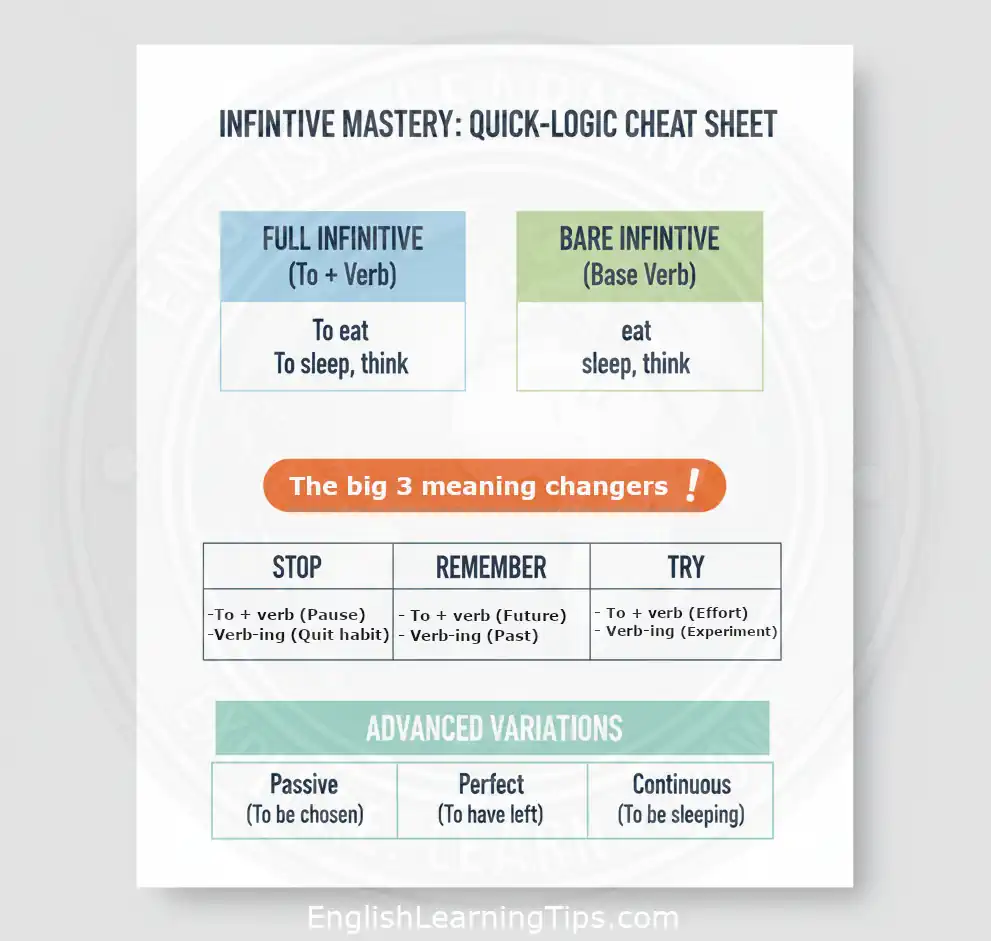
Video: Giving reasons with infinitives
This video guide explains how to use infinitives in English.
The Infinitive Quiz
Infinitive mastery quiz
Test your knowledge of English infinitives!
The Infinitive Master Cheat Sheet
1. The core formula
- Full Infinitive: To + Base Verb (e.g., To explore)
- Bare Infinitive: Base Verb (e.g., Explore)
2. When to use which? (Quick-Logic Table)
| Context | Form to use | Example |
| After Modals (can, will, should) | Bare Infinitive | “I should go.” |
| Expressing Purpose (why?) | To-Infinitive | “I called to ask.” |
| After ‘Let’ or ‘Make’ | Bare Infinitive | “Let him stay.” |
| Following Adjectives | To-Infinitive | “It’s easy to see.” |
| As a Subject | To-Infinitive | “To wait is hard.” |
3. The “Big Three” meaning changers
Some verbs change their entire meaning depending on whether you use an infinitive or a gerund.
- Forget:
- To-Infinitive: Forget a future task (“Don’t forget to pay the bill.”)
- Gerund: Forget a past memory (“I’ll never forget paying that bill.”)
- Regret:
- To-Infinitive: Sad to give bad news (“I regret to tell you…”)
- Gerund: Sad about a past action (“I regret telling him the secret.”)
- Try:
- To-Infinitive: Make an effort (“Try to open the jar.”)
- Gerund: Experiment with a method (“Try opening the window for fresh air.”)
4. Advanced variations (Cheat list)
- Negative: Not + to + verb (“Try not to fall.”)
- Passive: To + be + past participle (“I want to be chosen.”)
- Perfect: To + have + past participle (“He seems to have left.”)
- Continuous: To + be + -ing (“I’d love to be sleeping right now.”)
Conclusion: Mastering the heartbeat of English
Infinitives are more than just “to” followed by a verb; they are the flexible tools that allow you to express purpose, opinion, and nuance. From the to-infinitive used as a subject to the bare infinitive used after modals, mastering these forms is a major milestone in achieving English fluency. By understanding the subtle shifts in meaning between infinitives and gerunds, you can ensure your writing is always precise and professional.
Nouns are the foundation of every sentence you write. This is part of the Ultimate Guide, which explores every category and rule, providing you with the tools to identify, use, and master them with total confidence.
All about nouns in English: Types, examples, and usage
Compound nouns in English: Rules, examples, and types
Nominalization: Definition, examples, and how to improve your writing
Uncountable nouns: A complete guide to mass nouns in English
Countable nouns: A complete guide to grammar and usage
Collective nouns: The ultimate guide to group names and usage
Abstract nouns: Definition, examples, and how to use them
What are concrete nouns? Definition, examples, and usage
Proper nouns: Definition, examples, and usage rules
Infinitives: A complete guide to understanding and using the base verb form (this article)
Understanding gerunds: A complete guide to grammar, rules, and examples
Join the conversation: How do you use infinitives?
Grammar can be tricky, and even native speakers debate the “split infinitive” or when to use a gerund instead. We want to hear from you:
- What is one verb that always trips you up? (For us, it’s always remember vs. forget!)
- Do you prefer “to boldly go” or “to go boldly”? Tell us your stance on splitting infinitives in the comments below.
If you found this guide helpful, please share it with a fellow learner or writer. Your shares help us create more free, high-quality grammar resources.
Discover more from English Learning Tips
Subscribe to get the latest posts sent to your email.


