


Nominalization: Definition, examples, and how to improve your writing

Nominalization happens when you turn a verb or adjective into a noun. It’s the difference between saying we decided (active) and a decision was made (nominalized).
What is nominalization?
Nominalization is the grammatical process of transforming actions (verbs) or qualities (adjectives) into nouns. This often involves adding specific suffixes to a base word to create a concept or “thing.”
By nominalizing a word, you shift the focus from the actor or the action to the concept itself. For example, instead of saying “The team reacted,” you might discuss “The team’s reaction.”
Common nominalization suffixes
The following table highlights the most frequent suffixes used to create nominalized nouns in English.
| Original word type | Base word | Suffix | Nominalized noun |
| Verb | Decide | -ion | Decision |
| Verb | Achieve | -ment | Achievement |
| Adjective | Intense | -ity | Intensity |
| Adjective | Kind | -ness | Kindness |
| Verb | Resist | -ance | Resistance |
How nominalization works: Transformations and examples
Understanding how to form nouns from other parts of speech is the first step in mastering this grammatical tool.
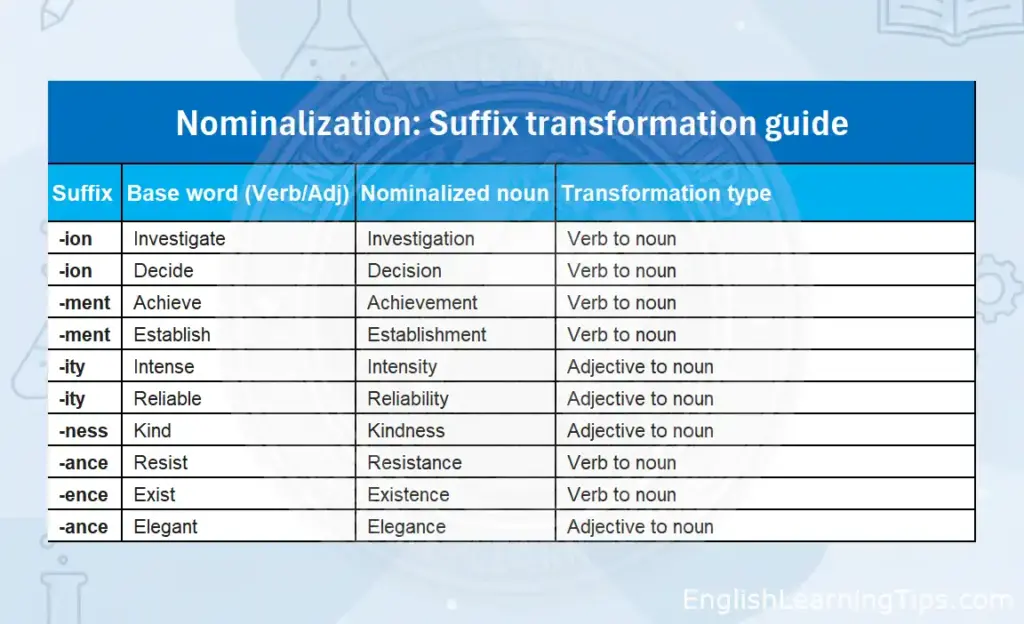
Verbs to nouns
This is the most common form of nominalization. It allows you to describe a process as a static event rather than an ongoing action.
- Investigate becomes investigation
- Establish becomes establishment
- React becomes reaction
Adjectives to nouns
Transforming adjectives into nouns helps you discuss abstract qualities as independent entities.
- Applicable becomes applicability
- Careless becomes carelessness
- Elegant becomes elegance
Adverbs to nouns
While less frequent, some adverbs can be traced to nominal roots or function within nominal phrases to add precision.
- Example: “He arrived timely” (adverbial) vs. “The timeliness of his arrival” (nominalized).
When to use nominalization in your writing
Nominalization is not “bad” grammar. In fact, it is essential for several professional writing goals:
- To condense complex information: It allows you to group several ideas into one subject, which is helpful for summarizing previous points.
- To create a formal or objective tone: In scientific and legal writing, nominalization removes the “actor” to create a sense of clinical objectivity.
- To shift sentence focus: If the result of an action is more important than who performed it, nominalization is the ideal tool.
The “zombie nouns” warning: When nominalization goes wrong
Linguist Helen Sword famously called over-nominalized words “zombie nouns“ because they can suck the life out of your prose. When you turn active verbs into heavy nouns, your writing can become stagnant and difficult to read.
Pro-tip: If you see three or more words ending in -tion in a single sentence, you’ve likely created a ‘zombie sentence.’ Try to convert at least one of those nouns back into a verb.
The risks of overuse
- Wordiness: It often takes more words to say the same thing.
- Passivity: It hides who is responsible for an action (e.g., “A decision was made” vs. “I decided”).
- Cognitive load: Heavy nominalization lowers readability scores (like Flesch-Kincaid) because it replaces “action” verbs with “state of being” verbs like is, was, or has.
Comparison: Active writing vs. nominalization
| Style | Sentence example | Why it’s used |
| Active | “The scientist experimented with the chemicals and discovered a cure.” | Engaging; focuses on the person (the actor). |
| Nominalized | “The scientist’s experimentation led to the discovery of a cure.” | Clinical; focuses on the event itself. |
Frequently asked questions about nominalization
Quiz: Are you a master of nominalization?
Test your ability to identify and fix “zombie nouns” in the sentences below.
- Identify the nominalized noun: “The movement of the tectonic plates caused the earthquake.”
- A) Plates
- B) Movement
- C) Caused
- Identify the nominalized noun: “Their refusal to sign the contract was unexpected.”
- A) Refusal
- B) Sign
- C) Unexpected
- Spot the adjective-to-noun transformation: “We must improve the reliability of the app.”
- A) Improve
- B) Reliability
- C) App
- Which sentence is the “de-nominalized” (active) version of this statement:“The implementation of the plan was a success.”
- A) A success was made of the implementation.
- B) Implementing the plan succeeded.
- C) The plan’s implementation resulted in success.
- Identify the “hidden” nominalization (one without a common suffix): “The heavy rain caused a flood in the valley.”
- A) Heavy
- B) Caused
- C) Flood
Check your results below to see how well you understand these grammatical shifts.
- B) Movement. This is a nominalization of the verb move.
- A) Refusal. This is a nominalization of the verb refuse.
- B) Reliability. This is a nominalization of the adjective reliable.
- B) Implementing the plan succeeded. This version replaces the heavy noun “implementation” with the active verb “implementing” and “success” with “succeeded,” making it much punchier.
- C) Flood. This is a “zero-derivation” nominalization. The word flood can be a verb (“The river will flood”) or a noun (“The flood was devastating”). In this sentence, it is used as a noun.
Visual tools to help you learn
Video: Making your English more advanced with Nominalization
Video: Beware of zombie nouns
Conclusion: Balancing clarity and formality
Mastering nominalization is about knowing your audience. While “zombie nouns” like utilization or implementation can add a necessary layer of objectivity to academic papers and legal briefs, they often act as speed bumps for the everyday reader.
By identifying these hidden verbs and turning them back into active, “living” words, you can slash your word count, boost your readability scores, and keep your readers engaged from the first sentence to the last. Remember:
- Use nominalization to summarize complex ideas or maintain a formal tone.
- Avoid nominalization when you need to be direct, persuasive, or easy to understand.
Join the conversation
We want to hear from you! Grammatical “rules” often evolve based on how we actually use the language.
- What is your “pet peeve” zombie noun? (Ours is “prioritization” when “ranking” works just fine!)
- Do you find academic writing easier or harder to read because of these abstract nouns?
Drop a comment below with your thoughts or a “before and after” sentence you’ve recently edited. If you found this guide helpful for your writing or studies, share it with a friend or colleague who is looking to sharpen their prose.
Discover more from English Learning Tips
Subscribe to get the latest posts sent to your email.


