
Proper nouns: Definition, examples, and usage rules

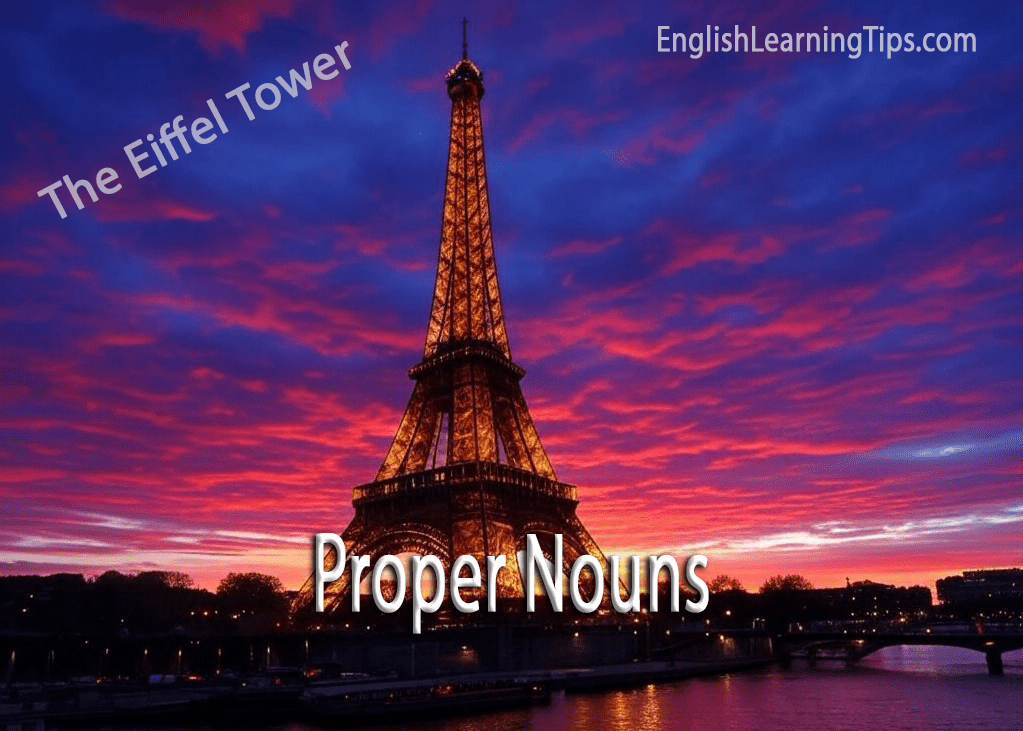
Have you ever wondered what makes a name like New York or the Eiffel Tower stand out in a sentence? The answer lies in proper nouns. These specific identifiers do more than just label people, places, or things—they bring precision and personality to our language.
In this guide, we’ll dive into what proper nouns are, how they function, and why they’re essential for clear communication.
Nouns are the foundation of every sentence you write. This guide explores every category and rule, providing you with the tools to identify, use, and master them with total confidence.
- All about nouns in English: Types, examples, and usage
- Compound nouns in English: Rules, examples, and types
- Nominalization: Definition, examples, and how to improve your writing
- Uncountable nouns: A complete guide to mass nouns in English
- Countable nouns: A complete guide to grammar and usage
- Collective nouns: The ultimate guide to group names and usage
- Abstract nouns: Definition, examples, and how to use them
- What are concrete nouns? Definition, examples, and usage
- Proper nouns: Definition, examples, and usage rules
- Infinitives: A complete guide to understanding and using the base verb form
- Understanding gerunds: A complete guide to grammar, rules, and examples (this article)
What is a proper noun?
A proper noun is a specific name for a particular person, place, or organization. Unlike common nouns, which refer to general items or groups, proper nouns identify unique entities.
One of the most important rules in English grammar is that proper nouns are always capitalized, regardless of where they appear in a sentence.
Proper nouns vs. common nouns
To understand the difference, it helps to see them side-by-side. While a common noun is generic, a proper noun is a specific “title.”
| Common noun (General) | Proper noun (Specific) |
| City | Tokyo |
| Scientist | Albert Einstein |
| Company | |
| Drink | Coca-Cola |
| Planet | Mars |
| Language | Spanish |
Why proper nouns matter in writing
Proper nouns are the building blocks of clear storytelling and technical writing. They perform two primary functions:
- Provide specificity: They allow us to pinpoint exact entities. Instead of saying “a city,” we can say “London.” This gives the reader a mental image immediately.
- Eliminate ambiguity: If you tell a friend, “I’m going to the park,” they might not know which one. If you say, “I’m going to Yellowstone National Park,” the meaning is unmistakable.
Common categories of proper nouns
Proper nouns cover a wide range of categories. Here are the most common types you will encounter:
- People: John Smith, Queen Victoria, Malala Yousafzai.
- Geographic locations: Paris, the Amazon River, Mount Everest, Canada.
- Organizations and institutions: United Nations, Red Cross, Harvard University.
- Days of the week and months: Monday, January, October.
- Holidays: Christmas, Ramadan, Thanksgiving.
- Brands and trademarks: Nike, Apple, Samsung.
- Historical events: The Renaissance, World War II.
Grammar rules for proper nouns
While capitalization is the main rule, there are a few nuances to keep in mind to ensure your writing is grammatically correct:
The use of “the”
Some proper nouns require the definite article “the,” while others do not. For example, we say “The Netherlands” or “The Atlantic Ocean,” but we do not say “The France.” Generally, if the noun is plural or represents a collective (like a range of mountains), you use “the.”
Titles and professions
Titles like “President” or “Doctor” become proper nouns only when they precede a name.
- Correct: “I am going to see Doctor Smith.”
- Correct: “I need to see a doctor.”
Frequently asked questions about proper nouns
The proper noun quiz
Now that you’ve learned the rules—from capitalizing Paris to keeping summer lowercase—it’s time to put your skills to the test. Specificity is the key to great writing, and mastering proper nouns is the first step toward professional-level clarity.
The quiz below consists of 20 questions designed to challenge your understanding of capitalization, brand names, geographic locations, and tricky exceptions. Can you get a perfect score?
Instructions for the quiz
- Read each question carefully: Some questions ask for proper nouns, while others ask you to identify common nouns.
- Navigate: Use the “Next” and “Previous” buttons to move through the 20 questions.
- Submit: Once you reach the end, hit “Submit” to see your final score and feedback.
Proper Nouns Mastery Quiz
Test your knowledge of English grammar!
Your Results
The ultimate proper nouns cheat sheet: 60+ examples
If you are ever in doubt, use this quick-reference categorization guide. We’ve organized these by the most common types of entities you’ll encounter in English writing.
1. The world stage (Geography & places)
These are always capitalized because they refer to one-of-a-kind locations.
- Continents: Africa, Antarctica, Asia, Europe, North America.
- Waterways: The Nile River, the Baltic Sea, the Pacific Ocean, the English Channel.
- Landmarks: The Great Wall of China, Machu Picchu, the Grand Canyon.
- Space: Mars, the Milky Way, the North Star, Jupiter.
2. The human touch (People & titles)
Names are the most common proper nouns, but titles can be tricky.
- Individuals: Serena Williams, Nelson Mandela, Malala Yousafzai.
- Specific Titles: President Lincoln (used as a name), Doctor Watson, Pope Francis.
- Nationalities/Languages: Spanish, Japanese, Nigerian, Cherokee.
3. The clock and calendar (Time & events)
While time feels abstract, specific points on the calendar are unique identifiers.
- Days & Months: Friday, June, September, Wednesday.
- Holidays: Diwali, Hanukkah, Easter, Labor Day.
- History: The Industrial Revolution, the Middle Ages, the Great Depression.
4. The corporate world (Brands & entities)
Brands are proper nouns because they are legally registered “identities.”
- Tech & Media: Netflix, Instagram, Spotify, Wikipedia.
- Global Brands: Starbucks, Toyota, Adidas, Rolex.
- Organizations: NASA, the World Health Organization (WHO), Greenpeace.
💡 Pro-tip: The “Substitute Test”
Not sure if a word is a proper noun? Try replacing it with a generic word.
- Example: “I want to visit Yellowstone.” $\rightarrow$ “I want to visit a park.”
- If the sentence still makes sense but loses its specific identity, the original word was a proper noun.
The “Check twice” list: 5 common proper noun mistakes
Even professional writers occasionally trip over these nuances. Use this checklist to proofread your work and ensure your capitalization is perfect.
1. The “Season” trap
- The Mistake: Capitalizing spring, summer, fall, or winter.
- The Rule: Seasons are common nouns.
- Correct: “I love the summer heat.”
- Incorrect: “I love the Summer heat.”
2. Family titles (Mother, Father, Uncle)
- The Mistake: Capitalizing them when they follow a possessive pronoun.
- The Rule: Only capitalize if the title is being used as a name.
- Correct: “I asked Mother for advice.” (You are using it as her name).
- Correct: “I asked my mother for advice.” (The word “my” makes it a general relationship term).
3. Directions vs. Regions
- The Mistake: Capitalizing “north,” “south,” “east,” or “west” when giving directions.
- The Rule: Capitalize only when referring to a specific geographic region.
- Correct: “She moved to the South to be near the beach.” (Region)
- Correct: “Drive south for three miles.” (Direction)
4. Job titles
- The Mistake: Capitalizing a job title when it stands alone.
- The Rule: Capitalize only when it is part of a specific name.
- Correct: “We met with Professor Higgins.”
- Correct: “We met with the professor after class.”
5. Academic subjects
- The Mistake: Capitalizing every school subject (e.g., Math, Science).
- The Rule: Only capitalize languages (English, Spanish) or specific course titles with numbers.
- Correct: “I am taking history and English.”
- Correct: “I am enrolled in History 101.”
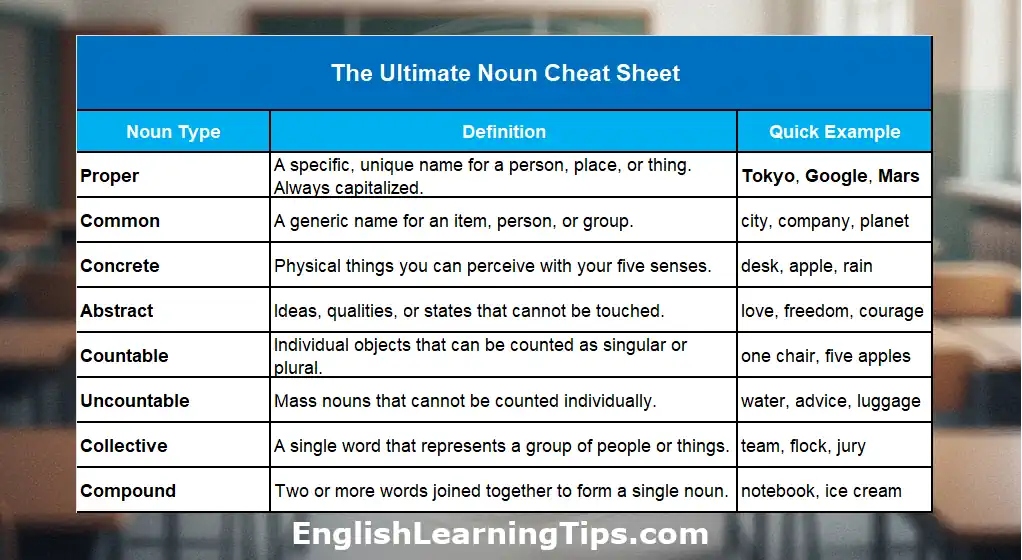
The noun cheat sheet
Conclusion: Mastering the art of specificity
Proper nouns are the practical tools that turn a vague sentence into a clear narrative. By naming specific entities like Leonardo da Vinci or the Eiffel Tower, you anchor your writing in reality and eliminate guesswork for your reader. Mastery of these rules—from capitalizing Monday to keeping “summer” lowercase—is the fastest way to signal professionalism and authority in your work. Use the Ultimate Noun Cheat Sheet we provided above as your go-to reference to ensure your writing remains sharp, clear, and grammatically perfect.
For more on sentence structure, you can explore the Purdue Online Writing Lab (OWL) for advanced capitalization rules.
Join the conversation
We want to hear from you! Grammar is constantly evolving—just look at how the word internet shifted from a proper noun to a common one.
- What is the trickiest proper noun you’ve encountered?
- Are there any capitalization rules that still confuse you?
Drop a comment below with your thoughts or questions. If you found our Noun Cheat Sheet or the Eiffel Tower examples helpful, share this guide with a friend or colleague who wants to level up their writing today!
Discover more from English Learning Tips
Subscribe to get the latest posts sent to your email.


