

Environmental issues: Cloud seeding

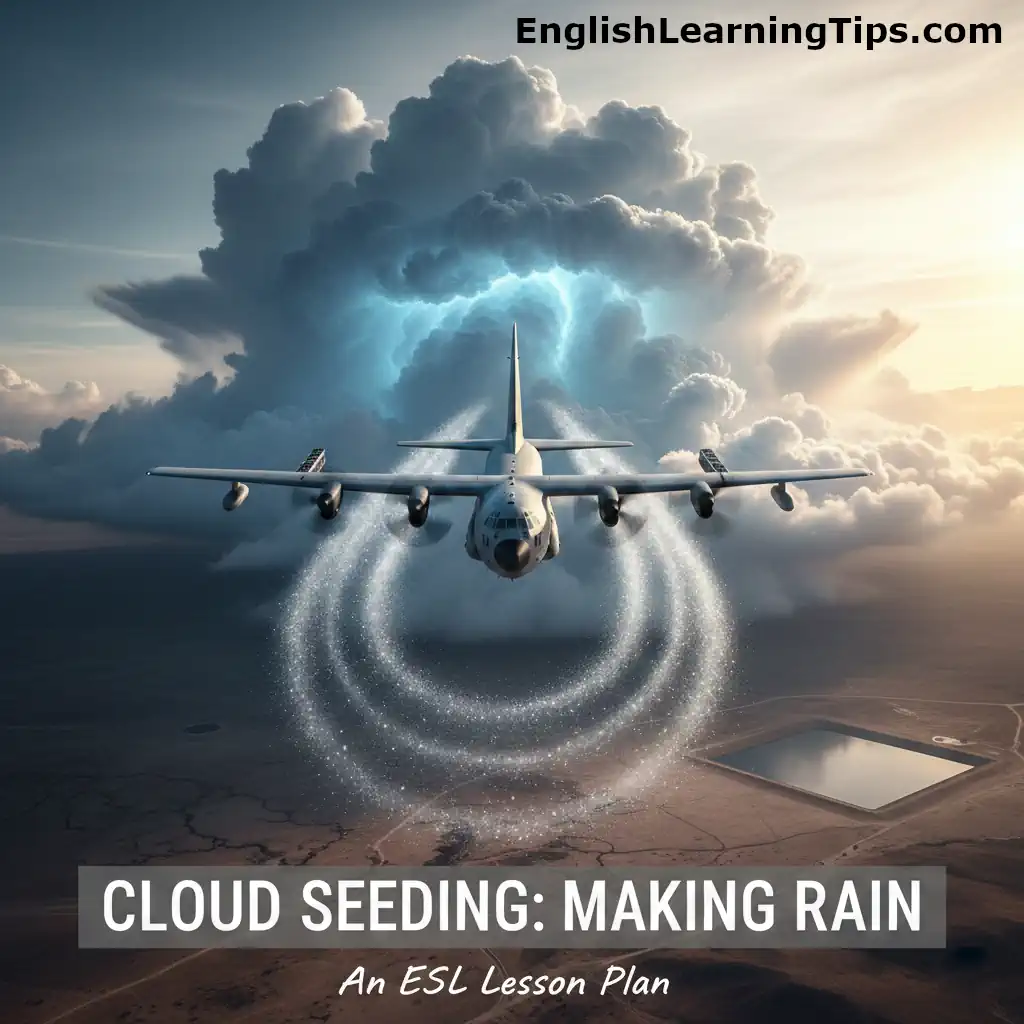
Cloud seeding is a weather modification technique that involves dispersing substances, typically silver iodide or dry ice, into clouds to encourage precipitation, such as rain or snow. These substances act as nuclei around which water droplets or ice crystals form, enhancing the cloud’s ability to produce precipitation. It’s often used to increase rainfall in drought-prone areas, reduce hail, or enhance snowfall in ski resorts. The process is usually carried out by aircraft or ground-based generators, targeting specific cloud types like cumulus or stratus.
Effectiveness varies, with studies showing modest increases in precipitation (5-20%) under optimal conditions, though results are inconsistent due to complex atmospheric factors. It’s been practiced since the 1940s, notably in the U.S., China, and the UAE. Environmental concerns include potential impacts from chemicals like silver iodide, though studies suggest minimal ecological harm at typical concentrations.
Basic vocabulary
Start with essential words related to cloud seeding and weather modification. These should be simple, commonly used terms that learners can easily apply.
Vocabulary list
- Cloud: A mass of water droplets or ice in the sky.
- Cloud seeding: A method to make clouds produce rain or snow.
- Rain: Water falling from clouds.
- Snow: Frozen water falling from clouds.
- Precipitation: Any form of water (rain, snow) falling from the sky.
- Weather: The condition of the atmosphere (e.g., sunny, rainy).
- Airplane: An aircraft used to release substances into clouds.
- Silver iodide: A chemical used in cloud seeding to create rain or snow.
- Dry ice: Frozen carbon dioxide used in cloud seeding.
- Drought: A long period without enough rain.
- Storm: Strong weather with rain, wind, or snow.
- Environment: The natural world affected by cloud seeding.
- Moisture: Water in the air or clouds.
- Temperature: How hot or cold the air is.
- Atmosphere: The layer of air around the Earth.
Vocabulary for extension
- Humidity: The amount of water vapor in the air (e.g., high humidity makes clouds form).
- Aerosol: Tiny particles (like silver iodide) sprayed into clouds for seeding.
- Condensation: The process of water vapor turning into liquid in clouds.
- Radar: A device used to track clouds or weather patterns.
- Agriculture: Farming, which often benefits from cloud seeding.
- Reservoir: A place where water is stored, often filled by cloud seeding rain.
- Meteorology: The study of weather and its processes.
- Particle: A small piece of a substance, like silver iodide, used in cloud seeding.
- Climate: The typical weather in a place over a long time.
- Experiment: A test or trial, like trying cloud seeding in a new area.
Teaching Tip
- Use visuals like diagrams of clouds, airplanes, or weather patterns to connect vocabulary to real contexts. For example, show a picture of an airplane releasing particles into a cloud.
- Practice pronunciation of terms like “silver iodide” (SIL-ver EYE-o-dide) or “precipitation” (pre-sip-i-TAY-shun).
- Create flashcards with words on one side and definitions or images (e.g., a cloud or rain) on the other for quick recall.
Grammar spotlight
Subject-verb agreement with singular nouns
When discussing cloud seeding, we often talk about the process or the substances as singular subjects. It is important to use the correct verb form for the third-person singular (he/she/it). See our guide: Understanding subject pronouns in English: A complete guide.
- The rule: Add -s or -es to the verb when the subject is singular.
- Examples:
- “The airplane flies into the cloud.” (Not “The airplane fly into the cloud.”)
- “Silver iodide helps the cloud make rain.” (Not “Silver iodide help the cloud make rain.”)
- “It increases the amount of precipitation.”
Using ‘because’ and ‘so’ for cause and effect
Since cloud seeding is a cause-and-effect process, learners need to connect their ideas logically.
- Because: Used to explain the reason for something.
- “Farmers like cloud seeding because it brings rain to their crops.”
- So: Used to explain the result or effect of something.
- “There was a drought, so the government decided to use cloud seeding.”
Present simple for facts and routines
We use the present simple tense to describe how cloud seeding works because it is a scientific fact or a standard procedure.
- Affirmative: “They use silver iodide to seed clouds.”
- Negative: “Cloud seeding does not always work perfectly.”
- Question: “Does cloud seeding use dry ice?”
Useful phrases
Teach simple sentence structures for discussing cloud seeding. These phrases should be versatile, easy to adapt, and focused on explaining or discussing the process.
Key phrases
- Describing cloud seeding
- “Cloud seeding is a way to make rain.”
- “They use [silver iodide/dry ice] to seed clouds.”
- “Airplanes fly into clouds to add chemicals.”
- “It helps clouds produce [rain/snow].”
- Explaining purpose or effects
- “Cloud seeding is used to fight drought.”
- “It can increase precipitation in dry areas.”
- “It might change the weather.”
- “Cloud seeding can help farmers.”
- Expressing opinions
- “I think cloud seeding is [helpful/interesting/risky].”
- “It’s good because it brings rain.”
- “I’m not sure if it’s safe for the environment.”
- “Cloud seeding sounds [complicated/amazing].”
- Asking questions
- “What is cloud seeding?”
- “How does cloud seeding work?”
- “Is cloud seeding safe?”
- “Do they use cloud seeding in [place]?”
Teaching tip
- Write phrases on a board or handout and model their use (e.g., “Cloud seeding is a way to make rain. They use silver iodide.”).
- Have learners substitute their own ideas or places (e.g., “They use cloud seeding in my country.”).
- Practice question forms to encourage interactive discussions about cloud seeding.
Example conversations
Provide short, realistic dialogues to model how to talk about cloud seeding. These examples progress from basic to more detailed, incorporating vocabulary and phrases.
Conversation 1: Basic exchange
Anna: What is cloud seeding?
Tom: It’s a way to make rain. They use airplanes to put chemicals in clouds.
Anna: Oh, like silver iodide?
Tom: Yes, exactly! It helps clouds make rain or snow.
Anna: Is it helpful?
Tom: Yes, it can help when there’s a drought.
Conversation 2: Adding details
Sara: Have you heard about cloud seeding, Juan?
Juan: Yes, it’s when they add silver iodide to clouds to make rain.
Sara: Why do they do it?
Juan: To increase precipitation, especially in dry places. It helps farmers.
Sara: Is it safe for the environment?
Juan: I’m not sure. Some people say it’s okay, but others worry.
Conversation 3: More advanced
Mark: Hi, Lisa! Do you know how cloud seeding works?
Lisa: Yes, airplanes or machines put silver iodide or dry ice into clouds. It makes more rain or snow.
Mark: That’s cool! Where do they use it?
Lisa: In places with drought, like parts of the USA or Australia. It helps with the water supply.
Mark: Do you think it’s a good idea?
Lisa: It’s helpful for rain, but I wonder if it affects the atmosphere too much.
Teaching tips
- Role-play these dialogues with the learner, switching roles to practice asking and answering.
- Encourage learners to adapt the dialogues using their own opinions or knowledge about cloud seeding.
- In group settings, pair students to practice, prompting them to ask at least one follow-up question.
Teaching strategy
Here’s a step-by-step lesson plan to teach this topic effectively (approximately 45 minutes).
Step 1: Warm-up (5 minutes)
- Ask: “Have you ever heard of making rain? What do you think it means?” to spark interest.
- Show a short video or image of cloud seeding (e.g., an airplane flying through clouds) and briefly explain it (e.g., “This is cloud seeding. It helps clouds make rain.”).
Step 2: Vocabulary introduction (10 minutes)
- Present the vocabulary list using visuals like a diagram of cloud seeding or a weather map.
- Practice pronunciation, especially for terms like “silver iodide” or “precipitation.”
- Play a quick game: Say a word (e.g., “cloud”), and learners explain what it means or use it in a sentence (e.g., “Clouds hold water.”).
Step 3: Phrase practice (10 minutes)
- Display key phrases and model them with your own example (e.g., “Cloud seeding uses silver iodide to make rain. It helps dry areas.”).
- Have learners practice by filling in the blanks (e.g., “Cloud seeding is used to fight ____.”).
- Correct pronunciation and grammar gently, emphasizing clear and simple sentences.
Step 4: Conversation practice (15 minutes)
- Read one example conversation aloud, emphasizing natural tone and flow.
- Pair learners (or role-play with them) to practice the dialogues, encouraging personalization (e.g., opinions about cloud seeding).
- Ask learners to create their own short dialogue about cloud seeding, using at least three vocabulary words.
Step 5: Wrap-up and personalization (5 minutes)
- Have each learner share one or two sentences about cloud seeding (e.g., “Cloud seeding makes rain. I think it’s interesting.”).
- Provide feedback on their use of vocabulary and phrases.
- Assign homework: Write 3-5 sentences about cloud seeding or practice a dialogue with a friend.
Additional tips
- Simplify concepts: Cloud seeding is scientific, so break it down into simple ideas (e.g., “It’s like adding seeds to clouds to make rain”).
- Cultural sensitivity: Some learners may come from regions where cloud seeding is controversial or unfamiliar. Encourage open discussion about its benefits or concerns.
- Visual aids: Use diagrams or videos of cloud seeding (e.g., from YouTube or weather websites) to make the lesson engaging.
- Listening practice: Play a short audio or video clip (e.g., from BBC Learning English or YouTube) about cloud seeding to expose learners to different accents.
- Adapt for level: For beginners, focus on simple phrases (e.g., “Cloud seeding makes rain.”). For intermediate learners, encourage details (e.g., “They use silver iodide to increase precipitation.”).
- Incorporate technology: If teaching online, share a screen with a cloud seeding diagram or use a virtual whiteboard to highlight vocabulary.
Common mistakes to address
- Grammar: Learners may say “It make rain” instead of “It makes rain.” Emphasize subject-verb agreement.
- Pronunciation: Terms like “silver iodide” or “precipitation” may be challenging. Practice these explicitly.
- Word choice: Clarify differences like “rain” (liquid) vs. “snow” (frozen) or “weather” (general) vs. “precipitation” (specific).
Example activity: “Explain cloud seeding”
For group classes, try this interactive activity.
- Give each learner a card with a prompt (e.g., “Explain why cloud seeding is used,” “Describe how cloud seeding works”).
- Learners take turns explaining their prompt using vocabulary and phrases, while others ask questions (e.g., “Is it safe?” or “What chemicals do they use?”).
- Alternatively, create a “Find Someone Who” game (e.g., “Find someone who thinks cloud seeding is helpful”).
Homework or follow-up
- Writing: Write a short paragraph (5 sentences) about what cloud seeding is and whether you think it’s a good idea.
- Speaking: Record a 30-second audio or video explaining cloud seeding in your own words.
- Research: Look up one fact about cloud seeding (e.g., a country that uses it) and share it in 2-3 sentences.
Discover more from English Learning Tips
Subscribe to get the latest posts sent to your email.


