

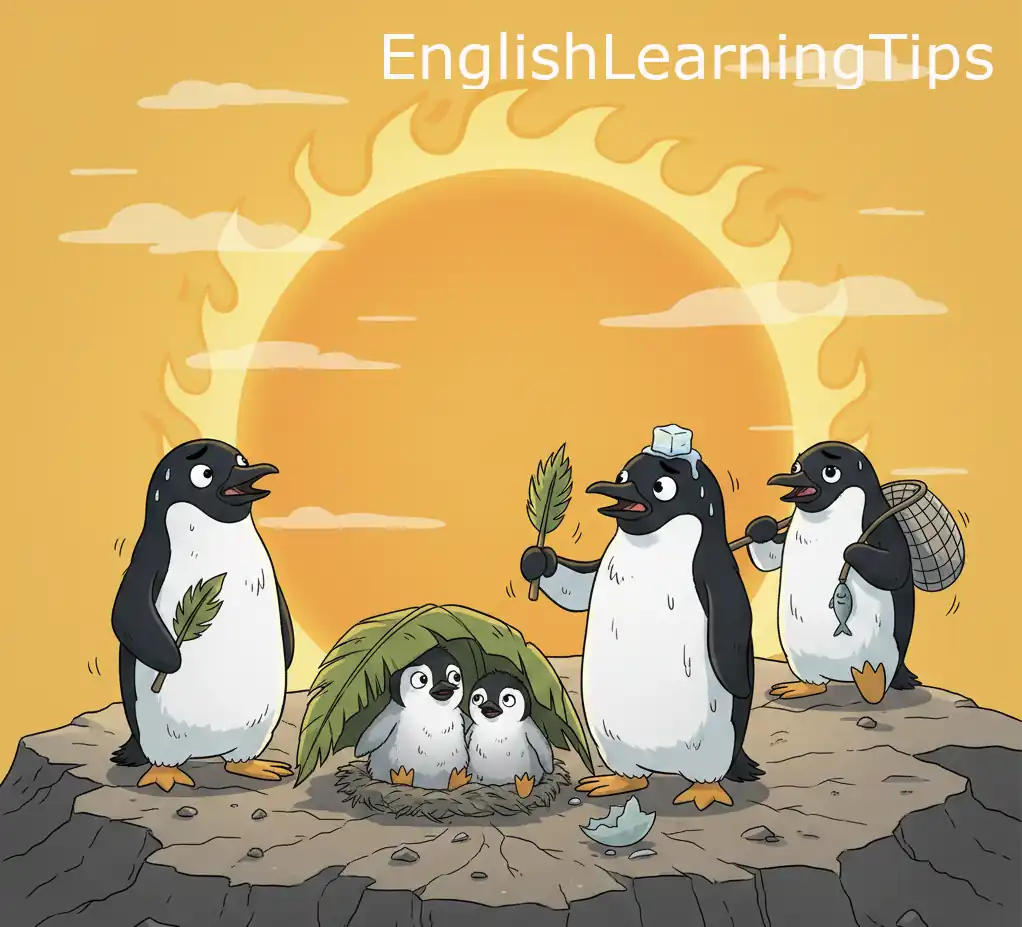
Penguins in the heat — Video-based ESL lesson

This 60-minute ESL lesson plan, designed for intermediate (B1-B2) learners, explores the biological struggle of penguins facing extreme heat. Using a transcript from a nature documentary, students will master vocabulary related to adaptation, endurance, and environmental challenges.
The lesson integrates listening, reading, and critical thinking skills, encouraging students to analyze how animals built for the cold survive in a changing climate.
ESL lesson plan: Penguins in the heat
- Level: Intermediate (B1-B2)
- Duration: 60 minutes
- Objective: Students will acquire vocabulary related to biological adaptation, practice identifying context clues in a transcript, and discuss the impact of environmental stress on wildlife.
- Materials: Lesson transcript/video (below), whiteboard (digital or for markers), dry-erase markers, vocabulary handouts, and writing journals.
Warm-up (10 minutes)
Activity: Visualizing the struggle
- Extreme opposites: Write the numbers “-40°C” and “+40°C” on the board. Ask students: “Which environment is harder to survive in? Why?”
- Anticipation: Show a picture of a penguin. Ask: “What physical features keep this animal alive in the snow?” (e.g., feathers, fat/blubber).
- The conflict: Ask students to predict: “What happens to these features when the sun is too hot? Can a penguin take off its coat?”
Teacher’s Tip: To make the most of this video lesson, I recommend using a high-quality Bluetooth speaker so students can clearly hear the narrator’s nuances and tone.
Vocabulary introduction (15 minutes)
Activity: Contextual discovery
Present the following 10 vocabulary words taken directly from the transcript:
- Dense (adj): Thick; closely compacted together.
- Stifle (v): To make someone unable to breathe properly; to feel suffocated by heat.
- Exposed (adj): Not covered; unprotected from the sun or wind.
- Soaring (adj): Rising very quickly to a high level (usually temperatures or birds).
- Desert (v): To leave or abandon a place or a duty (e.g., a nest).
- Rear (v): To care for and help a young animal or child grow to maturity.
- Adapted (adj): Naturally evolved to survive in a specific environment.
- Withstand (v): To remain undamaged or unaffected by; to resist a force.
- Endurance (n): The ability to keep doing something difficult or painful for a long time.
- Intensive (adj): Involving a lot of effort or activity in a short period of time.
10 additional expansion words
- Habitat (n): The natural home or environment of an animal.
- Fatal (adj): Causing death.
- Thermoregulation (n): The process that allows an animal to maintain its body temperature.
- Vulnerable (adj): At risk of physical or emotional harm.
- Exhaustion (n): The state of being extremely tired.
- Hatch (v): To emerge from an egg.
- Dehydration (n): A dangerous lack of water in the body.
- Resilient (adj): Able to withstand or recover quickly from difficult conditions.
- Strategy (n): A plan of action designed to achieve a long-term goal.
- Climate (n): The weather conditions prevailing in an area in general or over a long period.
Listening and reading comprehension (15 minutes)
Activity: Transcript analysis
Read the transcript aloud or watch the video clip. Have students follow along with the text.
Check for understanding:
- The physical problem: Why does the “dense coat” become a disadvantage on the rocks?
- The tragedy: Why does the neighbor desert his nest, and what is the consequence for the egg?
- The numbers: What is the temperature difference between what the penguins are adapted to and what they are currently experiencing?
- The timing: Why is the “hottest part of the day” described as the “very worst time” for the chicks?
- The resolution: What is the father penguin doing while the mother reaches the limit of her endurance?
Speaking practice (10 minutes)
Activity: Adaptation debate
Divide students into small groups and discuss:
- Survival: Is it the mother’s fault if the chicks do not survive the heat, or is it the environment’s fault?
- Human adaptation: Humans use technology (AC, clothes) to withstand heat. If our technology failed, would we have the endurance to survive like these animals?
- Climate change: Do you think these penguins can change their behavior fast enough to survive soaring global temperatures?
Writing practice (10 minutes)
Activity: The mother’s perspective
Ask students to write a short paragraph (5-7 sentences) in their journals.
- Prompt: Write from the perspective of the mother penguin waiting for her partner. Describe the heat and your struggle to protect the eggs. Use at least five vocabulary words from today (e.g., stifle, endurance, intensive, adapted, exposed).
Wrap-up and FAQ (5 minutes)
Frequently asked questions (FAQs)
How do penguins cool down? Penguins are adapted to cold, so they cool down by panting (like dogs) and ruffled feathers to let heat escape.
What happens if a parent deserts the nest? In most cases, the egg is vulnerable to predators or the elements and will not survive.
Is this because of global warming? While nature has hot cycles, soaring temperatures are becoming more frequent, testing the endurance of many species.
What can humans do to help? Protecting coastal habitats and reducing carbon emissions helps stabilize the environments these animals are adapted to, giving them a better chance to rear their young successfully.
Homework
Research one animal that lives in an “extreme” environment (very hot or very cold). Write four sentences using the words habitat, withstand, and adapted.
Appendix: Student worksheets
Vocabulary matching table
| Word | Definition |
| 1. Stifle | A. To care for and help a young animal grow. |
| 2. Rear | B. To leave or abandon. |
| 3. Endurance | C. To suffocate or feel oppressed by heat. |
| 4. Desert | D. To resist or remain unaffected by. |
| 5. Withstand | E. The ability to suffer through something difficult. |
Answers: 1-C, 2-A, 3-E, 4-B, 5-D.
Fill-in-the-blanks: The cooling struggle
Word bank: adapted, soaring, exposed, intensive, dense, hatch
The sun was (1) __________ over the colony, and the penguins were (2) __________ on the dark rocks with no shade. Because of her (3) __________ feathers, the mother felt like she was cooking. She was (4) __________ to ice and snow, not this heat. After (5) __________ fishing for over a week, the father finally returned just as the eggs began to (6) __________.
1. soaring, 2. exposed, 3. dense, 4. adapted, 5. intensive, 6. hatch.
Further reading and resources
To deepen your understanding of the themes discussed in this lesson—such as adaptation, climate resilience, and marine biology—explore the curated resources below. These links are excellent for extra credit assignments or for students who want to improve their academic English skills.
Deepen your knowledge of penguin biology
- Smithsonian Ocean: All About Penguins: Discover how different species of penguins are physically adapted to their specific environments, from the Antarctic ice to the tropical Galapagos.
- Global Penguin Society: Educational Kits: A wonderful collection of posters and factsheets that explain the perilous challenges penguins face in the wild today.
Explore the science of climate change
- NASA Climate Kids: How the Earth works: Learn about soaring global temperatures and how they affect the habitats of animals worldwide. This site uses clear English that is perfect for B1-B2 learners.
- British Council: Environmental English: A companion ESL lesson that focuses on the vocabulary of the climate crisis and how to discuss environmental strategies in English.
Advanced vocabulary tools
- Merriam-Webster Learner’s Dictionary: Use this to practice the pronunciation of today’s vocabulary, such as endurance and withstand, and to see more example sentences.
Discover more from English Learning Tips
Subscribe to get the latest posts sent to your email.


