


Metacognition ESL lesson: Master the art of thinking about thinking

This comprehensive metacognition ESL lesson is designed for intermediate to advanced learners who want to move beyond rote memorization and develop self-regulated learning strategies. By focusing on academic English vocabulary, students will learn to analyze their own mental processes, improving their ability to study, solve problems, and communicate in professional environments.
Lesson plan: Thinking about thinking: A guide to self-regulated learning
Level: Intermediate to advanced (B1-C1)
Time: 60–90 minutes
Topic: Metacognition, cognitive strategies, and educational psychology
Objectives: To define types of knowledge, apply monitoring strategies, and use academic vocabulary in professional contexts.
Background: The science of metacognition
To understand metacognition, we must look at the intersection of educational psychology and cognitive science. The concept was popularized by John Flavell in the 1970s, who defined it as “knowledge and cognition about cognitive phenomena.” In simpler terms, it is the ability to stand outside your own mind to observe, manage, and adapt your learning process.
Metacognition is generally divided into two main categories:
- Metacognitive knowledge: What you know about yourself as a learner (e.g., “I know I struggle with English phrasal verbs”).
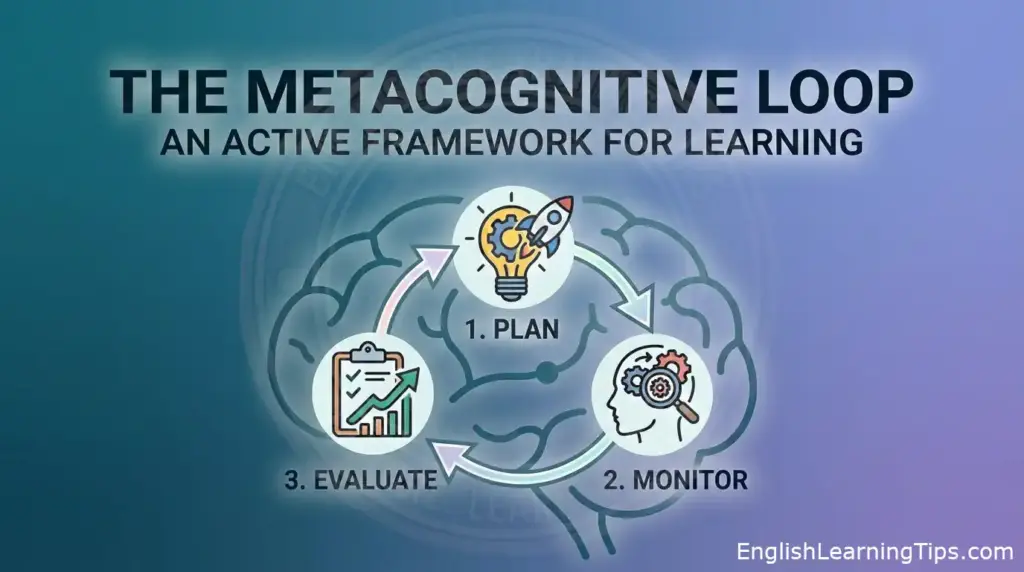
- Metacognitive regulation: The actual strategies you use to manage your learning, such as planning, monitoring, and evaluating your progress during a difficult task.
By teaching students these self-regulated learning strategies, we help them reduce their cognitive load. When a student knows how to “get meta,” they spend less energy being frustrated and more energy acquiring and retaining new information.
Basic vocabulary
Introducing essential words related to cognitive processes and learning theories.
Vocabulary list
These 10 words are key terms from the video transcript essential for English vocabulary acquisition.
| Word | Part of speech | Conjugations | Definition | Example sentence |
| Metacognition | Noun | Metacognitive (Adj) | Awareness of one’s own thought processes. | High-level metacognition helps you study more efficiently. |
| Declarative | Adjective | Declare (V), Declaration (N) | Relating to the knowledge of facts (knowing “what”). | Remembering that “apple” is a noun is declarative knowledge. |
| Procedural | Adjective | Procedure (N), Proceed (V) | Relating to the knowledge of how to do tasks. | Cooking a five-course meal requires deep procedural skills. |
| Conceptual | Adjective | Concept (N), Conceptualize (V) | Understanding relationships between ideas. | He has a strong conceptual grasp of organic chemistry. |
| Transfer | Verb | Transferable (Adj), Transference (N) | Applying knowledge to a new situation. | Can you transfer these coding skills to a different language? |
| Monitor | Verb | Monitoring (N/Gerund) | To observe and check progress. | You must monitor your speech to catch grammatical errors. |
| Strategy | Noun | Strategic (Adj), Strategize (V) | A plan of action to achieve a goal. | We need a new strategy to solve this math problem. |
| Acquire | Verb | Acquisition (N), Acquisitive (Adj) | To gain or get something (skills/info). | It takes years to acquire native-like fluency. |
| Retain | Verb | Retention (N), Retentive (Adj) | To keep information in memory. | Using flashcards helps you retain new adjectives. |
| Illuminated | Adjective | Illuminate (V), Illumination (N) | Made clear or bright; understood. | The teacher’s explanation illuminated the difficult theory. |
Vocabulary for extension
These terms expand the student’s academic English vocabulary for professional and academic contexts.
- Regulation (noun) | Verb: Regulate | Adj: Regulatory.
- Definition: The management of complex systems according to a set of rules.
- Reflective (adjective) | Noun: Reflection | Verb: Reflect.
- Definition: Characterized by deep thought; looking back at past actions to learn.
- Autonomy (noun) | Adj: Autonomous | Adv: Autonomously.
- Definition: The capacity to make an informed, uncoerced decision; independent learning.
- Schema (noun) | Adj: Schematic | Adv: Schematically.
- Definition: A mental framework or “map” used to organize and interpret information.
- Cognitive (adjective) | Noun: Cognition | Adv: Cognitively.
- Definition: Relating to the mental action or process of acquiring knowledge.
- Heuristic (noun/adjective) | Adv: Heuristically.
- Definition: A practical “rule of thumb” or mental shortcut used for problem-solving.
- Scaffolding (noun/verb) | Noun: Scaffold.
- Definition: Temporary support provided to a student to help them reach a higher level of understanding.
- Synthesis (noun) | Verb: Synthesize | Adj: Synthetic.
- Definition: The combination of ideas or parts to form a complex whole or theory.
- Insight (noun) | Adj: Insightful | Adv: Insightfully.
- Definition: A deep understanding of a person, thing, or complex problem.
- Evaluate (verb) | Noun: Evaluation | Adj: Evaluative.
- Definition: To judge or determine the significance, worth, or quality of something.
Teaching tips
- Word family mapping: Use a whiteboard to draw “word family trees” to show how adding suffixes changes a word from a verb to a noun or adjective.
- Knowledge sorting: Ask students to identify one piece of information they know (declarative) and one skill they possess (procedural) to anchor the definitions.
Grammar
In this lesson, focus on stative vs. dynamic verbs in the context of cognition. Verbs like know, understand, remember, and believe are generally stative and not used in the continuous form. However, metacognitive actions like monitoring, strategizing, and evaluating are dynamic.
- Incorrect: “I am knowing the answer.”
- Correct: “I know the answer, but I am currently monitoring how I reached it.”
Useful phrases
Key phrases
- To think about your thinking: To analyze your mental process.
- To see the big picture: To understand the conceptual links.
- To get stuck: To experience a cognitive block.
- To hit a wall: To reach the limit of current knowledge.
- To bridge the gap: To connect new information to an old schema.
Teaching tips
- Metaphor matching: Discuss why we use physical metaphors (walls, bridges, pictures) to describe invisible thoughts.
Example conversations
Conversation 1: Basic description
Student A: I feel like I’m memorizing words but I can’t use them in conversation.
Student B: It sounds like you have the declarative knowledge, but you haven’t turned it into procedural knowledge yet.
Student A: How do I do that?
Student B: You need a new strategy, like practicing those words in real sentences instead of just reading a list.
Conversation 2: Adding details
Teacher: Why did you decide to change your answer on the test?
Student: I was monitoring my work and realized my first answer didn’t fit the conceptual theme of the paragraph.
Teacher: That is great metacognition in action.
Student: Thank you; I’m trying to be more reflective about my mistakes.
Conversation 3: More advanced
Manager: We need to find a way to transfer our local success to the international market.
Consultant: We need to evaluate our current schema for sales and see if it’s too restrictive for a global audience.
Manager: Do you have any insights on how to start that synthesis of ideas?
Consultant: I suggest we deliberately separate our brainstorming from our judging phase to allow for more autonomy in the team.
Teaching tips
- Intonation practice: Have students practice the dialogues, emphasizing the bolded academic vocabulary to ensure they understand the word stress.
Teaching strategy
The most effective approach for this topic is the research-backed “think-aloud” method. The teacher should perform a task (like solving a riddle) and vocalize every thought, doubt, and adjustment they make. This models the cycle of Planning, Monitoring, and Evaluating.
45-minute lesson plan
Step 1: Warm-up (5 minutes)
The “reach and bend” test. Ask students to stand and reach high (representing big picture concepts) and bend low (representing declarative facts). Ask: “Can you walk properly if you only focus on your toes?”
Step 2: Vocabulary introduction (10 minutes)
Present the basic vocabulary list. Focus on the verb-to-adjective transitions and have students write one sentence for each word.
Step 3: Phrase practice (10 minutes)
Introduce the key phrases. Watch the Smithsonian video and ask students to raise their hands every time they hear a concept related to “monitoring” or “planning.”
Step 4: Conversation practice (15 minutes)
Students use the example conversations as a template to create their own dialogue about a time they “got stuck” while learning English.
Step 5: Wrap-up and personalization (5 minutes)
Ask each student to name one metacognitive strategy they will use tonight while doing their homework.
Additional tips
- Cultural sensitivity: Be aware that students from some backgrounds may find “questioning the teacher” or “questioning the text” difficult; frame it as a personal management tool.
- Visual aids: Use a “traffic light” poster—Red for stop/evaluate, Yellow for slow down/monitor, Green for go/transfer.
- Adapt for level: For intermediate students, focus on “learning habits.” For advanced students, dive into cognitive load theory to explain how managing mental resources improves fluency
- Technology: Use the Rocketbook app to scan and share student mind-maps for class discussion.
Common mistakes to address
- Grammar: Confusing “metacognition” (noun) with “metacognitive” (adjective). Remind students that they have metacognitive skills.
- Word choice: Overusing “know” instead of more precise words like acquire, retain, or conceptualize.
Example activity
The Instructional Gap: Give students a set of Lego or origami instructions with one step missing. They must work together to find the error and then explain—using their new vocabulary—the procedural steps they took to solve it.
Homework or follow-up
- Writing: Write a 200-word reflective journal entry about a time you solved a difficult problem.
- Speaking: Record a 2-minute “think-aloud” audio clip while you organize your digital files or a bookshelf.
- Research: Find a “learning heuristic” online (like the Pomodoro Technique) and explain how it helps with self-regulation.
FAQs about metacognition
Conclusion: Empowering your learning journey
Mastering metacognitive awareness is the most effective way to transition from a passive student to an autonomous learner. By understanding the difference between declarative and procedural knowledge, and by actively monitoring your progress, you gain a massive advantage in both academic and professional settings. Remember, the goal isn’t just to work harder—it is to use self-regulated learning strategies to work smarter and retain information for the long term.
Join the conversation: How do you “get meta”?
We want to hear about your experience with these critical thinking skills! Have you ever used a “think-aloud” strategy to solve a difficult problem? Which academic English word from today’s lesson was the most helpful for you?
Leave a comment below with your favorite study tip or a “cognitive block” you’ve recently overcome. If you found this metacognition ESL lesson helpful, please share this article with a fellow student or teacher to help them boost their learning efficiency!
Discover more from English Learning Tips
Subscribe to get the latest posts sent to your email.


