

Color idioms in English: A guide to common expressions

Colors are more than just visual descriptors; they are the backbone of many English expressions used to convey emotions, status, and situations. Mastering these common color idioms is a simple way to improve your English fluency and sound more natural in casual conversation.
Whether you are preparing for an English proficiency test or simply looking to expand your conversational vocabulary, these phrases are essential.
Think you know your color idioms? Take our interactive color idioms quiz to test your fluency!
Why color idioms are essential for English fluency
Idioms rely on cultural associations—such as red representing anger or green representing growth. When you use these phrases, you move beyond literal translations and tap into the nuances of native speech. These idioms appear constantly in:
- Media: Movies, podcasts, and television shows.
- Professional settings: Office emails and casual workplace interactions.
- Literature: Books, newspapers, and online journalism.
Pro-tip: If you’re nervous about using idioms, start by using them in text messages first. It’s a low-pressure way to see if your friends understand your meaning before trying them in a live meeting or conversation.
Common color idioms by color
We have organized these popular expressions by color to make them easier to memorize.
Red idioms: Danger and strong emotion
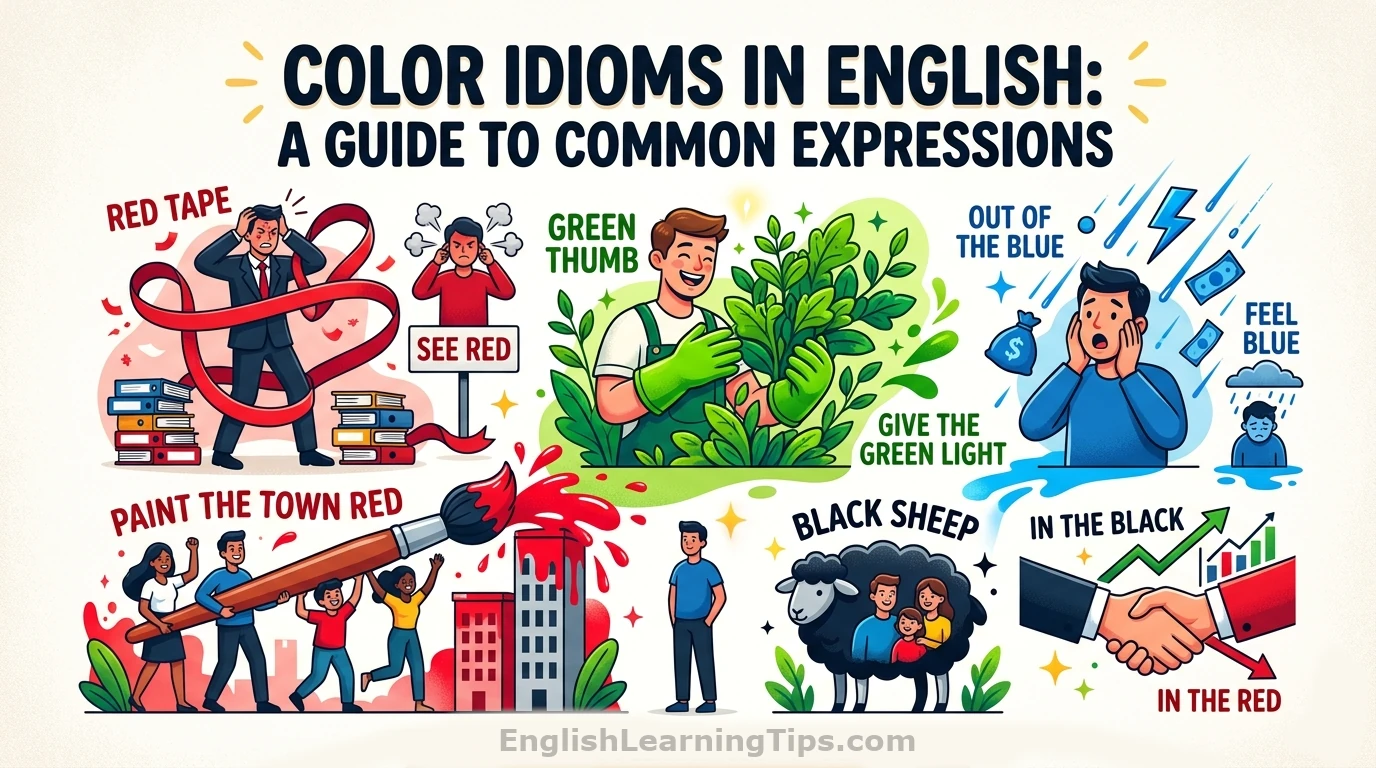
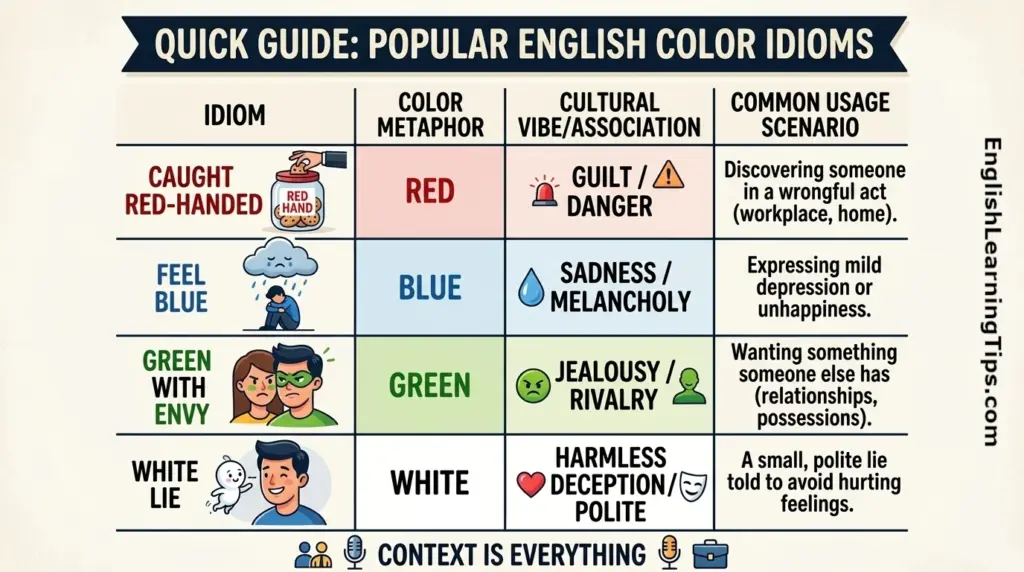
- Caught red-handed: Discovered while committing a wrongdoing.
- See red: To become suddenly and extremely angry.
- Red tape: Excessive bureaucracy or complex rules that hinder progress.
- In the red: Financial distress or operating at a loss.
- Paint the town red: To go out and celebrate exuberantly.
Blue idioms: Sadness and surprise
- Feel blue: To experience sadness or mild depression.
- Out of the blue: Something occurring completely unexpectedly.
- Once in a blue moon: An event that happens very rarely.
Green idioms: Envy, nature, and growth
- Green with envy: Feeling intense jealousy toward someone else.
- Green thumb: Having a natural talent for gardening or helping plants thrive.
- Give the green light: To grant permission for a project or plan to move forward.
Pro-tip: When using “Green thumb,” keep in mind that in the UK and Australia, they actually say “Green fingers.” If you tell a Londoner you have a “green thumb,” they’ll know what you mean, but “green fingers” will help you sound like a local!
Black and white idioms: The spectrum of contrast
- Black sheep: The member of a group or (usually) family who is viewed as an outsider or misfit.
- Black and blue: Bruised; often used to describe physical pain.
- In the black: Profitable; the opposite of being in debt.
- White lie: A small, harmless lie told to avoid hurting someone’s feelings. It is meant to be polite or protective, not malicious.
- As white as a sheet: Being extremely pale due to shock, illness, or fear.
Quick reference: Top English color idioms
The following table provides a quick summary of the most frequently used color-based idioms for rapid review.
| Idiom | Primary meaning | Usage context |
| Caught red-handed | Discovered in the act | Crime or mischief |
| Out of the blue | Unexpectedly | Surprise events |
| Green with envy | Extremely jealous | Personal relationships |
| Tickled pink | Very pleased | Happiness/gratitude |
| White lie | A harmless fib | Social etiquette |
| In the black | Financially profitable | Business/finance |
How to use color idioms naturally
Do not try to memorize all these phrases at once. Instead, follow these steps to integrate them into your vocabulary:
- Start with the most frequent: Prioritize “out of the blue,” “green with envy,” and “white lie” in your daily speech.
- Context is king: Treat context as your best friend. Don’t just memorize definitions; try to use the idiom in a sentence that reflects a real-life situation, like ‘My boss was red in the face after the deadline was missed.’
- Listen and observe: Pay attention to how native speakers use these idioms in podcasts or TV shows.
Frequently asked questions (FAQs)
Visual tools to help you learn
Video: Color idioms and their meanings
Video: Seven color idioms
Additional color idioms to level up
- A grey area: A situation where there are no clear rules, or it’s difficult to say what is right or wrong. Usage: “The ethics of AI-generated art are still a bit of a grey area.”
- To pass with flying colors: To pass a test or complete a task very successfully.
Usage: “She was nervous about her bar exam, but she passed with flying colors!” - Golden opportunity: A perfect chance to do something that likely won’t come again.
Usage: “Being offered an internship at NASA was a golden opportunity.” - Yellow-bellied: A classic (though slightly old-fashioned) way to call someone a coward.
Usage: “He was too yellow-bellied to stand up to the bully.”
Mastering color idioms: A summary for your journey
Improving your English fluency is a process of small, consistent steps, and mastering these common color idioms is one of the most effective ways to add personality and nuance to your speech. By understanding the cultural context behind phrases like “in the black” or “caught red-handed,” you bridge the gap between being a learner and sounding like a native speaker. Remember that language is meant to be used, so prioritize context over memorization and look for opportunities to weave these expressions into your daily conversations.
Join the conversation: Share your favorite idiom
Did you find a new favorite idiom, or is there a common color phrase you’ve heard that we didn’t cover? We want to know! Whether you are a native speaker or learning English as a second language, your perspective helps our community grow.
Drop a comment below with an idiom you use most often, or share this guide with a friend who is currently sharpening their English skills.
Discover more from English Learning Tips
Subscribe to get the latest posts sent to your email.


