

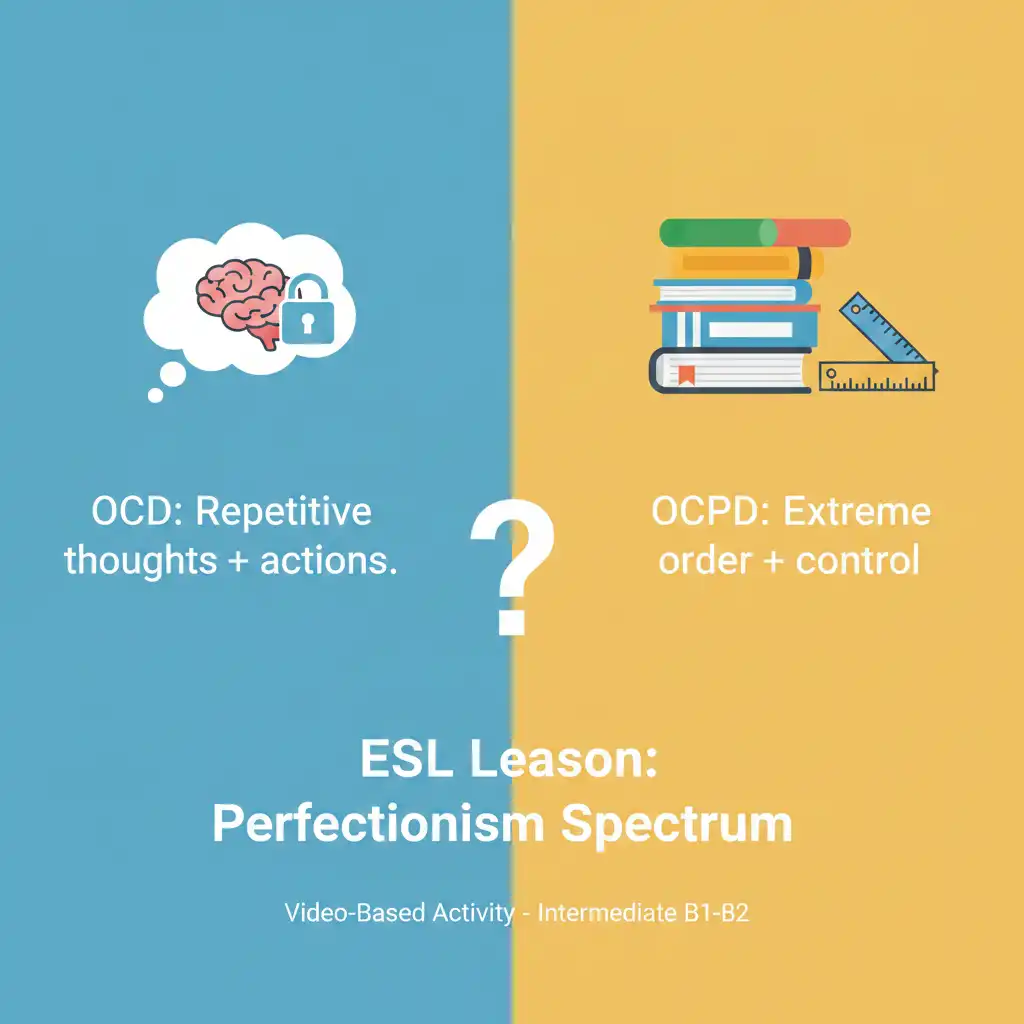
OCD vs. OCPD: Intermediate ESL lesson plan on personality disorders and perfectionism

This video-based ESL lesson helps students explore the nuance between obsessive-compulsive disorder (OCD) and obsessive-compulsive personality disorder (OCPD).
By using a podcast transcript, learners move beyond basic descriptions to master high-level vocabulary regarding mental health and interpersonal relationships.
Learning objectives
- Identify key differences between ocd and ocpd using authentic materials.
- Acquire 20 new vocabulary terms related to personality and psychology.
- Analyze how extreme personality traits affect relationships and work.
ESL lesson plan: Understanding obsessive-compulsive personality disorder and perfectionism
| Feature | Details |
| Level | Intermediate (B1-B2) |
| Topic | Psychology, mental health, and personality traits |
| Skills | Listening, reading, and vocabulary building |
| Duration | 60–90 minutes |
Materials
- Vocabulary handout.
- Audio/video/transcript of the interview (provided or printed handout).
- Whiteboard/markers.
Recommendations for further reading:
- The OCD Workbook: Your Guide to Breaking Free from Obsessive-Compulsive Disorder
- Stop Obsessing!: How to Overcome Your Obsessions and Compulsions (Revised Edition)
- Tormenting Thoughts and Secret Rituals: The Hidden Epidemic of Obsessive-Compulsive Disorder
Warm-up (10 min)
Show students an image of a perfectly organized pantry with labels or a highly organized desk. Ask: “Do you think this level of organization is helpful or extreme? Why?” Elicit ideas in pairs, then share 3–4 responses on the board.
Pre-reading vocabulary (15 min)
Hand out the vocabulary list. Students repeat words after the teacher for pronunciation, then read definitions and example sentences in pairs.
Vocabulary
- Obsessive – having thoughts or desires that continue in an uncontrolled way.
She has obsessive worries about cleanliness. - Compulsive – done repeatedly because you feel you must.
He has compulsive habits like checking the door many times. - Insight – the ability to understand the true nature of a situation.
People with OCD often have good insight and know their fears are excessive. - Ritual – a set of fixed actions performed regularly.
Washing hands 20 times is a ritual for some people with OCD. - Rigid – not able to change easily; very strict.
His rigid rules make it hard to plan trips with friends. - Perfectionism – the need to make everything perfect.
Her perfectionism stops her from finishing projects on time. - Fixated – thinking about one thing too much and unable to stop.
He is fixated on organizing his desk perfectly. - Frugality – being very careful with money; not wanting to spend.
Extreme frugality means never buying new clothes even when you can afford them. - Micromanagement – controlling every small detail of someone else’s work.
The boss’s micromanagement makes employees feel stressed. - Hoarding – keeping large amounts of things you do not need.
Hoarding old newspapers filled the whole room.
Vocabulary for extension
- Trait – a particular quality in someone’s personality.
Being organized is a positive personality trait. - Spectrum – a range between two extremes.
Personality traits exist on a spectrum from mild to extreme. - Adaptive – helpful for success or survival.
Some perfectionism can be adaptive in a job that needs accuracy. - Impair – to damage or weaken something.
Too much work can impair family relationships. - Compromise – an agreement where both sides give something up.
Good relationships need compromise from both partners. - Debilitating – causing serious problems that stop normal activity.
Debilitating anxiety made it impossible for her to leave home. - Temperament – a person’s basic nature, especially how they react emotionally.
Children can inherit temperament from their parents. - Coping strategy – a way of dealing with difficult situations.
Exercise is a healthy coping strategy for stress. - Negotiate – to discuss in order to reach an agreement.
They negotiated a fair way to share housework. - Humanitarian – concerned with improving people’s lives and reducing suffering.
She has a strong humanitarian sense and always helps others.
Grammar spotlight: expressing contrast and nuance
To help your students move from simple sentences to more complex, sophisticated descriptions of psychological states, focus on the following two grammar points. These will help them bridge the gap between B1 and B2 proficiency.
Using contrastive linkers for complex ideas
Students often rely on “but” to connect ideas. At the B2 level, encourage the use of more formal contrastive linkers to better distinguish between OCD and OCPD.
- While / whereas: These are excellent for highlighting the fundamental differences between the two conditions.
- Example: “While people with OCD often recognize their behavior as excessive, individuals with OCPD typically view their rigidity as the correct way to function.”
- On the other hand: Use this phrase to introduce a contrasting perspective after a full statement.
- Example: “OCD behaviors are often ego-dystonic, meaning they feel like unwanted intruders. On the other hand, OCPD traits are often ego-syntonic, feeling more like a natural part of the person’s character.”
- In contrast: This is a strong, formal transition for written work or presentations.
- Example: “OCD involves specific, repetitive rituals; in contrast, OCPD is characterized by a generalized need for perfection and control.”
Modal verbs of necessity and deduction
Because this lesson involves analyzing behavior, students need to express rules, degrees of certainty, and recommendations.
- Degrees of obligation (must vs. have to vs. should): Use these to discuss how traits might impact a person’s life.
- Example: “A person with OCPD feels they must have total control over their environment to feel secure.”
- Deduction (must be, might be, can’t be): These are perfect for the “speaking practice” section where students interpret personality traits.
- Example: “If someone spends hours checking the stove, that must be a source of great anxiety for them.”
- Example: “This level of perfectionism might be adaptive in surgery, but it can’t be healthy in a flexible team environment.”
Reading and listening (20 min)
- Students read the transcript silently (or key excerpts) for 5-7 minutes.
- Play the audio (or the teacher reads aloud) once while students follow along.
- Students underline or note any vocabulary words they recognize.
Comprehension check (10 min)True/False (write T or F)
- People with OCD usually lack insight into their behaviors. ___
- OCPD involves rigid thinking and believing one’s way is best. ___
- Perfectionism in OCPD can sometimes be productive. ___
- Hoarding is never associated with OCPD. ___
- Extreme rigidity can make compromising in relationships difficult. ___
Key (for teacher): 1-F, 2-T, 3-T, 4-F, 5-T
Speaking practice (20 min)
Pair work
- Student A: Explain the difference between OCD and OCPD (use at least 3 vocabulary words).
- Student B: Describe how perfectionism can affect relationships (use at least 3 vocabulary words).
- Switch roles.
Group discussion
- “Is some level of rigidity or perfectionism good in life? Why or why not?”
- “How can people with rigid traits maintain healthy relationships?”
Writing (15 min)
- Write 4–6 sentences giving your opinion on whether perfectionism is more helpful or harmful in daily life. Use at least 5 words from the vocabulary list.
- Example starter: While some perfectionism can be adaptive and lead to success…
Wrap-up and homework (5 min)
- Quick review: Teacher says a definition; students call out the word.
- Homework: Write a short paragraph (6-8 sentences) about a personality trait you have (e.g., organized, flexible). Explain if it helps or impairs your life, using at least 5 vocabulary words.
Discover more from English Learning Tips
Subscribe to get the latest posts sent to your email.


