

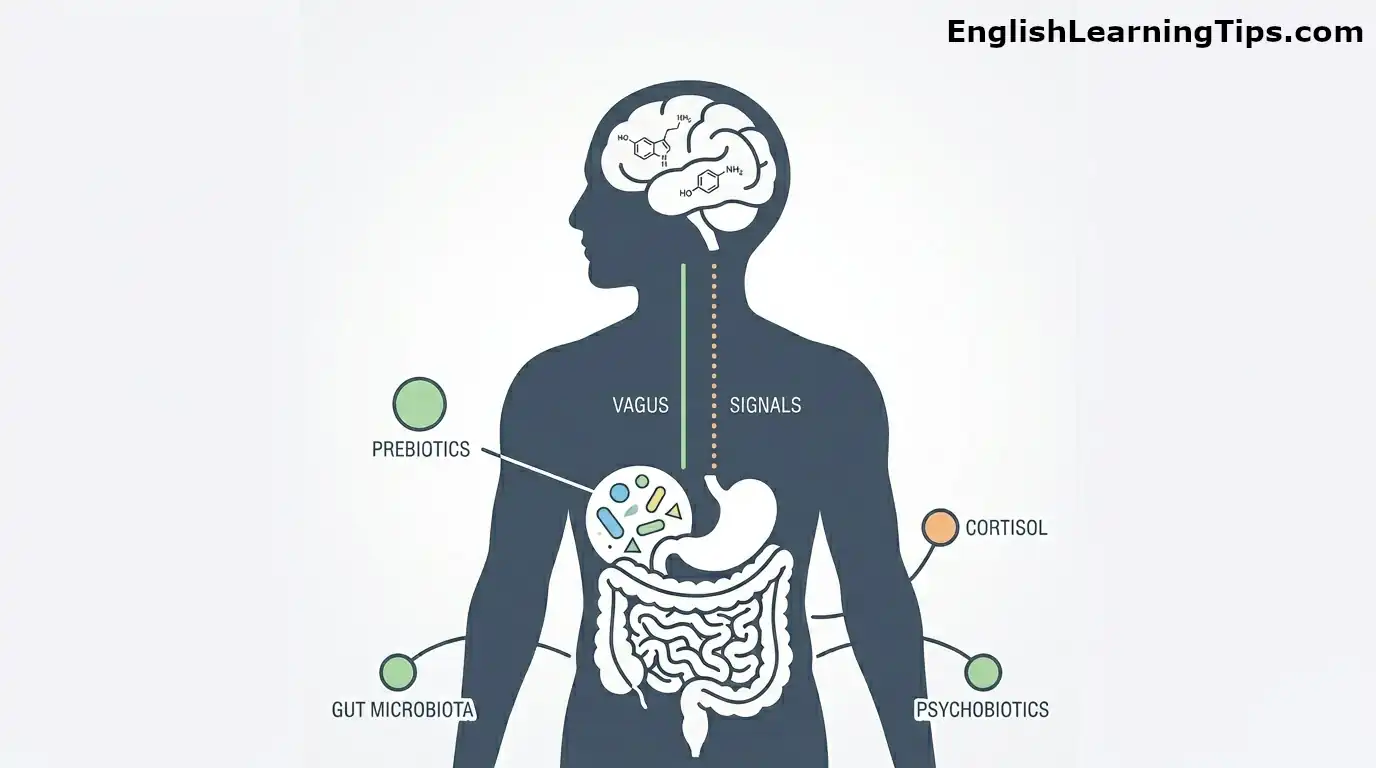
Understanding the gut-brain connection: A comprehensive ESL lesson plan

The link between our digestive system and our mental state is one of the most exciting frontiers in modern medicine. When we talk about the gut brain connection, we are referring to a complex, bidirectional communication network that influences everything from mood to long-term neurological health. By understanding the gut microbiota and the role of the vagus nerve, students can grasp how “gut feelings” are rooted in biological reality. This lesson dives deep into the enteric nervous system and the emerging field of psychobiotics to show how a healthy gut leads to a healthy mind.
Lesson plan: The second brain and mental wellness
Level: Intermediate to Advanced
Time: 45 minutes
Topic: The gut brain axis and psychobiotics
Objectives: Students will define the gut microbiota, explain the two-way communication of the vagus nerve, and identify the role of psychobiotics in mental health.
Student handout: Exploring the science of the gut brain axis [download]
Video: Psychobiotics and the gut-brain axis
Background
The idea that our gut influences our mind isn’t a modern “fad.” Over 2,000 years ago, Hippocrates, the father of medicine, famously stated that “all disease begins in the gut.” While this was once a philosophical observation, modern science is finally catching up. Researchers have discovered that the gut is far more than a tube for digestion; it is an intelligent system so complex it has been nicknamed our “second brain.”
At the heart of this system is the gut microbiota, an ecosystem of trillions of microorganisms unique to every individual. This system communicates with the head via the gut brain axis—a superhighway of chemical and physical signals. With 90% of the body’s serotonin being produced in the gut, it is clear that the health of our internal microbes directly dictates our emotional and cognitive resilience.
Basic vocabulary
Introducing essential words related to the biological and neurological functions of the digestive system is key to mastering this topic.
Vocabulary list
- Microbiota (noun): The collection of microorganisms living in a particular environment.
- Related forms: Microbial (adj).
- Sentence: Every person has a unique microbiota that acts like a fingerprint.
- Enteric (adj): Relating to the intestines.
- Related forms: Enterenteritis (noun).
- Sentence: The enteric nervous system can operate independently of the brain.
- Neuron (noun): A specialized cell transmitting nerve impulses.
- Related forms: Neural (adj), Neurally (adv).
- Sentence: There is a massive web of neurons lining the entire human gut.
- Axis (noun): An imaginary line about which a body rotates or a connection between two points.
- Related forms: Axial (adj).
- Sentence: The gut brain axis is a two-way communication superhighway.
- Bidirectional (adj): Functioning in two directions.
- Related forms: Bidirectionally (adv), Direction (noun).
- Sentence: Communication between the gut and the brain is bidirectional.
- Neurotransmitter (noun): A chemical substance released at the end of a nerve fiber.
- Related forms: Neurotransmission (noun), Transmit (verb).
- Sentence: Serotonin is a neurotransmitter that regulates our mood.
- Vagus (adj/noun): Referring to the tenth cranial nerve.
- Related forms: Vagal (adj).
- Sentence: The vagus nerve acts like a fiber optic cable between the abdomen and brain.
- Inflammation (noun): A physical condition in which part of the body becomes reddened or swollen.
- Related forms: Inflame (verb), Inflammatory (adj).
- Sentence: Chronic inflammation in the gut is linked to depression.
- Prebiotic (noun): Compounds in food that induce the growth or activity of beneficial microorganisms.
- Related forms: Prebiotically (adv).
- Sentence: Fiber acts as a prebiotic to fuel good bacteria.
- Psychobiotics (noun): Probiotics and prebiotics that, when ingested, yield mental health benefits.
- Related forms: Psychobiotic (adj).
- Sentence: Psychobiotics are being tested as treatments for anxiety.
Vocabulary for extension
- Ecosystem: A biological community of interacting organisms and their physical environment. (noun/adj: ecosystemic)
- Trillions: A number equal to a million million. (noun/adj: trillionth)
- Independent: Capable of thinking or acting for oneself. (adj/adv: independently/noun: independence)
- Pathway: A track or route which something moves along. (noun)
- Cortisol: A steroid hormone produced by the adrenal glands, often called the stress hormone. (noun)
- Cognitive: Relating to the mental action or process of acquiring knowledge. (adj/adv: cognitively/noun: cognition)
- Amyloid: A protein aggregate that is associated with diseases like Alzheimer’s. (noun/adj: amyloidal)
- Plaque: A small, distinct area of buildup, often harmful in the brain or on teeth. (noun)
- Strains: Genetic variants or subtypes of a microorganism. (noun/verb: strain)
- Personalized: Tailored to a specific individual. (adj/verb: personalize/noun: personalization)
Teaching tips
- Contextual Mapping: Use a diagram of the human body to have students label where the “second brain” is located compared to the primary brain.
- Word Roots: Explain that “micro” means small and “bio” means life to help students remember “microbiota.”
Grammar
In scientific English, we often use the Present Simple to describe established facts (e.g., “The gut produces serotonin”). However, when discussing ongoing research, we use the Present Continuous (e.g., “Scientists are discovering new links between gut health and ADHD”). Focus on cause and effect structures such as “If the gut is imbalanced, then the stress response increases,” and the use of passive voice for clinical findings: “Lower stress levels were found in patients taking psychobiotics.”
Useful phrases
Key phrases
- The second brain: Referring to the enteric nervous system.
- A two-way street: Describing the bidirectional communication of the axis.
- Flip the script: To change a situation or perspective completely.
- Game changer: A newly introduced element or factor that changes an existing situation.
Teaching tips
- Idiom Analysis: Discuss why the gut-brain connection is called a “two-way street” and have students brainstorm other biological systems that work this way.
Example conversations
Conversation 1: Basic description
Student A: I’ve been hearing a lot about the gut brain connection lately. Student B: It’s fascinating; scientists actually call the gut our second brain. Student A: Why is that? Isn’t the gut just for digesting food? Student B: Not at all! It has its own web of neurons that can act independently.
Conversation 2: Adding details
Student A: I read that most of our serotonin is made in the gut. Student B: Yes, about 90 percent of it, which is a total game changer for mental health. Student A: So, does that mean our diet directly affects our mood? Student B: Exactly, because the microbes in our gut send signals through the vagus nerve.
Conversation 3: More advanced
Student A: Have you looked into the clinical trials regarding psychobiotics? Student B: I have, and the results for major depressive disorder are very promising. Student A: It’s incredible that targeting gut microbiota could reduce amyloid plaques in Alzheimer’s patients. Student B: It really shifts the focus toward personalized medicine and healing the mind by treating the gut.
Teaching tips
- Role Play: Have students act out a doctor-patient scenario where the doctor explains how a specific diet might help the patient’s anxiety.
Teaching strategy
Use the Inquiry-Based Learning approach. Instead of simply providing facts, ask students “Why do you think we get ‘butterflies’ in our stomach when we are nervous?” This allows them to bridge the gap between their physical experiences and the scientific explanation of the HPA axis and the vagus nerve.
Here’s a 45-minute lesson plan
Step 1: Warm-up (5 minutes)
Ask the class if they have ever felt “nauseous” from stress. Discuss the physical sensations of emotions in the stomach.
Step 2: Vocabulary introduction (10 minutes)
Distribute the vocabulary list. Define key terms like “microbiota” and “vagus nerve,” focusing on their parts of speech.
Step 3: Phrase practice (10 minutes)
Students work in pairs to create sentences using the key phrases “two-way street” and “second brain.”
Step 4: Conversation practice (15 minutes)
Students practice the three example conversations, then try to write a fourth conversation about their favorite “brain-healthy” foods.
Step 5: Wrap-up and personalization (5 minutes)
Ask students to name one thing they can do this week to support their gut health (e.g., eating more fiber or fermented foods).
Discussion questions
- Question: Why is the gut microbiota compared to a fingerprint?
- Answer: Because every person’s ecosystem of microorganisms is unique, shaped by genes and lifestyle.
- Question: What is the primary function of the vagus nerve in this context?
- Answer: It acts as a physical hotline, zapping signals back and forth between the brain and the gut.
- Question: How do psychobiotics differ from regular probiotics?
- Answer: Psychobiotics specifically refer to bacteria that have a documented positive effect on mental health.
- Question: What role does the gut play in the body’s stress response?
- Answer: The gut can tap into the HPA axis to tell the body to increase or decrease stress hormones like cortisol.
- Question: Why is serotonin production in the gut so significant?
- Answer: Since 90% is made there, it suggests that mood disorders may be rooted in gut health rather than just brain chemistry.
Additional tips
- Cultural sensitivity: Acknowledge that dietary habits vary wildly across cultures, and “healthy” gut foods can look like kimchi, sauerkraut, or kefir depending on the region.
- Visual aids: Use an infographic showing the “superhighway” connection between the brain stem and the abdomen.
- Adapt for level: For lower levels, focus on “good vs. bad bacteria.” For higher levels, discuss “amyloid plaques” and “neurodegenerative diseases.”
- Technology: Use a short video clip of a microscopic view of gut bacteria to make the “trillions of microbes” concept more tangible.
Common mistakes to address
- Grammar: Students often confuse “microbiota” (the population) with “microbiome” (the genetic material).
- Word choice: Avoid using “stomach” when you mean “gut” or “intestines” in a scientific context.
Example activity
The Gut-Brain Map: Give students a blank diagram of the human body. Have them draw the “hotline” (vagus nerve) and list five chemicals (like dopamine or GABA) that are produced in the gut and sent to the brain.
Homework or follow-up
- Writing: Write a 200-word summary on how psychobiotics might change the future of mental health care.
- Speaking: Record a short “health tip” video explaining the importance of the gut brain axis to a friend.
- Research: Find one recent news article about a study involving the gut microbiota and a specific neurological condition.
FAQs
What are the best foods for the gut brain axis? Fiber-rich foods, fermented products like yogurt, and polyphenol-rich foods like dark chocolate and berries support a healthy gut-brain connection.
Can anxiety cause gut problems? Yes, because the communication is a “two-way street,” high stress can send signals that disrupt digestion and cause inflammation.
Are psychobiotics available as supplements? While many probiotics are sold, specific “psychobiotic” formulations are still largely in the research and clinical trial phase, though some strains like L. helveticus are becoming more common.
How long does it take to change your gut microbiota? Studies suggest that significant changes in gut bacteria can occur within just a few days of a major dietary shift.
Conclusion: Healing the mind through the gut
The discovery of the gut brain connection is revolutionizing how we approach mental and neurological health. By nurturing our gut microbiota, we aren’t just improving digestion—we are supporting our “second brain” and building a foundation for emotional resilience. Whether through psychobiotics or mindful nutrition, the future of mental health looks to be an internal effort.
What are your thoughts on the science of the second brain? Have you noticed a link between your diet and your mood? Please share this lesson with anyone interested in the future of mental health!
Discover more from English Learning Tips
Subscribe to get the latest posts sent to your email.


