
How to use parroting to improve your English speaking skills

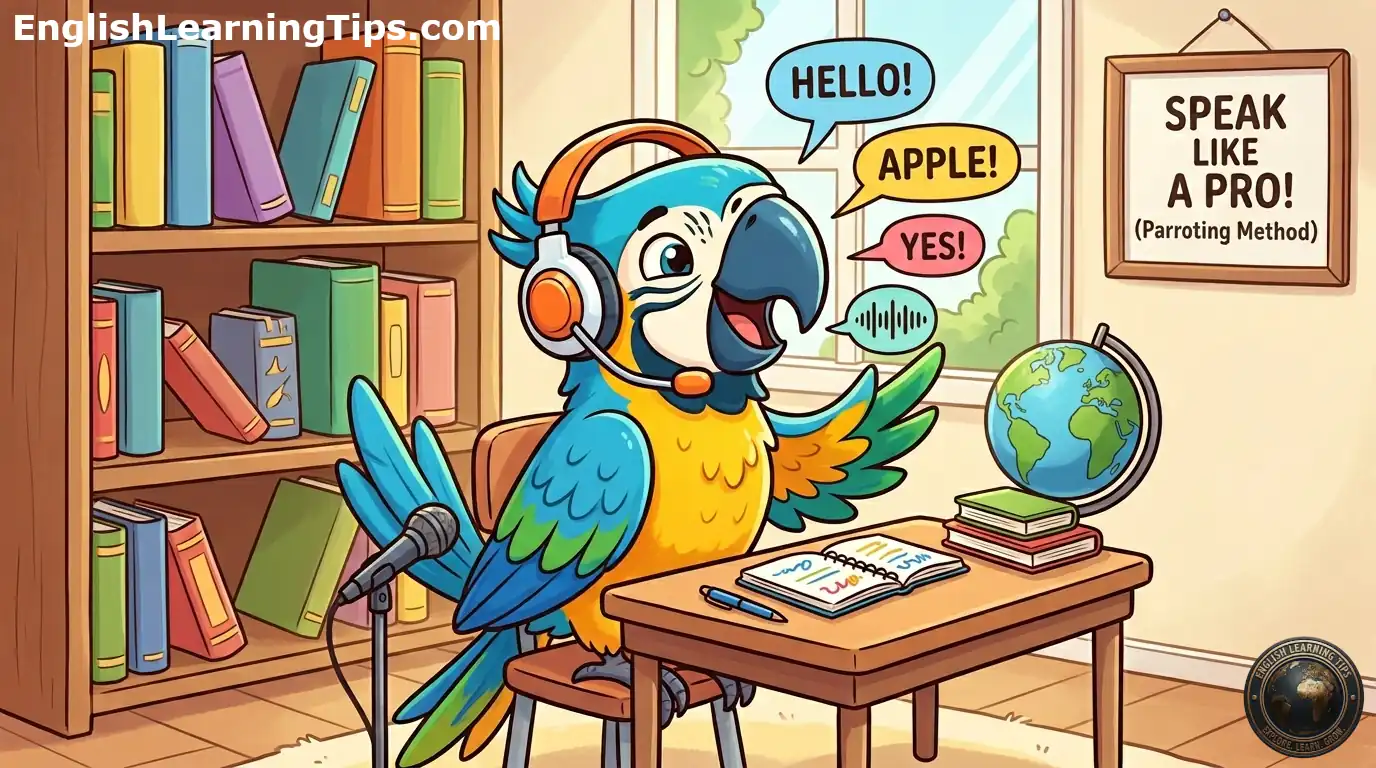
Parroting is a straightforward way to bridge the gap between understanding English and actually speaking it. It helps train your ears, mouth, and brain to produce natural-sounding English. Many learners use it to build better pronunciation, rhythm, and confidence in speaking.
What is parroting in English learning?
Parroting, often called the mimicry method, means copying a speaker’s words, intonation, speed, and rhythm as closely as possible. It goes beyond simple repetition; you are essentially “acting” as the speaker. You mimic the way natives stress words, link sounds (connected speech), and pause naturally.
This method overlaps with shadowing, where you repeat almost at the same time as the speaker. Beginners often start with a short delay (parroting), while advanced learners move to real-time shadowing to improve their cognitive processing of the language.
Why parroting works: The science of imitation
Whether you are a student or an educator, understanding the “why” helps with motivation and lesson design. Your brain learns language patterns through imitation, just like children pick up their first language. Parroting builds muscle memory for speaking and improves listening at the same time.
Key benefits of the mimicry method:
- Accent reduction: Better pronunciation of tricky sounds like “th,” “r,” or vowel reductions (the schwa sound).
- Prosody and flow: Improved intonation and rhythm, so you sound less robotic.
- Fluency: Stronger fluency through automatic phrasing instead of translating in your head.
- Contextual vocabulary: Expanded vocabulary and collocations (common word combinations) absorbed in context.
- Confidence: Increased speaking confidence by practicing without the pressure to create original sentences first.
Step-by-step guide to parroting practice
Ready to try it? Here is a simple daily English practice routine you can start today.
1. Choose good material
Pick short audio or video clips (30–90 seconds) with clear native speakers. Use podcasts, YouTube videos, or TED Talks at your level. Aim for ‘high-frequency’ dialogue—the kind of English you’ll actually use at work or when traveling. Basically, you want to focus on everyday English conversations for practical results.
2. Listen first without speaking
Play the clip 2–3 times to understand the meaning, emotional tone, and the “music” of the speaker’s voice.
3. Repeat after the speaker
Pause after each sentence and copy everything: words, word stress, linking, and tone. Record yourself on your phone to hear what you actually sound like.
4. Compare and adjust
Listen back to your recording next to the original. Note differences in speed or rhythm, then try again. This feedback loop is essential for accent improvement.
5. Build up to shadowing
Start slow with short phrases. Gradually increase speed and length. Move to shadowing (speaking along without pausing) once you feel comfortable with the material.
Pro-tip: Use the “mute” test. Once you’ve parroted a clip five times, mute the audio and try to say it with the video alone. If you can keep the rhythm without the sound, you’ve mastered that phrase.
For teachers: Integrating parroting into the classroom
Teachers can use parroting as a “warm-up” or a specific module for phonology and pronunciation.
- The “Mirror” activity: Play a 10-second clip and have the whole class parrot back in unison, then in small groups.
- Diagnostic recordings: Have students record a “before” and “after” version of a specific dialogue to track their phonetic progress.
- Intonation mapping: Provide a transcript where students draw arrows for rising and falling intonation before they start the parroting exercise.
Best resources for parroting English
| Resource type | Best for | Pros | Cons |
| YouTube shadowing | Visual cues & mouth movements | Free; massive variety | Variable audio quality |
| Language apps | Instant feedback | AI pronunciation scoring | Usually requires a subscription |
| Podcasts | Listening on the go | Real-world conversations | No visual support/gestures |
| Movies & TV scenes | Natural dialogue | Engaging and culturally relevant | Can be too fast for beginners |
Common mistakes to avoid in speech training
- Ignoring the “music”: Focusing only on words while ignoring rhythm and intonation.
- Flying blind: Practicing without recording yourself—you will miss your own errors.
- Wrong difficulty level: Using material that is too difficult leads to frustration, while too easy material prevents growth.
- Skipping comparison: The “Compare and Adjust” step is where the real learning happens.
Taking parroting to the next level
Once comfortable, combine parroting with active production. After mimicking a dialogue, create your own version using the same sentence patterns. Find language partners on apps like HelloTalk or Tandem to use what you practiced in real-time. Track your progress by recording a baseline speech at the start and comparing it to a new recording every 30 days.
Frequently asked questions: Parroting and shadowing
Final thoughts: Start your mimicry journey today
The parroting technique is one of the most effective, low-cost ways to bridge the gap between “knowing” English and “speaking” it. By focusing on the physical mechanics of the language—the rhythm, the linking, and the melody—you build a foundation that traditional grammar study cannot provide.
For students, this is your path to sounding more natural and feeling less anxious during real conversations. For teachers, it is a versatile tool that can transform a dry pronunciation lesson into an engaging, high-energy activity. Remember, the goal is not perfection on day one; the goal is consistent, deliberate imitation that leads to long-term fluency.
Share the gift of fluency
If you found this guide helpful, please share it with your fellow students or teachers. Helping someone else discover the mimicry method is a great way to build a community of confident English speakers.
Do you have a favorite podcast or video you use for parroting? Let us know in the comments or share this article on social media with your top resource recommendation!
Discover more from English Learning Tips
Subscribe to get the latest posts sent to your email.


