

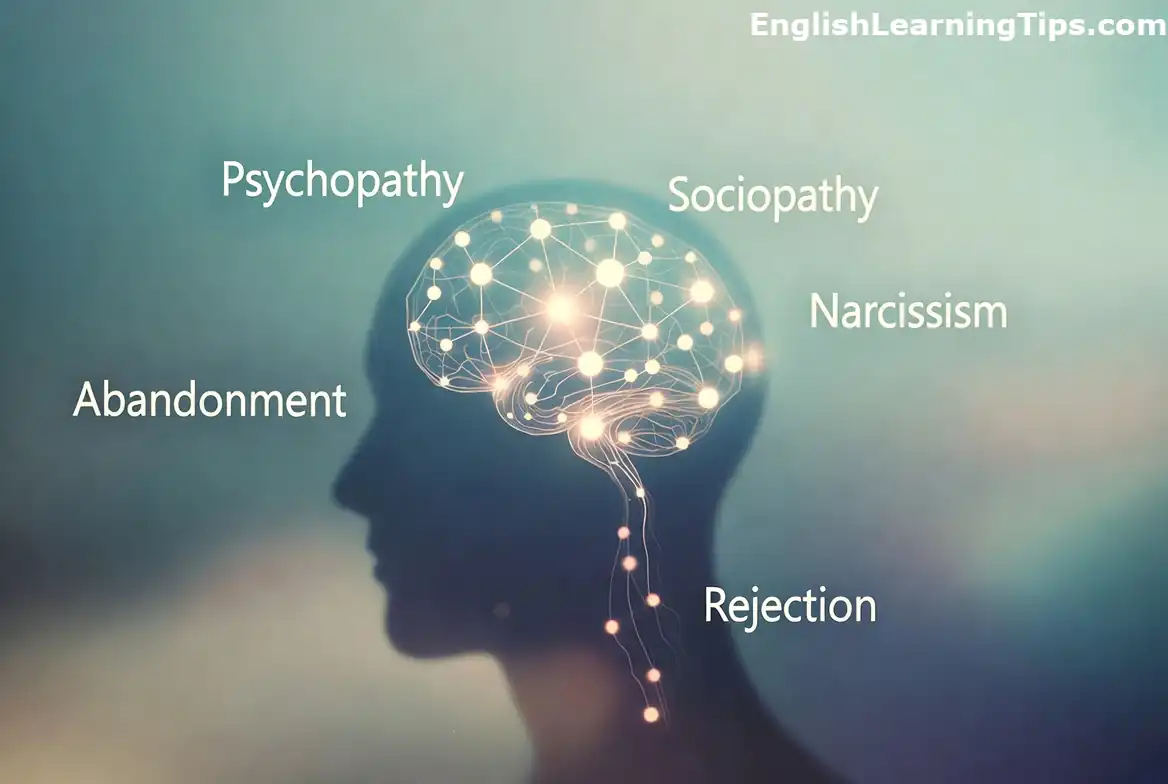
Understanding empathy deficit disorder — Video-based ESL lesson

Empathy is often described as the glue that holds society together. However, when an individual struggles to understand or share the feelings of others, it is colloquially referred to as empathy deficit disorder. While not a formal medical diagnosis in the DSM-5, this term is frequently used to describe a core feature of several personality disorders.
In this lesson, we will explore the lack of empathy as it relates to antisocial personality disorder, narcissistic personality disorder, and borderline personality disorder. By understanding the “core content” of these conditions, students can better distinguish between a neurological inability to feel empathy and a situational or emotional blockage.
Lesson plan: Exploring empathy and personality disorders
Level: Intermediate to advanced
Time: 45 minutes
Topic: Psychology and mental health
Objectives: To define empathy deficit disorder, distinguish between its presentation in different personality disorders, and master related psychological vocabulary.
Video: What no empathy really looks like | Antisocial, narcissistic & borderline explained
Background
The concept of an empathy deficit is central to understanding high-conflict personality types. According to Dr. Fox, empathy is not always “missing” in the same way. For some, like those on the antisocial spectrum (socialpathy), the deficit is a tool for power and profit. For others, it is a byproduct of intense internal pain or a choice based on perceived value.
Psychologists often look at core content—the underlying emotional drivers like shame, fear, or abandonment—to explain why empathy might be absent. Identifying these drivers helps clinicians and students alike understand that what looks like a simple “lack of care” is often a complex surface structure of a much deeper psychological issue.
Basic vocabulary
Vocabulary list
- Empathy (noun): The ability to understand and share the feelings of another.
- Forms: Empathetic (adj), empathize (verb), empathetically (adv).
- Example: She showed great empathy toward the struggling student.
- Deficit (noun): The amount by which something is too small or lacking.
- Forms: Deficient (adj), deficiency (noun).
- Example: The patient exhibited a significant deficit in social awareness.
- Colloquial (adjective): Used in ordinary or familiar conversation; not formal or literary.
- Forms: Colloquialism (noun), colloquially (adv).
- Example: “Empathy deficit disorder” is a colloquial term rather than a clinical one.
- Remorse (noun): Deep regret or guilt for a wrong committed.
- Forms: Remorseful (adj), remorseless (adj), remorsefully (adv).
- Example: The offender showed no remorse for his actions during the trial.
- Manipulative (adjective): Characterized by unscrupulous control of a situation or person.
- Forms: Manipulate (verb), manipulation (noun), manipulator (noun).
- Example: His manipulative behavior made it hard for colleagues to trust him.
- Spectrum (noun): A wide range of related qualities or ideas.
- Forms: Spectral (adj).
- Example: Personality disorders often exist on a spectrum from mild to extreme.
- Byproduct (noun): An incidental or secondary product made in the manufacture or synthesis of something else.
- Example: In some cases, a lack of empathy is a byproduct of intense fear.
- Impulsivity (noun): The tendency to act on a whim, displaying little or no forethought.
- Forms: Impulsive (adj), impulsively (adv).
- Example: High levels of impulsivity can lead to reckless decision-making.
- Remorseless (adjective): Without regret or guilt.
- Forms: Remorselessly (adv), remorselessness (noun).
- Example: The antisocial individual appeared remorseless after taking advantage of his peers.
- Manifest (verb): To display or show a quality or feeling by one’s acts or appearance.
- Forms: Manifestation (noun), manifested (adj).
- Example: A lack of empathy can manifest differently depending on the disorder.
Vocabulary for extension
- Psychopathy (noun): A mental disorder characterized by abnormal or violent social behavior.
- Forms: Psychopath (noun), psychopathic (adj).
- Definition: A clinical condition involving a high degree of empathy but also a lack of or absence of remorse.
- Sociopathy (noun): A label for antisocial personality disorder, often emphasizing social environmental factors.
- Forms: Sociopath (noun), sociopathic (adj).
- Definition: A pattern of antisocial behaviors and attitudes.
- Narcissism (noun): Excessive interest in or admiration of oneself and one’s physical appearance.
- Forms: Narcissist (noun), narcissistic (adj).
- Definition: A self-centeredness that often ignores the needs of others.
- Abandonment (noun): The action or fact of abandoning or being abandoned.
- Forms: Abandon (verb), abandoned (adj).
- Definition: A core fear in BPD involving the loss of a loved one.
- Rejection (noun): The dismissing or refusing of a proposal or idea.
- Forms: Reject (verb), rejective (adj).
- Definition: The act of being cast aside, which causes high sensitivity in some disorders.
- Clinician (noun): A person qualified in the clinical practice of medicine or psychology.
- Forms: Clinical (adj), clinically (adv).
- Definition: A professional who works directly with patients.
- Subsume (verb): To include or absorb something into something else.
- Forms: Subsumed (adj), subsumption (noun).
- Definition: To place a specific term under a broader category.
- Erratic (adjective): Not even or regular in pattern or movement; unpredictable.
- Forms: Erratically (adv), erraticism (noun).
- Definition: Behavior that is inconsistent or unstable.
- Conniving (adjective): Involved in conspiring to do something immoral, illegal, or harmful.
- Forms: Connive (verb), connivance (noun).
- Definition: Secretly allowing or being involved in wrongdoing.
- Neurological (adjective): Relating to the anatomy, functions, and organic disorders of nerves and the nervous system.
- Forms: Neurology (noun), neurologist (noun).
- Definition: Having to do with the physical structures of the brain.
Teaching tips
- Use a “concept map” to link the vocabulary words to the specific disorders (e.g., link “Abandonment” to BPD).
- Encourage students to use the different forms of the words in sentences to ensure they understand the grammar of psychological terms.
Grammar spotlight: Conditional language and clinical nuance
In psychological discussions, we often use conditional sentences and speculative language. Because mental health is a spectrum, we avoid absolute statements. Note the use of “may,” “can,” “often,” and “typically.” For example: “If an individual has BPD, they might appear to lack empathy, but they actually feel intense remorse.” We also utilize nominalization (turning verbs/adjectives into nouns) like “impulsivity” or “narcissism” to discuss abstract concepts as clinical entities.
Using modals for speculation
When discussing a diagnosis or a patient’s behavior, we use modal verbs to avoid making definitive claims that could be inaccurate or stigmatizing.
- May / Might: Used to suggest a possibility.
- Example: “An individual with narcissistic traits might ignore others’ needs to protect their own ego.”
- Can / Could: Used to describe a general capability or potential manifestation.
- Example: “A lack of empathy can manifest as coldness or calculated manipulation.”
- Tend to / Typically: Used to describe frequent patterns without saying they happen 100% of the time.
- Example: “Those with BPD tend to experience empathy as an overwhelming emotional burden.”
First and second conditionals in psychology
We use conditional structures to link a core content (the cause) to a surface structure (the behavior).
- The zero conditional (General truths):
- Structure: If + present simple, present simple.
- Example: “If a person has no affective empathy, they struggle to feel remorse.”
- The first conditional (Specific possibilities):
- Structure: If + present simple, will/can/might + verb.
- Example: “If the clinician identifies the core content, the treatment will be more effective.”
Nominalization: Turning adjectives into clinical entities
To speak more formally, psychologists often use nominalization. This is the process of turning an adjective (a description) into a noun (a concept). This allows you to discuss the “thing” itself rather than just describing a person.
| Adjective (Descriptive) | Noun (The Concept) | Clinical application |
| Impulsive | Impulsivity | “We must measure the patient’s level of impulsivity.” |
| Narcissistic | Narcissism | “Narcissism is often a byproduct of deep-seated shame.” |
| Deficient | Deficit | “The test revealed a significant deficit in cognitive empathy.” |
| Empathetic | Empathy | “Empathy is the glue that holds society together.” |
Adverbs of frequency and degree
Precision is key in psychological reporting. Using the right adverb helps define where a behavior sits on the spectrum.
- Adverbs of frequency: Frequently, occasionally, rarely, persistently.
- Example: “The subject persistently sought validation from peers.”
- Adverbs of degree:Significantly, mildly, acutely, moderately.
- Example: “The deficit was significantly more pronounced in the antisocial group.”
Pro-tip: When writing your case studies, try to replace “He is impulsive” with “He displays high levels of impulsivity.” This small shift makes your writing sound much more professional and academic.
Useful phrases
Key phrases
- “On the spectrum” (used to describe where someone fits in a range of behaviors).
- “Core content” (referring to the underlying emotional driver).
- “Surface structure” (the visible behavior resulting from the core content).
- “Colloquial use” (informal language).
- “Byproduct of…” (a result of something else).
Teaching tips
- Practice “if/then” structures regarding the disorders (e.g., “If the core content is power, then the person might show antisocial traits”).
- Role-play using these phrases in a professional or academic setting.
Example conversations
Conversation 1: Basic description
Student A: Have you heard of empathy deficit disorder? Student B: Yes, but my teacher said it isn’t an official clinical diagnosis. Student A: That’s right, it is a colloquial term for a lack of empathy. Student B: It seems to show up in many different personality disorders.
Conversation 2: Adding details
Student A: How does empathy differ between a narcissist and a psychopath? Student B: A psychopath has a neurological deficit and feels no remorse at all. Student A: And a narcissist? Student B: They can feel empathy, but they often choose not to because they don’t value it.
Conversation 3: More advanced
Student A: People often assume individuals with borderline personality disorder lack empathy. Student B: Actually, that is usually a misunderstanding of their erratic behavior. Student A: You’re right; they often feel immense regret and turn that pain inward. Student B: It’s important to identify the core content before making a judgment.
Teaching tips
- Have students record themselves speaking these dialogues to improve their intonation with complex vocabulary.
- Ask students to swap out the specific disorder in Conversation 3 to see how the “core content” changes the dialogue.
Teaching strategy
Use the Comparative Analysis strategy. Create a three-column chart on the board for ASPD, NPD, and BPD. As you go through the lesson, have students fill in the “Core Content” and the “Type of Empathy Deficit” for each. This visual categorization helps solidify the differences between the disorders.
Here’s a 45-minute lesson plan
Step 1: Warm-up (5 minutes)
Ask students to define “empathy” in their own words. Discuss a time they felt empathy and a time they found it difficult to do so.
Step 2: Vocabulary introduction (10 minutes)
Distribute the vocabulary list. Pronounce each word clearly and have students repeat them. Discuss the different forms (noun/verb/adj) of each term.
Step 3: Phrase practice (10 minutes)
Introduce the “Key Phrases.” Have students create three sentences using “core content” and “on the spectrum” to describe people or characters from movies.
Step 4: Conversation practice (15 minutes)
Split the class into pairs. Have them practice the three example conversations. Then, ask them to create a fourth conversation where one person is a clinician explaining a diagnosis to a student.
Step 5: Wrap-up and personalization (5 minutes)
Ask students: “Why is it helpful to know that some people ‘choose’ not to use empathy while others physically cannot feel it?”
Discussion questions
- Question: Why is “empathy deficit disorder” not in the DSM-5?
- Answer: It is a colloquial term used to describe a symptom found in several other official disorders, rather than being a distinct condition itself.
- Question: What is the core content for someone with antisocial personality disorder?
- Answer: The core content is usually power and profit.
- Question: How does a narcissist’s lack of empathy differ from a psychopath’s?
- Answer: Research suggests psychopaths have a neurological deficit, whereas narcissists can utilize empathy but often choose not to.
- Question: Why is BPD behavior sometimes misconstrued as a lack of empathy?
- Answer: Their erratic or aggressive behavior can look like they don’t care, but internally they often feel intense remorse and regret.
- Question: What does Dr. Fox mean by “surface structure”?
- Answer: It refers to the visible behaviors (like manipulation or violence) that are caused by the hidden “core content.”
Additional tips
- Cultural sensitivity: Remember that different cultures express empathy and emotions in various ways; avoid labeling a cultural difference as a “disorder.”
- Visual aids: Use a spectrum diagram to show where sociopathy and psychopathy fall under the ASPD umbrella.
- Adapt for level: For lower levels, focus on “remorse” and “empathy.” For higher levels, focus on “neurological deficits” and “subsumed terms.”
- Technology: Use a digital quiz tool (like Kahoot) to test students on the vocabulary forms at the end of the lesson.
Common mistakes to address
- Grammar: Using “empathy” as a verb. Remind students the verb is “empathize.”
- Word choice: Confusing “sociopath” with “psychopath.” Explain that while related, psychopathy is generally considered a more extreme end of the spectrum.
Example activity
Core content detective: Provide students with three short “case studies” (brief descriptions of behavior). In groups, students must look for the “core content” (Is it power? Is it abandonment? Is it shame?) and decide which personality disorder is most likely represented.
Homework or follow-up
- Writing: Write a 200-word paragraph explaining why the term “empathy deficit disorder” is a colloquialism.
- Speaking: Record a 1-minute summary of the differences between BPD and NPD regarding empathy.
- Research: Find a reputable article about the neurological studies of psychopathy and list three findings.
FAQs
- Can a person with an empathy deficit learn to feel empathy? It depends on the core content. While a narcissist may learn to “choose” to use empathy, a clinical psychopath may only be able to learn “cognitive empathy” (understanding it intellectually) rather than feeling it.
- Are all “cold” people suffering from a disorder? No. Emotional reservedness can be a personality trait or a cultural norm and does not necessarily indicate a lack of empathy.
- What is the difference between cognitive and emotional empathy? Cognitive empathy is knowing what someone else is feeling; emotional empathy is feeling it along with them.
- Is BPD the same as having no empathy? Not at all. In fact, many with BPD feel “too much” empathy but struggle to manage their reactions to those intense feelings.
Conclusion: Take the next step in understanding
Grasping the complexities of empathy and personality disorders is essential for anyone interested in psychology or social work. By looking past surface behaviors to the core content, we can develop a more nuanced view of mental health.
Have you ever encountered a situation where someone seemed to have an empathy deficit? How did you handle it? Share your thoughts in the comments below and share this article with your fellow students to start a discussion!
Discover more from English Learning Tips
Subscribe to get the latest posts sent to your email.


