

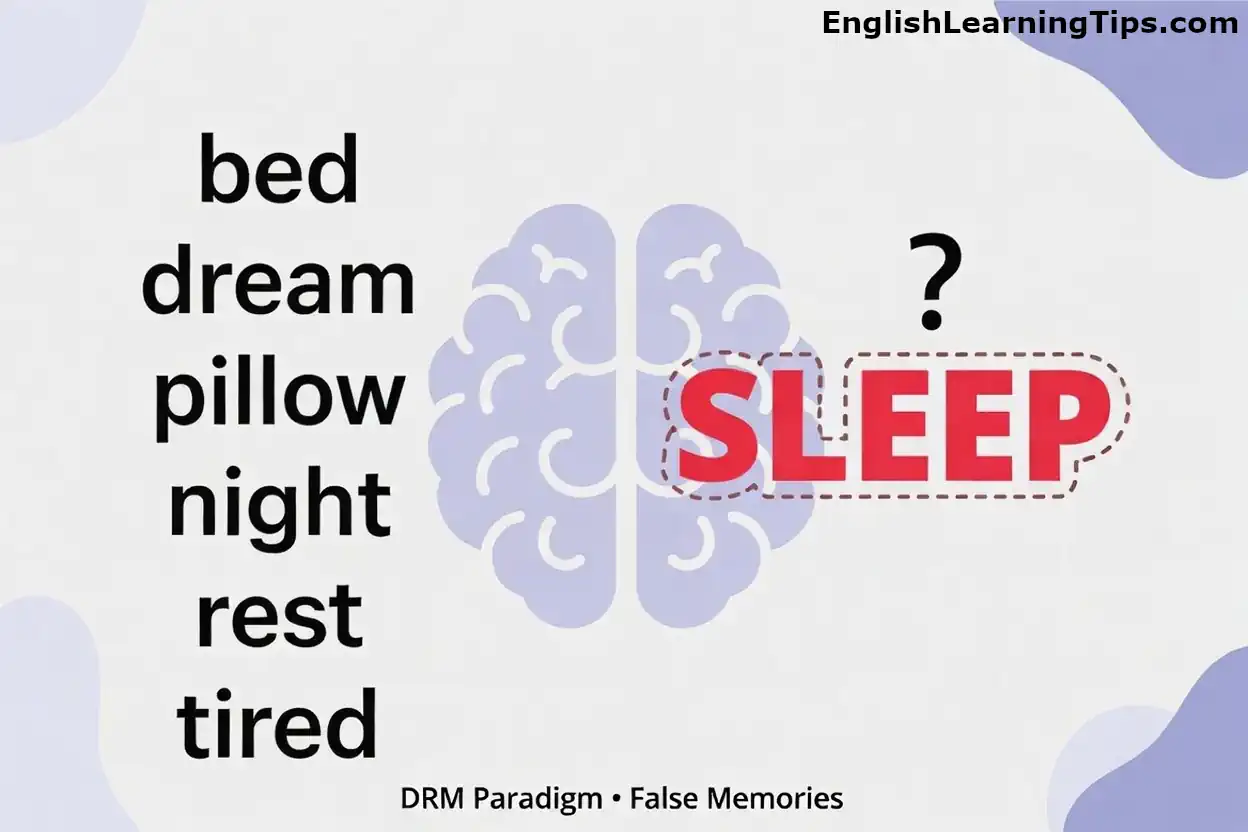
Understanding false memories: The DRM paradigm ESL lesson plan

Welcome to this comprehensive lesson guide on cognitive psychology and language learning. Mastering advanced academic topics can be a challenge for English language learners, but exploring how the human brain processes information is a fascinating way to build fluency. In this lesson, we dive deep into a classic psychological phenomenon to discover how minds can be tricked into remembering things that never happened. By studying these cognitive patterns, students can significantly improve their reading, listening, and analytical skills in English.
Lesson plan: Exploring cognitive illusions and memory accuracy
Level: Upper-intermediate to advanced (B2-C1)
Time: 60 minutes (with an adaptable 45-minute core structure)
Topic: The Deese-Roediger-McDermott (DRM) paradigm and false memories
Objectives: Students will be able to explain the concept of a critical lure, discuss theories of cognitive reconstruction, use advanced psychological vocabulary in context, and apply passive voice structures to describe scientific procedures.
Video: DRM Procedure Explained: How False Memories Form in Psychology
Background
The human memory is not a flawless digital recording device that perfectly captures every moment of our lives. Instead, human memory is a reconstructive process where our brains encode information, store it, and then rebuild it during recall. Because our brains rely heavily on patterns, prior knowledge, and semantic associations to fill in missing information, we are naturally susceptible to memory distortions and cognitive illusions.
To study these mental glitches under controlled laboratory conditions, psychologists use a classic experimental method known as the Deese-Roediger-McDermott paradigm, or simply the DRM paradigm. Pioneered by James Deese in 1959 and popularized by Henry L. Roediger III and Kathleen McDermott in 1995, this procedure demonstrates that hearing a list of highly related words can reliably trigger false memories. When participants are exposed to words like “bed,” “dream,” and “pillow,” they will frequently and confidently claim they heard the word “sleep,” even though it was completely absent from the list.
Basic vocabulary
Introducing essential words related to cognitive psychology, memory research, and the DRM paradigm helps students articulate complex scientific concepts clearly.
Vocabulary list
- Encode (verb)
- Reconstruct (verb)
- Other forms: Reconstruction (noun), reconstructive (adjective)
- Definition: To rebuild or piece together past events using a mix of actual memory fragments and general knowledge.
- Example: When you try to remember your fifth birthday party, your brain has to reconstruct the scene.
- Paradigm (noun)
- Other forms: Paradigmatic (adjective)
- Definition: A distinct set of concepts, thought patterns, or experimental methodologies used as a standard model in a scientific field.
- Example: The DRM paradigm remains a foundational method for studying false memories in psychology labs.
- Lure (noun)
- Other forms: Lure (verb), alluring (adjective)
- Definition: An item or word designed to attract attention or trick someone; in psychology, a missing word that is highly associated with a presented list.
- Example: The word “sleep” serves as the critical lure in a list filled with nighttime terms.
- Illusion (noun)
- Other forms: Illusory (adjective)
- Definition: Something that looks or seems different from what it actually is; a false perception or misleading mental image.
- Example: Optical tricks create a visual illusion, while the DRM paradigm creates a memory illusion.
- Endorse (verb)
- Other forms: Endorsement (noun)
- Definition: To officially approve, support, or declare validity for something; in testing, to confidently choose or claim an item is correct.
- Example: Many participants will falsely endorse the missing word during the recognition test phase.
- Verbatim (adjective/adverb)
- Other forms: None (used directly as an adjective or adverb)
- Definition: Using exactly the same words as were originally spoken or written.
- Example: It is incredibly difficult to remember a long lecture verbatim without taking notes.
- Gist (noun)
- Other forms: None
- Definition: The substance, general meaning, or essential theme of a speech, text, or list of items.
- Example: Even if you forget the exact phrasing of the story, you can usually remember the gist of it.
- Persist (verb)
- Other forms: Persistence (noun), persistent (adjective), persistently (adverb)
- Definition: To continue firmly or obstinately in an opinion or a course of action in spite of difficulty, warnings, or opposition.
- Example: False memories often persist even when participants are explicitly warned about the trick beforehand.
- Association (noun)
- Other forms: Associate (verb), associative (adjective)
- Definition: A mental connection or bond formed between ideas, words, sensations, or memories.
- Example: The strong semantic association between “doctor” and “nurse” can easily trigger a memory error.
Vocabulary for extension
- Activation-monitoring theory (noun)
- The idea that hearing related words automatically activates a target concept in our web of memory, leading to source confusion during recall.
- Fuzzy-trace theory (noun)
- A cognitive theory stating that we encode memory into two parallel tracks: exact verbatim details and a general, intuitive gist.
- Semantic (adjective)
- Relating to meaning in language or the deep logical connections between words.
- Distortion (noun)
- A change, twist, or exaggeration that makes something appear different from its true, original state.
- Eyewitness testimony (noun)
- A legal term referring to an account given by a bystander or victim in a courtroom describing what they observed during an event.
- Recall (verb/noun)
- The act of retrieving stored information from the past without any external prompts or cues.
- Recognition (noun)
- The ability to identify a piece of information, a person, or an object as something previously encountered when it is presented again.
- Absence (noun)
- The state of being away, missing, or completely left out of a specific situation or list.
- Genuine (adjective)
- Truly what something is said to be; authentic, real, and free from falsehood or manipulation.
- Provoke (verb)
- To stimulate, trigger, or deliberately cause a specific reaction, emotion, or cognitive response to occur.
Teaching tips
To help students internalize these advanced concepts, have them map out words visually. Create semantic webs on the board by placing a word like “sleep” in the center and asking students to shout out related terms. This mimics the exact cognitive structure of the DRM paradigm, showing them firsthand how associations function in the brain. A pro-tip for reinforcing word forms is to build a quick grid on the board with columns for nouns, verbs, and adjectives, and then have students race to fill in the missing variations of words like “reconstruct” and “persist.”
Grammar spotlight: Master the passive voice in academic English
When discussing scientific experiments, cognitive psychology, or research data, academic writers rarely focus on who did the action. Instead, the focus stays squarely on the process, the experiment, or the results. In English, we achieve this objective tone by using the passive voice.
Formulating the passive voice
To transition a sentence from the active voice to the passive voice, you must make the original object of the sentence the new grammatical subject. Use the appropriate tense of the auxiliary verb to be, followed by the past participle of the main verb.
Active: Psychologists code the data.
Passive: The data + are (to be) + coded (past participle).
Comparing active and passive structures in research
| Tense | Active voice structure | Passive voice structure | Academic focus |
| Simple past | Roediger and McDermott popularized the paradigm in 1995. | The paradigm was popularized in 1995 by Roediger and McDermott. | Focuses on the historical breakthrough of the framework itself. |
| Simple present | The DRM list reliably produces false memories. | False memories are reliably produced by the DRM list. | Emphasizes the psychological phenomenon over the tool. |
| Modal verbs | Warnings can reduce memory illusions. | Memory illusions can be reduced by warnings. | Highlights the cognitive outcome and potential solutions. |
Understanding the role of the agent
In many passive sentences, the person or thing performing the action—known as the agent—is completely omitted because it is obvious, unknown, or unimportant to the scientific process.
Pro-tip: Only include the agent at the end of the sentence using the word by if knowing exactly who performed the action adds necessary historical context or scientific validation.
- Agent omitted: “The critical lure was left out of the list.” (We do not need to know which specific research assistant left it out.)
- Agent included: “The initial study was conducted by James Deese in 1959.” (The specific researcher adds essential historical context.)
Avoiding common passive voice pitfalls
When editing your academic writing, pay close attention to the auxiliary verb. A common mistake for language learners is skipping the verb to be entirely, which turns the sentence into an incorrect active structure.
- Incorrect: “The words encoded incorrectly by the brain.”
- Correct: “The words were encoded incorrectly by the brain.”
Another frequent error is using the base form or the present participle instead of the past participle.
- Incorrect: “The experiment was perform last week.”
- Correct: “The experiment was performed last week.”
Useful phrases
Key phrases
- According to the activation-monitoring theory… (Used to attribute an explanation to a specific scientific framework)
- The signature of this effect is… (Used to highlight the defining characteristic or primary outcome of a phenomenon)
- We tend to rely on… (Used to describe a common human habit, pattern, or baseline cognitive behavior)
- It serves as both a warning and a guide… (Used to explain something that has dual utility, highlighting both a risk and a helpful lesson)
- Separate genuine recall from simple association… (Used to distinguish between real accuracy and a misleading mental connection)
Teaching tips
Encourage students to use these phrases as building blocks when debating or explaining the lesson concepts. You can write these phrases on index cards and challenge pairs of students to use at least three of them during a five-minute discussion about memory reliability.
Example conversations
Conversation 1: Basic description
Teacher: Can you explain the basic setup of the DRM experiment? Student A: Sure, a researcher reads a list of related words to a participant. Teacher: Exactly, and what makes the list special? Student B: The most important word, which is called the critical lure, is completely missing.
Conversation 2: Adding details
Student A: Why do people confidently say they heard the missing word? Student B: It happens because our brains naturally focus on the general gist of the list. Student A: So, if the list is about bedtime, our brain just assumes “sleep” was included? Student B: Exactly, because the semantic association between those words is incredibly strong.
Conversation 3: More advanced
Student A: Do you think warnings can completely prevent this cognitive illusion from happening? Student B: According to the text, warnings do reduce false memories, but the errors still persist. Student A: That has huge implications for things like real-world eyewitness testimony in courtrooms. Student B: Definitely, because it proves that high confidence does not guarantee high accuracy.
Teaching tips
Have students practice these dialogues in pairs to improve their intonation and conversational flow. Once they read through them verbatim, challenge them to close their books and reconstruct the dialogues using their own words while retaining the bolded speaker format.
Teaching strategy
When introducing highly conceptual material, use a strategy called scaffolding. Start with a concrete, physical demonstration before moving into abstract definitions. Conduct a live mini-DRM test right in your classroom by reading a list of words out loud (e.g., sour, candy, sugar, bitter, good, taste, cake, honey) and checking how many students mistakenly write down the critical lure (e.g., sweet). Once students experience the mental illusion themselves, they will be far more engaged and receptive to the complex theories and academic vocabulary that explain why it happened.
Here’s a 45-minute lesson plan
Step 1: Warm-up (5 minutes)
Read a list of 12 related words to the class without letting them write anything down. Ask them to listen closely, wait 30 seconds in silence, and then have them write down as many words as they can remember. Reveal that the core theme word was never actually read, introducing the concept of a memory trick.
Step 2: Vocabulary introduction (10 minutes)
Distribute the vocabulary list. Define key terms like “critical lure,” “encode,” and “gist” using the whiteboard. Have students practice repeating the words out loud to master pronunciation, and clarify the different word forms and conjugations.
Step 3: Phrase practice (10 minutes)
Introduce the key passive voice grammar structures and the useful phrases section. Write the useful phrases on the board and have students create their own original sentences using those frames to describe the mini-experiment from the warm-up.
Step 4: Conversation practice (15 minutes)
Divide the class into pairs. Have them read through the three example conversations, alternating roles. Afterward, ask pairs to write a short, original four-sentence conversation discussing how memory can affect everyday life, using at least two new vocabulary words.
Step 5: Wrap-up and personalization (5 minutes)
Bring the class back together to share thoughts. Ask students to share a time when they were completely certain about a memory, only to discover later that they were mistaken or had misremembered the details.
Discussion questions
- Question: Why does high confidence not always mean that a memory is completely accurate?
- Answer: Confidence often comes from the strong semantic associations or the general gist we hold in our minds. Because our brains use these patterns to reconstruct memories, the feeling of certainty can be very strong even if the verbatim detail is incorrect.
- Question: How does the fuzzy-trace theory explain why we accept critical lures during recognition tests?
- Answer: This theory states that we store memories on two tracks: exact details and the general theme. Because verbatim details fade quickly, we rely heavily on the gist, which tricks us into thinking the lure word was actually there.
- Question: In what ways could the DRM effect impact real-world eyewitness testimony during a criminal trial?
- Answer: If witnesses are exposed to leading questions or highly related pieces of information after an event, their brains might create a false memory. They might confidently testify to seeing something that was actually just a logical association, not a real observation.
- Question: What is the main difference between the activation-monitoring theory and the fuzzy-trace theory?
- Answer: The activation-monitoring theory focuses on mental networks activating related words and creating source confusion. The fuzzy-trace theory focuses on two distinct memory tracks, showing how we rely on a general theme over exact details.
- Question: What can students do to apply these findings and reduce cognitive illusions when studying for exams?
- Answer: Students can reduce illusions by focusing on distinctive, specific details of each concept, rehearsing exact phrasing, doing quick source checks, and mixing up their study modalities by reading, listening, and writing.
Additional tips
- Cultural sensitivity: Keep in mind that some vocabulary list items or word lists might rely on specific cultural associations that do not translate perfectly across all languages. Ensure the lists use universal, highly accessible concepts like food, sleep, or nature.
- Visual aids: Use diagrams of interconnected semantic webs or simple flowcharts on the board to illustrate how the activation-monitoring theory spreads throughout a person’s memory network.
- Adapt for level: For intermediate students, focus primarily on the concept of memory tricks and simple lists. For advanced students, challenge them to critique the experimental design or discuss deeper legal applications.
- Technology: Have students use digital flashcard apps like Quizlet to study vocabulary word forms and practice matching definitions with their correct parts of speech outside of class.
Common mistakes to address
- Grammar: Watch out for students mixing up the passive voice by forgetting the auxiliary verb “to be” (e.g., saying “The word encoded by the brain” instead of “The word was encoded by the brain”).
- Word choice: Students often confuse “recall” and “recognition.” Remind them that recall means retrieving information from scratch, while recognition means identifying something that is placed right in front of them.
Example activity
Divide the class into small groups of three or four. Give each group a blank piece of paper and assign them a common theme, such as “the kitchen,” “the beach,” or “the classroom.” Instruct each group to secretly design their own DRM list consisting of 12 highly associated words, while making sure to completely leave out the obvious central keyword (the critical lure). Once finished, groups will take turns reading their custom lists to the rest of the class to see if they can successfully provoke a false memory illusion in their peers.
Homework or follow-up
- Writing: Write a short paragraph summarizing how the DRM paradigm functions, ensuring you use at least three passive voice sentences and four new vocabulary words.
- Speaking: Record a brief two-minute voice memo explaining the difference between verbatim memory and gist memory to a friend who has never studied psychology.
- Research: Search online for a real case where eyewitness testimony was proven inaccurate due to memory distortions, and note down two factors that contributed to the error.
FAQs
What does the abbreviation DRM stand for in cognitive psychology?
It stands for Deese-Roediger-McDermott. It is named after James Deese, who discovered the core effect in 1959, and Henry L. Roediger III and Kathleen McDermott, who popularized the method and expanded the research paradigm in 1995.
Can someone completely avoid making false memory errors if they are highly intelligent?
No, intelligence does not prevent these errors. Cognitive illusions are a natural byproduct of how the healthy human brain processes, categorizes, and organizes vast networks of language and information efficiently.
Why do false memories persist even when participants are given a clear warning?
They persist because our reliance on semantic associations and general themes is incredibly fast and automatic. Even when we try to be careful, our brains still struggle to separate an internal thought from an external observation.
How do researchers verify that a memory is actually false during a DRM test?
Researchers compare the participant’s final written recall sheet or recognition test selections against the original list of words. If a participant writes down a word that was never read, it is categorized as a false memory.
Is the DRM paradigm used to study severe mental trauma or psychological amnesia?
No, it is primarily used in laboratory settings to study everyday memory distortions, word associations, and general cognitive processing in healthy individuals.
Conclusion
Exploring the intricate inner workings of human memory reveals just how fascinating and complex the English language can be. By understanding the DRM paradigm, you can improve your academic vocabulary, master advanced grammar structures, and develop a sharper mind for critical analysis. Now, we want to hear from you: Have you ever been absolutely certain of a memory, only to find out your brain played a trick on you? Leave a comment below with your thoughts, share this lesson plan with your fellow teachers or classmates, and let us get a conversation started on how we can build better study habits together.
Discover more from English Learning Tips
Subscribe to get the latest posts sent to your email.


