

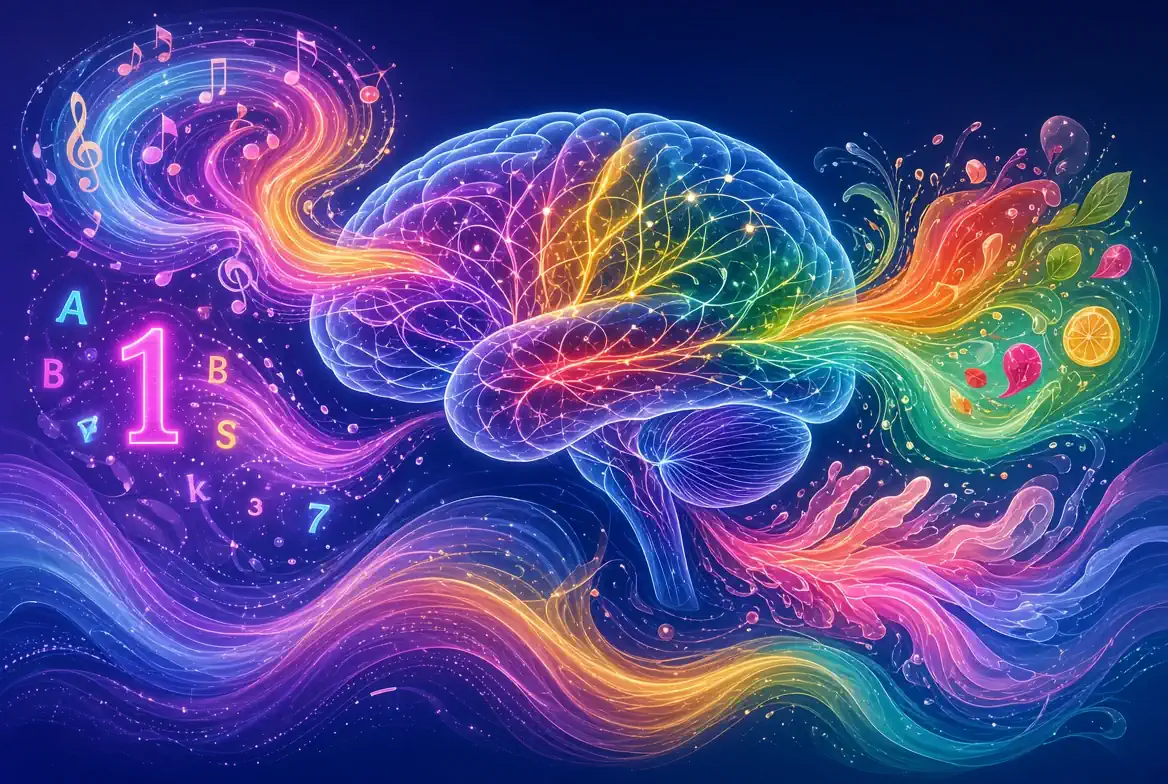
Exploring the neurological world of blended senses: A comprehensive teaching guide

Understanding how our brains process the world is fascinating, especially when sensory experiences overlap. In this comprehensive English as a Second Language (ESL) guide, we explore synesthesia, a unique neurological condition where stimulating one sense automatically triggers an experience in another. Whether you are searching for a synesthesia lesson plan, neurological vocabulary activities, or sensory perception teaching resources, this complete curriculum is optimized to help your students master advanced scientific and descriptive language.
By linking key words like neural associations, sensory cortex, and cross-wiring in the brain throughout this article, educators and learners can dive deep into the fascinating intersection of neuroscience and language acquisition.
Lesson plan: Unlocking the mind: Understanding synesthesia through language and science
Level: Intermediate to advanced (B2–C1)
Time: 45 to 60 minutes
Topic: Synesthesia, neuroscience, and sensory perception
Objectives: Students will learn and correctly use 10 vocabulary terms derived from neuroscience, understand adjective-to-noun word forms, master descriptive language structures, and engage in multi-turn conversational practice about unique brain functions.
Video: A neuroscientist explains synesthesia
Background
Synesthesia is a fascinating neurological phenomenon in which the stimulation of one sensory or cognitive pathway leads to automatic, involuntary experiences in a second sensory or cognitive pathway. For example, individuals with grapheme-color synesthesia perceive specific letters or numbers as inherently colored, viewing the number one not just as a digit, but as a specific shade of fuchsia. According to neuroscientists, this occurs because the sensory regions for sight, sound, touch, and taste sit adjacent to one another in the sensory cortex.
During early childhood development, human brains possess dense neural connections. As a person matures, a vital neurological process known as pruning eliminates unused pathways while strengthening frequently used ones. In individuals with synesthesia, this pruning process happens less efficiently or differently, leaving cross-wired neural pathways intact. Consequently, activating one sensory region simultaneously triggers another, creating a rich, dual perception of the external world.
Basic vocabulary
Vocabulary list
- Synesthesia (Noun) | Conjugations: Synesthetic (Adjective), synesthetically (Adverb)
- Definition: A neurological condition where stimulation of one sense triggers an involuntary experience in another.
- Example sentence: People with synesthesia often report seeing specific colors when they hear particular musical notes.
- Neuroscience (Noun) | Conjugations: Neuroscientist (Noun), neurological (Adjective), neurologically (Adverb)
- Definition: The scientific study of the nervous system and brain.
- Example sentence: Modern neuroscience uses advanced brain-imaging technology to study how sensory information is processed.
- Stimulation (Noun) | Conjugations: Stimulate (Verb), stimulating (Adjective), stimulated (Adjective)
- Definition: The action of arousing or exciting an organ or neural pathway to functional activity.
- Example sentence: Auditory stimulation can instantly evoke vivid visual patterns for certain individuals.
- Perception (Noun) | Conjugations: Perceive (Verb), perceptible (Adjective), perceptibly (Adverb)
- Definition: The ability to see, hear, or become aware of something through the senses.
- Example sentence: Her unique sensory perception allows her to taste words as she reads them.
- Cortex (Noun) | Conjugations: Cortical (Adjective)
- Definition: The outer layer of an organ, specifically the outer layer of the cerebrum in the brain.
- Example sentence: The sensory cortex handles incoming signals from touch, taste, sight, and hearing.
- Neuron (Noun) | Conjugations: Neuronal (Adjective), neurogenesis (Noun)
- Definition: A specialized cell transmitting nerve impulses; a nerve cell.
- Example sentence: Billions of neurons communicate across intricate pathways throughout the human brain.
- Pruning (Noun/Verb) | Conjugations: Prune (Verb), pruned (Adjective)
- Definition: The neurological process of reducing the number of active synaptic connections to improve brain efficiency.
- Example sentence: Synaptic pruning typically occurs during childhood and adolescence to streamline neural networks.
- Association (Noun) | Conjugations: Associate (Verb/Noun), associative (Adjective), associatively (Adverb)
- Definition: A mental connection or link between ideas, concepts, or sensory inputs.
- Example sentence: His permanent neural association between numbers and colors remained consistent over many years.
- Involuntary (Adjective) | Conjugations: Involuntarily (Adverb), voluntary (Antonym)
- Definition: Done without conscious control or choice; automatic.
- Example sentence: The color experience triggered by letters is completely involuntary for synesthetes.
- Genetic (Adjective) | Conjugations: Genetics (Noun), genetically (Adverb), gene (Noun)
- Definition: Relating to genes or heredity; passed down through families.
- Example sentence: Because synesthesia is often genetic, multiple family members may share similar traits.
Vocabulary for extension
- Cross-wiring (Noun) | Conjugations: Cross-wired (Adjective) | Definition: An anatomical state where neural pathways intersect or connect across unrelated functional regions.
- Cognitive (Adjective) | Conjugations: Cognition (Noun), cognitively (Adverb) | Definition: Relating to the mental action or process of acquiring knowledge and understanding.
- Simultaneous (Adjective) | Conjugations: Simultaneously (Adverb), simultaneity (Noun) | Definition: Occurring, operating, or done at the same time.
- Anatomy (Noun) | Conjugations: Anatomical (Adjective), anatomically (Adverb) | Definition: The branch of science concerned with the bodily structure of humans, animals, and other living organisms.
- Consistency (Noun) | Conjugations: Consistent (Adjective), consistently (Adverb) | Definition: The quality of achieving the same results or behavior over successive trials.
- Inherent (Adjective) | Conjugations: Inherently (Adverb) | Definition: Existing in something as a permanent, essential, or characteristic attribute.
- Phenomenon (Noun) | Conjugations: Phenomena (Plural noun), phenomenal (Adjective) | Definition: A fact or situation that is observed to exist or happen, especially one whose cause is unusual.
- Stimulus (Noun) | Conjugations: Stimuli (Plural noun), stimulate (Verb) | Definition: A thing or event that evokes a specific functional reaction in an organ or tissue.
- Development (Noun) | Conjugations: Develop (Verb), developing (Adjective), developed (Adjective) | Definition: The process of growing, changing, or advancing over a period of time.
- Perceive (Verb) | Conjugations: Perception (Noun), perceptible (Adjective) | Definition: To become aware or conscious of something through the senses.
Teaching tips
- Multisensory matching: Write numbers and letters on colored index cards and have students match them repeatedly across two distinct rounds to simulate consistency testing.
- Word-family charts: Create a whiteboard grid displaying noun, verb, adjective, and adverb forms side-by-side to reinforce morphological transformations.
- Personalized analogies: Ask students to describe how music makes them feel using color words to bridge abstract concepts with tangible vocabulary.
Grammar
This lesson integrates descriptive adjectives, passive voice constructions for scientific processes, and modal verbs of deduction.
- Descriptive and compound adjectives: When discussing synesthesia, students utilize compound adjectives (e.g., cross-wired, fuchsia-colored, involuntary) to modify complex nouns precisely.
- Example: “A synesthete experiences a cross-wired sensory reaction.”
- Passive voice in scientific explanations: Because neurological processes happen independently of human will, scientific explanations rely heavily on the passive voice (e.g., is located, might be retained, are activated).
- Example: “Regions of the brain that handle hearing and sight are located right next to each other.”
- Modal verbs of possibility and deduction: Use modals (might, could, may) when discussing scientific hypotheses and genetic inheritance.
- Example: “If someone in your family has it, you might inherit the trait.”
Useful phrases
Key phrases
- “Have you ever tasted a number?”
- “Stimulation of one sense results in…”
- “A cross-wiring between brain regions…”
- “This pruning process happens efficiently…”
- “Permanent neural associations in the brain…”
- “A merging of sensory perception…”
Teaching tips
- Choral repetition: Practice rising and falling intonation with rhetorical questions like “Have you ever tasted a number?” to build conversational engagement.
- Substitution drills: Provide the frame “Stimulation of [Sense A] results in [Sense B]” and prompt students to swap terms rapidly.
Example conversations
Conversation 1: Basic description
Student A: Did you watch that video about Dr. Brain explaining synesthesia?
Student B: Yes, I did! It was so strange to learn that some people can taste words.
Student A: Exactly, my mind was blown when he said numbers have specific colors.
Student B: I know, for some people, the number one is a bright fuchsia color.
Conversation 2: Adding details
Student A: Do you remember the neurological cause behind how synesthesia happens?
Student B: Dr. Brain explained that it involves cross-wiring in the sensory cortex.
Student A: Right! As babies, our brain regions are heavily connected to one another.
Student B: Then a pruning process happens as we grow up, but in synesthetes, extra connections remain active.
Conversation 3: More advanced
Student A: It makes you wonder how scientists can prove someone genuinely has synesthesia without just guessing.
Student B: They use consistency tests, right? Asking subjects to assign colors or tastes and repeating it later.
Student A: Exactly. Because the neural associations are permanent, a synesthete will match the exact same characteristics in round two.
Student B: That’s such an elegant way to prove it’s not just memorization or imagination.
Teaching tips
- Role-play pairs: Assign students roles as a curious interviewer and a neuroscientist to practice natural phrasing and follow-up inquiries.
- Pacing control: Encourage students to pause naturally after rhetorical questions to maximize conversational tension.
Teaching strategy
This lesson utilizes an inquiry-based, communicative approach combined with content-based instruction (CBI). By anchoring abstract neurological concepts in concrete human experiences (like tasting words or seeing colored numbers), students connect unfamiliar scientific terminology to personal imagination. Scaffold learning from receptive vocabulary identification to structured dialogue production, ensuring students move smoothly from comprehension to active spoken output.
Here is a 45-minute lesson plan
Step 1: Warm-up (5 minutes)
- Hook the class by asking the opening rhetorical questions from the transcript: “What do colors smell like? Have you ever tasted a number?”
- Elicit brief reactions and write student guesses on the board.
Step 2: Vocabulary introduction (10 minutes)
- Introduce the 10 core vocabulary words, focusing on parts of speech and word family conjugations (noun, adjective, verb, adverb).
- Have students identify the definitions and practice reading the example sentences aloud.
Step 3: Phrase practice (10 minutes)
- Review the key phrases list with choral repetition.
- Conduct partner substitution drills using structures like “Stimulation of [Sense A] results in…” to reinforce fluent delivery.
Step 4: Conversation practice (15 minutes)
- Put students in pairs to read and practice Conversations 1, 2, and 3.
- Direct pairs to create their own original 4-sentence dialogue discussing how the brain’s pruning process works.
Step 5: Wrap-up and personalization (5 minutes)
- Invite volunteers to share their original dialogues with the class.
- Conclude with a brief reflection on how everyone’s brain perceives the world differently.
Discussion questions
- Question: What is synesthesia, and how does it alter a person’s everyday sensory experience?Answer: Synesthesia is a neurological condition where stimulating one sense automatically triggers an unrelated sense, causing people to experience overlapping perceptions like tasting words or seeing colored numbers.
- Question: Where in the brain are the sensory regions responsible for hearing, sight, touch, and taste located?Answer: They are located right next to each other in a part of the brain known as the sensory cortex.
- Question: What is synaptic pruning, and what role does it play in developing synesthesia?Answer: Pruning is the natural developmental process where frequently used neural connections grow stronger and unused ones weaken. In synesthesia, this pruning happens less efficiently, retaining extra cross-connections between sensory regions.
- Question: How do researchers test whether someone genuinely has synesthesia?Answer: Researchers use consistency tests where subjects assign characteristics (colors, tastes, or textures) to objects, and then repeat the test later to see if their permanent neural associations produce identical results.
- Question: Why does Dr. Brain describe synesthesia as a “union of the senses”?Answer: He views it as a beautiful merging of sensory perception that highlights how individual brains process the same essential materials in wonderfully unique ways.
Additional tips
- Cultural sensitivity: Acknowledge that neurological differences vary across populations, and frame cognitive conditions as natural human variations rather than deficits.
- Visual aids: Display a diagram of the sensory cortex or color-coded letters/numbers to help visual learners anchor abstract vocabulary.
- Adapt for level: For lower intermediate learners, focus primarily on basic vocabulary and Conversation 1; for advanced learners, emphasize neurological mechanisms and Discussion questions 3 and 4.
- Technology: Utilize interactive online flashcard tools or short video clips to let students hear native pronunciations of scientific terms like neuroscientist and cortex.
Common mistakes to address
- Grammar: Students often forget third-person singular “s” when describing neural functions (e.g., saying “a neuron activate” instead of “a neuron activates”). Remind them that singular scientific subjects require singular verb endings.
- Word choice: Learners frequently confuse the noun perception with the verb perceive or adjective perceptible. Ensure they match the grammatical form to the sentence slot (e.g., using the noun after possessive adjectives like “her perception”).
Example activity
Sensory mapping workshop: Give each student a blank sheet of paper and a set of colored markers. Instruct them to write out the alphabet or numbers 0 through 9, and assign a spontaneous color, texture, or emotion to each character based on intuition. Afterward, students pair up and interview each other about their choices, practicing modal verbs (“I might choose blue because…”) and vocabulary terms learned in class.
Homework or follow-up
- Writing: Write a 150-word journal entry imagining what life would be like if you experienced grapheme-color synesthesia, using at least five vocabulary words from the lesson.
- Speaking: Record a 1-minute audio message explaining the neurological cause of synesthesia (mentioning the sensory cortex and synaptic pruning) to a friend or family member.
- Research: Research another rare type of synesthesia (such as lexical-gustatory synesthesia, where words evoke tastes) and prepare three interesting facts to share during the next class.
Frequently asked questions
- What causes synesthesia in the human brain? Synesthesia is primarily caused by retention of extra neural connections between sensory processing regions in the brain due to variations in developmental synaptic pruning.
- Is synesthesia considered a medical disorder or disease? No, synesthesia is not a medical disorder, disease, or brain injury; it is a harmless, fascinating neurological variation in sensory perception.
- Can people develop synesthesia later in life, or are they born with it? Most individuals with synesthesia are born with it, and it tends to run in families due to genetic factors, though temporary sensory cross-over can sometimes occur through sensory deprivation, meditation, or psychoactive substances.
- What is the most common form of synesthesia? One of the most common forms is grapheme-color synesthesia, where letters, numbers, or words are consistently perceived as having specific colors.
- How do scientists verify that someone isn’t just making up their synesthetic experiences? Scientists use rigorous consistency testing over time. Because synesthetes rely on permanent, involuntary neural connections rather than memorization, their reported color and sensory associations remain identical across months or years.
Conclusion and call to action
Exploring the intricate workings of the human mind opens up incredible avenues for language learning and scientific curiosity. Understanding conditions like synesthesia not only expands our vocabulary but also deepens our appreciation for how wonderfully diverse our cognitive experiences truly are.
What are your thoughts on sensory overlap? Have you ever associated numbers with specific colors or personalities? Drop a comment below to share your experiences, and make sure to share this article with fellow educators and language learners!
Discover more from English Learning Tips
Subscribe to get the latest posts sent to your email.


