


Capitalization rules in English: A comprehensive guide to proper grammar

Capitalization rules in English might feel overwhelming at first, but they are essential for professional communication. Far from being random, these rules enhance grammar and syntax, improve readability, and ensure your message is clear. Whether you are drafting a formal essay or a quick email, mastering these mechanics makes your writing more polished.
Why capitalization matters in writing
Capitalization serves as a visual cue for readers. It signals the beginning of new thoughts and distinguishes specific entities from general ones. Without consistent capitalization, sentences would blur together, making it difficult to identify names, brands, or titles.
Quick reference: Common capitalization rules
| Category | Rule | Example |
| Sentences | Capitalize the first word | The sun is bright. |
| Proper nouns | Names, places, and brands | John, London, Apple |
| The pronoun “I” | Always capitalized | She and I went home. |
| Calendar items | Days, months, and holidays | Monday, July, Easter |
| Nationalities | Languages and ethnic groups | English, French, Korean |
11 Essential capitalization rules you should know
1. First word of a sentence
The most basic rule is to capitalize the first letter of every new sentence. This helps structure the flow of your text.
- Example: The cat sat on the mat.
2. Proper nouns and specific entities
Proper nouns refer to specific people, places, or things. Unlike common nouns (like “city” or “man”), proper nouns are always capitalized.
- People: Marie Curie, Nelson Mandela
- Places: Paris, Mount Everest, the Amazon River
- Organizations: United Nations, Google, the Red Cross
- Specific products: iPhone, Coca-Cola
3. Titles of works and people
Capitalizing titles depends on their placement and the style guide you use (such as APA or Chicago).
- Books and movies: Capitalize the first, last, and principal words.
- Example: The Lord of the Rings
- Professional titles: Capitalize a title when it precedes a name.
- Example: President Washington.
- High-ranking officials: Some guides capitalize titles like The President even when the name is absent.
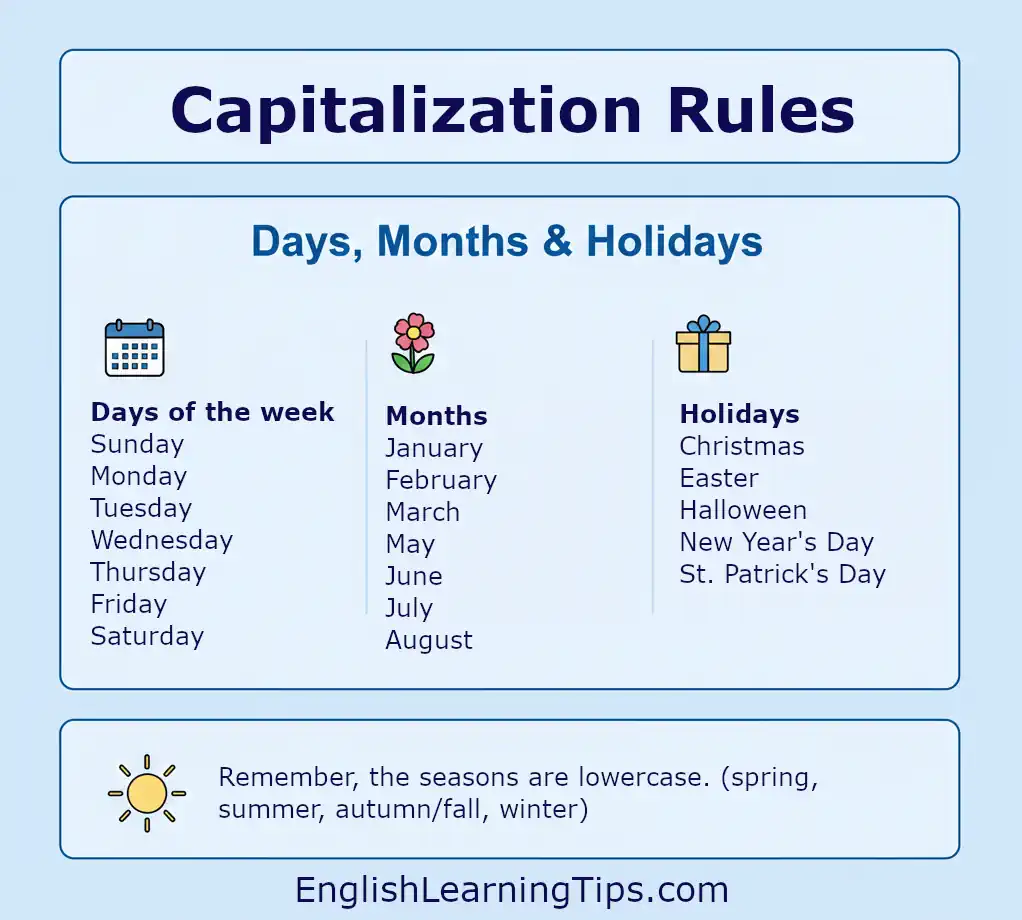
4. Days, months, and holidays
While seasons (summer, winter) are generally lowercase, specific calendar units are not.
- Example: Monday, January, Christmas, Ramadan.
5. Compass directions and regions
This is a common area for mistakes. Only capitalize directions when they refer to a specific geographic region.
- Capitalize: We are traveling to the South of France.
- Lowercase: Drive south for two miles.
6. Historical periods and major events
Major eras and specific historical events are considered proper nouns.
- Example: The Renaissance, the Great Depression, and World War II (WWII).
7. Religions, deities, and sacred texts
Capitalize the names of religions, their followers, and their holy books.
- Example: Christianity, Islam, Buddhism, the Bible, the Quran.
8. Languages and nationalities
Always capitalize the names of languages and the countries or ethnic groups they originate from.
- Example: He speaks Spanish; she is American.
9. The pronoun “I”
Regardless of where it falls in a sentence, the first-person singular pronoun is always capitalized.
- Example: He told me that I should go.
10. First word in a quotation
Capitalize the first word of a quote if it is a complete sentence.
- Example: He said, “Hello, how are you?”
11. Salutations and closings
In letters or emails, capitalize the first word of the greeting and the closing.
- Example: Dear Mr. Smith; Sincerely.
How to handle capitalization after a colon
A frequent question in English grammar is whether to capitalize after a colon. Generally, you do not capitalize the word after a colon if it introduces a list or a phrase. However, if the colon is followed by a complete sentence, some style guides (like APA) recommend capitalization.
- List (Lowercase): I need three things: apples, bananas, and oranges.
- Complete sentence (Uppercase): There is only one way to succeed: Work hard.
Important notes on consistency and style guides
While these rules are standard, different style guides (AP, MLA, and Chicago) have slight variations, especially regarding titles and headers.
- Consistency: Always stay consistent within a single document. We often call this parallelism in writing.
- Style guides: If writing for a specific publication, check their preferred manual to ensure your capitalization is perfect. Read our article on the style guides to help you determine which to use (including American and British English).
Pro tip: Are you using a style guide to help you write? Support this website by checking out the latest editions of the AP Stylebook or The Chicago Manual of Style.
Hidden rules: Proper nouns that stay lowercase
Most people think proper nouns are always capitalized, but there are several exceptions that even advanced writers miss.
1. Genericized trademarks
Some brands became so successful that their names became synonymous with the product itself. Over time, many style guides began to lowercase these words when they refer to the general item rather than the specific brand.
- aspirin (originally a trademark by Bayer)
- escalator (originally a brand name by Otis)
- thermos (originally a brand name by Thermos LLC)
- dry ice (originally a trademark by Dry Ice Corporation of America)
2. Eponyms (Words derived from names)
When a person’s name is turned into a common noun, verb, or adjective, the capitalization often disappears.
- pasteurize (from Louis Pasteur)
- diesel (from Rudolf Diesel)
- macadam (from John McAdam)
- boycott (from Captain Charles Boycott)
3. Biological species names
In scientific writing, the rules for binomial nomenclature are strict. While the Genus (the first word) is always capitalized, the specific epithet (the second part of the name) is always lowercase, even if it is derived from a proper noun or a person’s name. Scientific names should also be italicized.
- Example: Homo sapiens (The second word is always lowercase).
- Example: Magnolia hodgsonii (Even though “Hodgson” is a proper name, the species epithet remains lowercase).
4. Brand-mandated lowercase
Some modern companies use lowercase letters as a stylistic choice for their official brand identity. While many style guides suggest capitalizing them in formal text (e.g., “Adidas”), the brands themselves often prefer the lowercase version.
- adidas
- ebay
- intel
- amazon (specifically in their logo)
Common pitfalls: “Almost” proper nouns
Google users frequently search for these “borderline” cases. Use this table to clear up any confusion for your readers.
| Use this (Proper) | Not this (Common) | The Rule |
| History 101 | history class | Use caps for the specific course name. |
| Coke | a cola | Capitalize the brand, lowercase the drink type. |
| The North | driving north | Capitalize the region, lowercase the direction. |
| Aunt Sarah | my aunt | Capitalize as a title; lowercase as a relation. |
Frequently asked questions about capitalization
Videos to help you learn
Eight capitalization rules you should know
This is a quick video to give you the basics of capitalization.
Capitalization rules by Sparkle English
This is a longer, more in-depth guide to learning capitalization
The ultimate English capitalization quiz
- Which of the following sentences uses the correct capitalization for a professional title? A) The President will arrive at noon. B) My Cousin is a doctor in Chicago. C) I spoke with Professor Higgins yesterday. D) Both A and C are correct.
- When should you capitalize compass directions like “north” or “west”? A) Whenever they follow a preposition. B) Only when they refer to a specific geographic region. C) Every time you use them. D) Never; they are always lowercase.
- Which sentence correctly handles capitalization after a colon? A) I have one goal: To win the race. B) She bought three fruits: Apples, Oranges, and Grapes. C) The rule is simple: always wear a helmet. D) Both A and C can be correct depending on the style guide.
- Which of these is a properly capitalized title of a book? A) The Catcher In The Rye B) The Catcher in the Rye C) the Catcher in the Rye D) The catcher in the rye
- Are the seasons of the year (spring, summer, fall, winter) capitalized? A) Yes, always. B) Only if they start a sentence. C) Only when used in a poem. D) Yes, if they are part of a proper name like “Winter Olympics.”
- Identify the correctly capitalized sentence: A) I am studying history, French, and Calculus. B) I am studying History, French, and calculus. C) I am studying history, French, and calculus. D) I am studying History, French, and Calculus.
- Which of the following should not be capitalized? A) Days of the week B) Names of deities C) General job titles (e.g., “the manager”) D) Nationalities
- What is the rule for capitalizing the first word of a quotation? A) Always capitalize it. B) Only capitalize it if the quote is a complete sentence. C) Never capitalize it. D) Only capitalize it if it follows a comma.
- Which historical period is capitalized correctly? A) the Middle ages B) The middle ages C) The Middle Ages D) the middle Ages
- True or False: The pronoun “I” is only capitalized at the beginning of a sentence. A) True B) False
Answer key
- D (Specific titles before names and high-ranking officials are capitalized.)
- B (Directions are lowercase; regions like “the Midwest” are uppercase.)
- D (Style guides vary; if it’s a complete sentence, it often gets a capital letter.)
- B (Articles and prepositions in the middle of titles stay lowercase.)
- D (Seasons are common nouns unless they are part of a specific proper name.)
- C (Only languages are proper nouns; other school subjects stay lowercase.)
- C (Job titles are lowercase when used generally without a name.)
- B (Only capitalize the start of a quote if it’s a full sentence.)
- C (Major historical eras are treated as proper nouns.)
- B (The pronoun “I” is always capitalized in English.)
Conclusion: Mastering your capitalization skills
Mastering capitalization rules in English does not happen overnight, but with practice, it becomes second nature. These guidelines are not just about following tradition—they help your writing flow, highlight important ideas, and ensure your meaning is clear. By staying consistent and paying attention to context, you can use capitalization as a powerful tool to elevate your professional communication.
Whether you are writing a formal report or a quick social media update, remember that these small details make a big difference in how your audience perceives your message. Keep this guide bookmarked for those moments when you are unsure about a specific title or geographic region.
Join the conversation: What is your biggest grammar pet peeve?
Did any of these rules surprise you? We want to hear from you!
- Which capitalization rule do you find the most confusing?
- Is there a specific word you always struggle with?
Drop a comment below to share your thoughts or ask a question. If you found this guide helpful, share it with a friend or colleague who wants to sharpen their writing skills. Let’s help everyone write with more confidence!
Discover more from English Learning Tips
Subscribe to get the latest posts sent to your email.


