
The four types of sentences: An English grammar guide

If you’ve ever been told your writing is “choppy” or “too aggressive,” you might be using the wrong sentence types. In English grammar, how you structure a thought—whether as a statement, a question, or a command—completely changes how people react to you.
1. Declarative sentences: Making statements
The declarative sentence is the most common type of sentence in the English language. Its primary purpose is to relay information, state facts, or express an opinion.
- Punctuation: Always ends with a period (.).
- Word order: Usually follows a subject-verb-object (SVO) pattern.
Declarative sentence examples:
- The sun sets in the west. (Fact)
- I believe chocolate ice cream is the best flavor. (Opinion)
Most of your writing should be declarative. It builds trust by providing clear, direct information without fluff.
2. Interrogative sentences: Asking questions
Interrogative sentences are used to request information or seek clarification. These sentences typically begin with “wh-” words (who, what, where, when, why) or auxiliary verbs (do, can, will).
- Punctuation: Always ends with a question mark (?).
- Function: Directs a specific inquiry toward a listener or reader.
Interrogative sentence examples:
- Where is the nearest library?
- Did you finish the report on time?
3. Imperative sentences: Giving commands
An imperative sentence tells someone to do something. This can range from a friendly request or an instruction to a stern command. Notice that you don’t usually see the word “you” in these. When you tell someone to “sit down,” the “you” is understood—making the sentence short, punchy, and direct.
- Punctuation: Ends with a period (.) or an exclamation mark (!) for added urgency.
- Tone: Can be polite, neutral, or forceful.
Imperative sentence examples:
- Please pass the salt. (Request)
- Turn left at the next intersection. (Instruction)
- Stop talking! (Command)
4. Exclamatory sentences: Expressing emotion
Exclamatory sentences communicate strong feelings, such as surprise, anger, joy, or excitement. While they convey similar information to declarative sentences, the emphasis is much higher.
- Punctuation: Always ends with an exclamation mark (!).
- Usage note: Overusing these in professional writing can make the tone seem unprofessional.
Exclamatory sentence examples:
- I can’t believe we won the game!
- What a magnificent sunset that is!
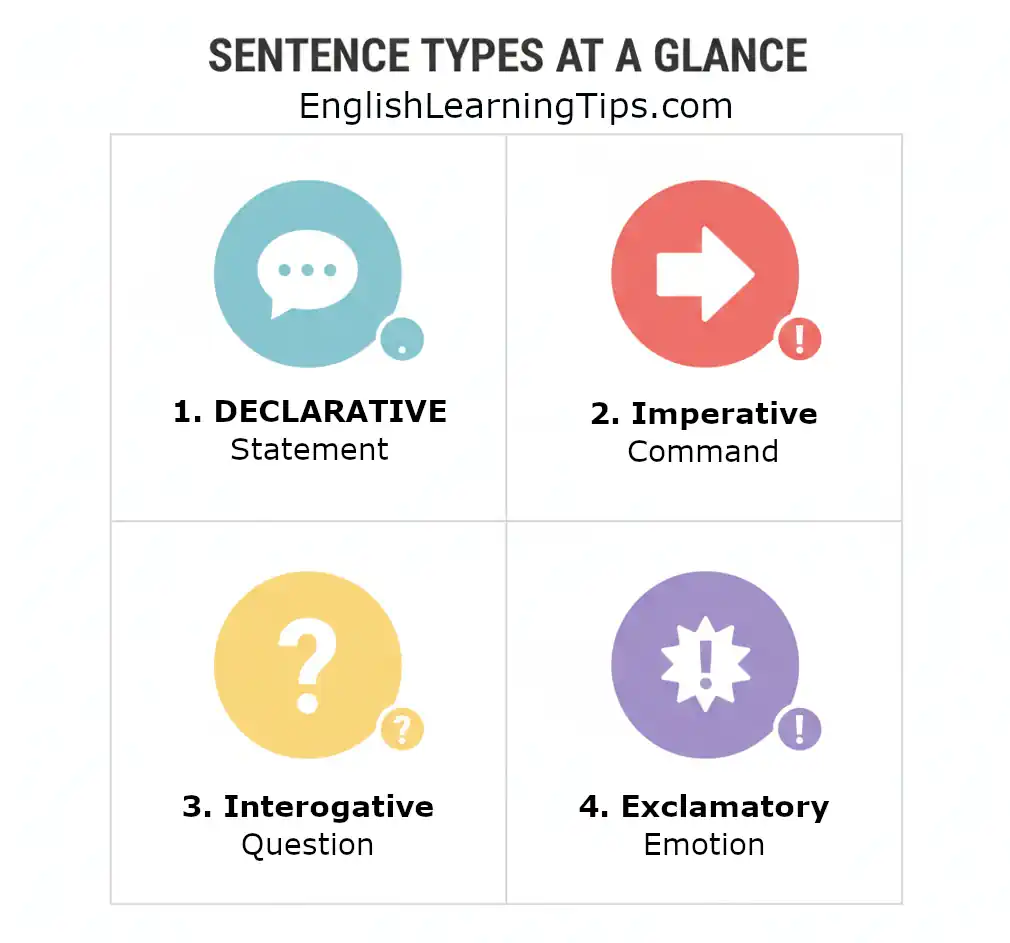
Comparison of sentence types at a glance
| Sentence type | Purpose | Ending punctuation | Example |
| Declarative | Statement / Fact | Period (.) | The cat is sleeping. |
| Interrogative | Question | Question mark (?) | Is the cat sleeping? |
| Imperative | Command / Request | Period or Exclamation (. or !) | Wake up the cat. |
| Exclamatory | Strong emotion | Exclamation mark (!) | That cat is so cute! |
Frequently asked questions about sentence types
Visual tools to help you learn
The four types of sentences
This video will help you understand declarative, interrogative, imperative, and exclamatory sentences.
A six-step process for making better sentences
John Fox walks you through six steps to help improve your sentences.
Expert tips: 12 ways to write better sentences
These twelve tips by novel editor Ellen Brock will help you polish your writing skills.
Conclusion: Mastering the four types of sentences
Understanding the four types of sentences and their syntax is more than just a grammar exercise; it is the key to becoming a more versatile and persuasive writer. By strategically mixing declarative statements, interrogative questions, imperative commands, and exclamatory remarks, you can control the pace and tone of your writing to better connect with your audience.
Whether you are drafting a professional email, writing a creative story, or preparing a presentation, remember that your choice of sentence type dictates how your message is received.
Mastering the types is only half the battle. To truly improve your flow, you need to know how to combine them. Check out our deep dive into the four basic sentence structures to see how simple and complex sentences work together.
Join the conversation
Which of the four sentence types do you find hardest to use in formal writing? Or do you have a tricky example of an indirect question you’re unsure how to punctuate?
Leave a comment below with your thoughts or questions! If you found this guide helpful, share it with a friend or colleague who wants to sharpen their English grammar skills.
Discover more from English Learning Tips
Subscribe to get the latest posts sent to your email.


