


The four basic sentence structures in English: A complete guide

Good writing isn’t just about what you say; it’s about how you build it. While most people focus on sentence types (like questions or statements), it’s the structure—how you organize your clauses—that determines if your reader stays with you or gets lost.”
Mastering these four patterns allows you to break down complex texts, identify main ideas, and vary your writing style to keep readers engaged.
Why sentence structure matters for clarity
Without a varied structure, your writing sounds like a robot (too many simple sentences) or a legal contract (too many complex ones). Learning these four structures helps you strike the right balance and allows you to analyze how writers use language to persuade or inform, making you a more critical reader and a more effective communicator.
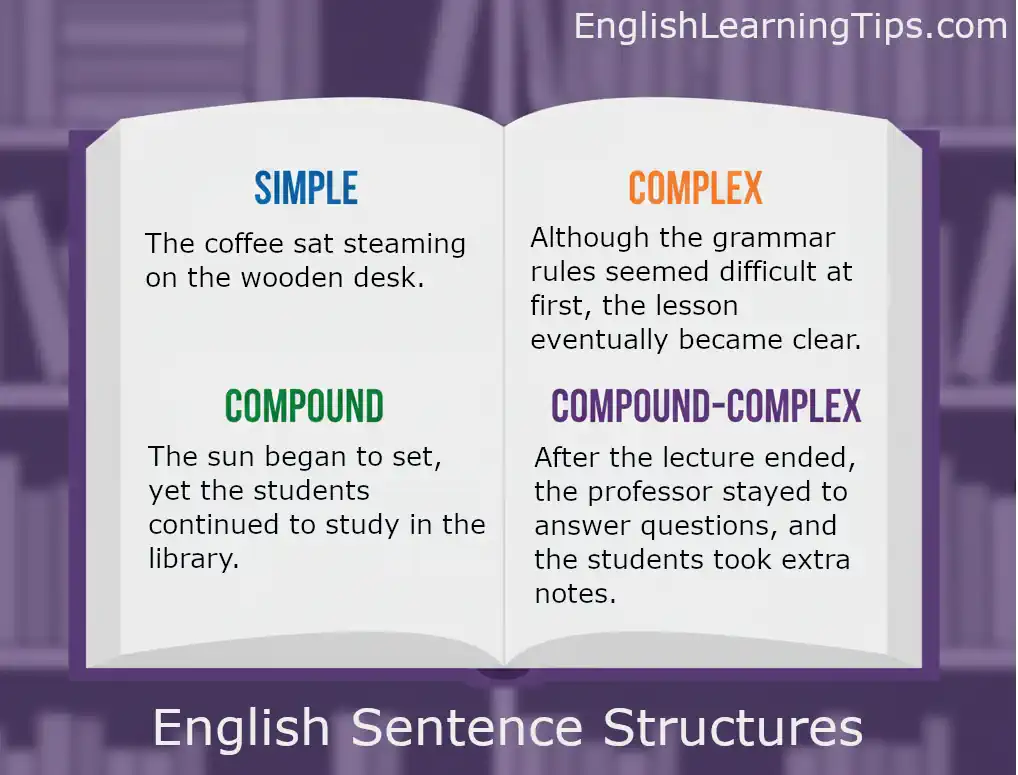
The four types of sentence structure
Every English sentence falls into one of these four categories based on the number and type of clauses it contains.
1. Simple sentence
A simple sentence consists of a single independent clause. This means it has a subject and a verb and expresses a complete thought. Despite the name, simple sentences can include prepositional phrases or compound subjects.
- Structure: 1 Independent Clause
- Example: The dog barked loudly.
Pro-tip: Don’t let the name fool you—a simple sentence can be quite long if it has multiple subjects or objects.
2. Compound sentence
A compound sentence joins two or more independent clauses. These are typically connected by a coordinating conjunction (FANBOYS: for, and, nor, but, or, yet, so) or a semicolon.
- Structure: 2+ Independent Clauses
- Example: The dog barked loudly, and the cat hissed back.
3. Complex sentence
A complex sentence contains one independent clause and at least one dependent clause (also known as a subordinate clause). Dependent clauses begin with subordinating conjunctions like because, although, if, or since.
- Structure: 1 Independent Clause + 1+ Dependent Clauses
- Example: Because the dog barked loudly, the cat hissed back.
4. Compound-complex sentence
This is the ‘heavy lifter’ of English grammar. It handles complex logic by combining the features of both compound and complex sentences.
- Structure: 2+ Independent Clauses + 1+ Dependent Clauses
- Example: Because the dog barked loudly, the cat hissed back, and the bird flew away.
Sentence structure comparison table
| Sentence type | Independent clauses | Dependent clauses | Connection method |
| Simple | 1 | 0 | N/A |
| Compound | 2 or more | 0 | Coordinating conjunction or semicolon |
| Complex | 1 | 1 or more | Subordinating conjunction |
| Compound-complex | 2 or more | 1 or more | Both coordinating and subordinating |
Common questions about English sentence structure
Visual tools to help you learn sentence types
Simple, compound, complex, compound-complex sentences
6-step formula for writing better sentences
Building more fluid sentences
Conclusion: Putting sentence structure into practice
You don’t need to think about these labels every time you pick up a pen. But once you understand how they work, you’ll start noticing them everywhere—in the books you read and the speeches you hear. Use that awareness to break out of repetitive writing habits. By varying your use of simple, compound, complex, and compound-complex sentences, you can control the “musicality” of your prose. Short sentences provide punch and clarity, while longer, nested structures allow for nuance and sophistication.
Whether you are preparing for an English proficiency exam or simply want to sound more professional in your daily emails, recognizing these patterns is the first step toward total language fluency.
Join the conversation: Which structure do you find hardest?
We want to hear from you! Is the compound-complex sentence still giving you trouble, or do you have a trick for remembering your subordinating conjunctions?
- Leave a comment below with an example of a complex sentence you’ve written today—we’ll let you know if you nailed it!
- Share this guide with a fellow student or colleague who is working on their writing skills.
Your feedback helps us create better resources for the English learning community. For more tips on mastering English grammar and syntax, be sure to bookmark this page.
Discover more from English Learning Tips
Subscribe to get the latest posts sent to your email.


