

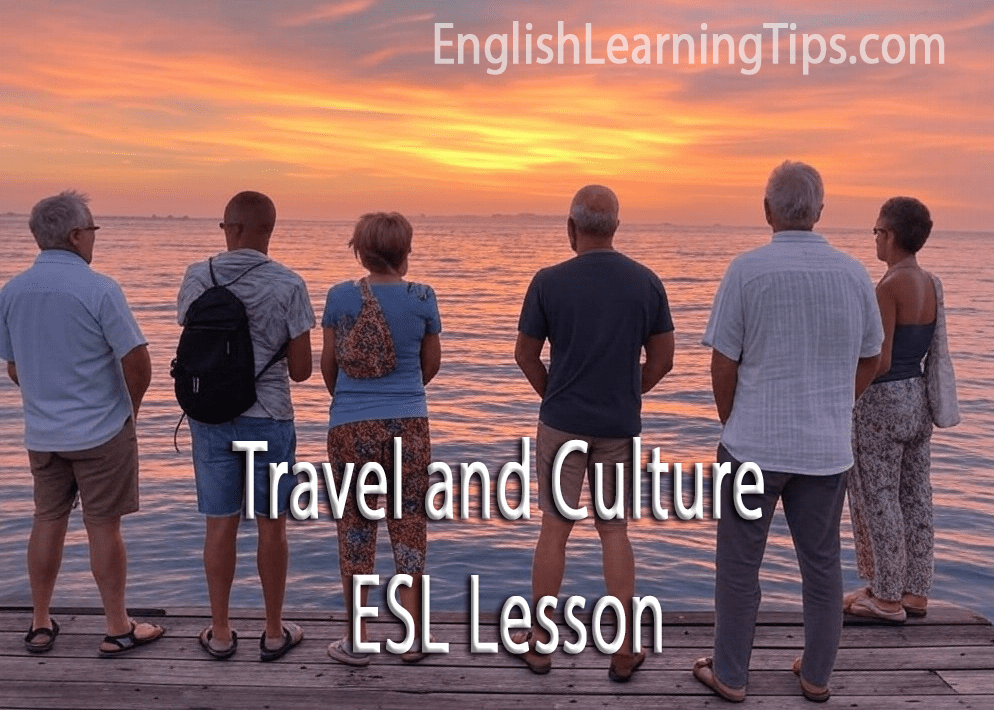
Travel and culture: An advanced ESL lesson plan for global citizens

Travel is more than just checking off a bucket list; it is a deep dive into different ways of life, histories, and languages. For an English as a second language (ESL) learner, exploring intercultural communication and travel ethics is a powerful way to move from intermediate to advanced fluency.
This lesson plan focuses on the intersection of tourism and sociology, helping students navigate cross-cultural encounters with sensitivity and sophisticated vocabulary.
Why study travel and culture in ESL?
- Cultural sensitivity: Develop the ability to respect diversity in a globalized workforce.
- Practical communication: Learn how to handle real-world social norms and cultural exchanges.
- Advanced vocabulary: Move beyond “nice” and “pretty” to words like picturesque, indigenous, and ethnocentrism.
- Level: Advanced (C1-C2)
- Duration: 60-90 minutes
- Focus: Vocabulary & grammar.
Lesson objectives and core competencies
By the end of this session, students will be able to:
- Analyze cultural differences and their direct impact on the travel experience.
- Apply advanced travel vocabulary in professional and casual contexts.
- Discuss hypothetical travel scenarios using the second conditional.
- Evaluate ethics in tourism, specifically regarding cultural appropriation and local impact.
Articles for pre-class reading
- Travel is said to increase cultural understanding. Does it?
- Travels Through Culture: Understanding Its Influence on Tourism
- The ethics of cultural heritage and tourism
Essential travel and culture vocabulary
Use this table to master high-level terms often found in travel literature and sociological discussions.
| Term | Part of speech | Definition | Example sentence |
| Ethnocentrism | Noun | Evaluating other cultures based on one’s own standards. | Overcoming ethnocentrism is key to enjoying a truly authentic travel experience. |
| Sojourn | Noun | A temporary stay in a specific place. | Her three-month sojourn in Kyoto changed her perspective on Zen. |
| Breathtaking | Adjective | Extremely beautiful or astonishing. | The view from the Andes was utterly breathtaking. |
| Indigenous | Adjective | Originating or occurring naturally in a particular place. | We should support businesses owned by indigenous communities. |
| Itinerary | Noun | A planned route or journey. | Our itinerary includes stops in both urban centers and remote villages. |
| Homogeneous | Adjective | Consisting of parts or people that are all the same or similar. | Japan is often described as a linguistically homogeneous society. |
| Mores | Noun | The essential customs and conventions of a community. | One must respect the social mores of the host country. |
Vocabulary for extension
Here are 10 additional high-level vocabulary words.
| Term | Part of speech | Definition |
| Auspicious | Adjective | Conducive to success; favorable; often used regarding the timing of cultural rituals. |
| Commodification | Noun | The action of treating something (like a culture or tradition) as a mere product to be bought and sold. |
| Cosmopolitan | Adjective | Familiar with and at ease in many different countries and cultures. |
| Diaspora | Noun | The dispersion or spread of any people from their original homeland. |
| Gastro-tourism | Noun | Travel specifically intended to explore the food and drink of a specific region. |
| Global-mindedness | Noun | The ability to understand and appreciate the interconnectedness of the world. |
| Inherent | Adjective | Existing in something as a permanent, essential, or characteristic attribute. |
| Parochial | Adjective | Having a limited or narrow outlook or scope; the opposite of cosmopolitan. |
| Pilgrimage | Noun | A journey, often to an unknown or foreign place, where a person goes in search of new or expanded meaning. |
| Sustainability | Noun | The ability to maintain tourism without depleting local resources or harming the environment. |
Step-by-step class activities
1. Warm-up: The “Why” of travel
Begin with a discussion on recent trips or bucket-list destinations. Ask the student: “Does travel actually increase cultural understanding, or does it just reinforce stereotypes?”
2. Vocabulary enrichment
Introduce the terms from the table above. Focus on the distinction between a “tourist” and a “traveler.” Discuss the nuances of cultural assimilation versus multiculturalism.
3. Cultural comparison analysis
Compare two contrasting environments (e.g., the “hustle culture” of New York City vs. the “slow living” of rural Tuscany).
- Task: How do these differences affect the way a traveler should behave?
4. Grammar focus: Modals and hypotheticals
Practice using the second conditional to discuss dream travel or “what if” scenarios.
- Structure: If + past simple, would + verb
- Example: “If I had a year off, I would circumnavigate the globe.”
Frequently asked questions about travel and culture
Travel and culture: Vocabulary and grammar check
Part 1: Vocabulary in context. Choose the best word to complete each sentence.
- After a long flight from London to Tokyo, Sarah suffered from severe __________, making it hard to stay awake during the welcome dinner.
- A) Sojourn
- B) Jet lag
- C) Itinerary
- D) Mores
- To truly understand a destination, one must look past their own __________ and try to see the world through the eyes of the locals.
- A) Ethnocentrism
- B) Expedition
- C) Odyssey
- D) Confluence
- The view of the sunrise over the Himalayas was absolutely __________, leaving the entire group of hikers in silence.
- A) Secular
- B) Homogeneous
- C) Breathtaking
- D) Contemporary
- Before you visit a religious site, you should research the local __________ to ensure you are dressed appropriately.
- A) Layovers
- B) Enclaves
- C) Mores
- D) Expeditions
- Many travelers prefer to visit __________ villages rather than crowded tourist hubs to find a more authentic way of life.
- A) Remote
- B) Transcontinental
- C) Diverse
- D) Multicultural
Part 2: Grammar and structure. Select the correct grammatical form based on the lesson rules.
- If I __________ more money, I would circumnavigate the globe next year.
- A) Have
- B) Will have
- C) Had
- D) Am having
- In this culture, you __________ eat with your left hand; it is considered a significant social taboo.
- A) Ought to
- B) Mustn’t
- C) Should
- D) Might
- After months of planning, the team finally decided __________ the Sahara Desert.
- A) Traverse
- B) Traversing
- C) To traverse
- D) Traversed
- If she lived in a more __________ society, she might find the diversity of New York City overwhelming.
- A) Homogeneous
- B) Picturesque
- C) Exotic
- D) Indigenous
- Travelers should avoid __________ photos during the sacred ritual out of respect for the participants.
- A) To take
- B) Taking
- C) Take
- D) Taken
Answer key
| Question | Correct answer | Rule/Definition |
| 1-5 | B, A, C, C, A | Contextual vocabulary |
| 6-10 | C, B, C, A, B | Grammar & usage |
Conclusion: Bridging the gap through travel and language
Mastering the intersection of travel and culture is a lifelong journey that goes far beyond memorizing an itinerary. By developing cultural sensitivity and expanding your advanced vocabulary, you transform from a passive observer into a global citizen. Whether you are navigating a sojourn in a remote village or practicing cross-cultural communication in a bustling metropolis, your ability to adapt to local mores is what truly defines a successful traveler.
English is the tool that unlocks these experiences, allowing you to move past ethnocentrism and embrace the beautiful diversity of our world. As you continue to explore and venture into the unknown, remember that the most profound discoveries aren’t just found on a map, but in the connections we make with people from different walks of life.
Join the conversation: What is your travel story?
We want to hear from you! Sharing your experiences helps other ESL learners build their confidence and cultural awareness.
- What is one cultural taboo you’ve encountered while traveling?
- If you could circumnavigate the globe tomorrow, which three countries would be on your must-visit list?
Leave a comment below with your thoughts or a “dream” travel sentence using the second conditional (If / would). If you found this lesson plan helpful for your studies or your classroom, please share it with a fellow traveler or teacher!
Discover more from English Learning Tips
Subscribe to get the latest posts sent to your email.


