

How to teach ESL to children: 13 Proven strategies for success

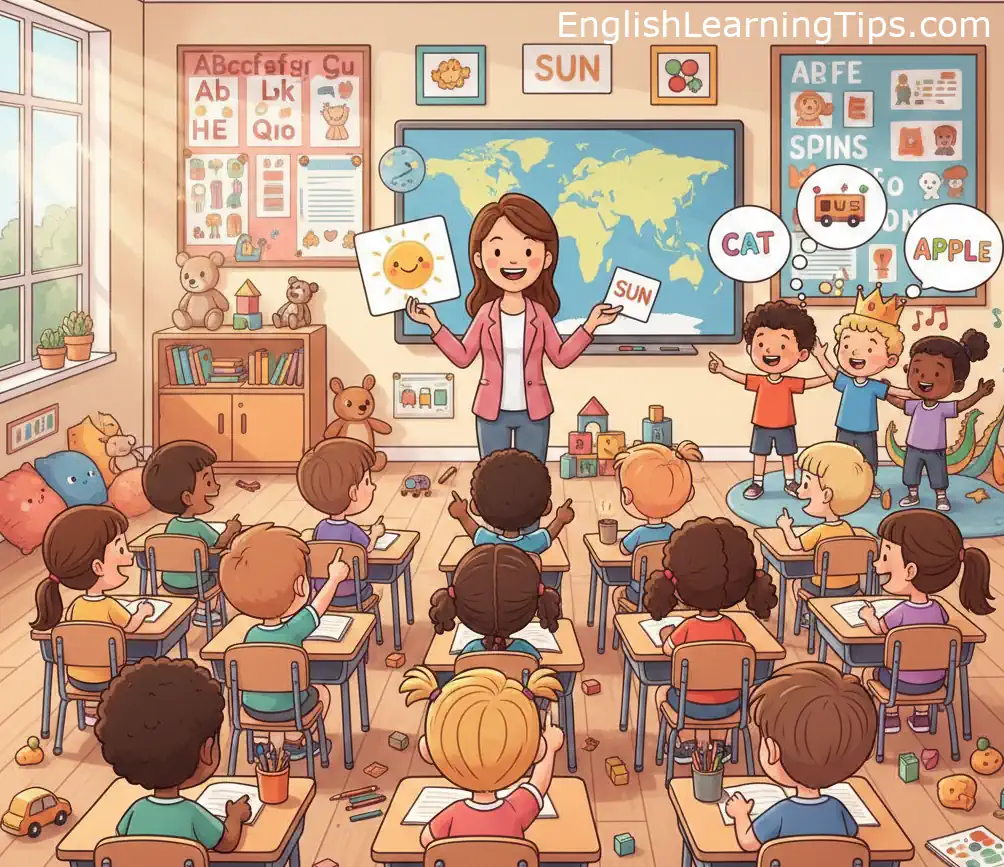
Teaching English as a Second Language (ESL) to children is a rewarding journey that requires a different toolkit than teaching adults. Teaching kids is a blast but requires a thick skin,” or “Your classroom toolkit. While adults often focus on grammar rules and professional utility, children acquire language through play, rhythm, and sensory experiences. To keep young learners engaged, you must balance structured lessons with high-energy activities.
The following strategies will help you build a classroom environment where students feel confident enough to take risks and have fun while learning.
Use visual aids and realia to bridge the gap
Children are naturally visual learners. When you use abstract words, they may struggle to connect the sound to the meaning. Realia (real-life objects) and visual cues provide an immediate context.
- Flashcards: Use vibrant images for nouns and emotions.
- Props: Bring in actual fruit, toys, or clothing to make lessons tangible.
- Digital media: Short, educational videos or interactive apps can reinforce concepts for a generation raised on screens.
Have you tried reusable flashcards? Save on your long-term budget and try some dry-erase flash cards.
Incorporate songs, rhymes, and music
Music is a powerful mnemonic device. The rhythm and melody help children memorize sentence structures and vocabulary without feeling like they are “studying.”
- Action songs: Songs like “Head, Shoulders, Knees, and Toes” teach anatomy and following directions.
- Phonics rhymes: Use chants to help students master difficult English pronunciations and the natural cadence of the language.
Make it fun with games
If a child is playing, they aren’t worried about making mistakes. Turning a lesson into a challenge increases participation and retention.
| Game type | Skill targeted | Example activity |
| Movement | Listening & Verbs | Simon says |
| Observation | Vocabulary & Colors | I spy |
| Deduction | Sentence Structure | 20 Questions |
| Creativity | Practical Speaking | Role-playing (At the grocery store) |
Master the art of storytelling
Storytelling fosters creativity and extends a child’s attention span. Use books with repetitive phrases so children can “predict” the next line. This builds confidence as they “read” along with you. After the story, encourage them to retell a portion or draw their favorite scene to practice comprehension.
Implement total physical response (TPR)
Total physical response is a method where students respond to language with body movements. This is particularly effective for “kinesthetic” learners who need to move to stay focused. For example, when teaching the verb “jump,” have the entire class jump. This physical connection creates a stronger neural pathway for memory than simply reading the word.
Create a safe and low-anxiety environment
A child’s “affective filter”—the emotional barrier to learning—must be low for them to speak.
- Normalize mistakes: Treat errors as a natural part of the process.
- Praise effort: Focus on their willingness to participate rather than perfect grammar.
- Minimize distractions: Especially in online ESL teaching, ensure the background is clean and the student’s environment is quiet.
Use real-life contexts and field trips
Context is the bridge between a “memorized sound” and a “meaningful word.” Instead of teaching isolated vocabulary lists, focus on functional language—the words children actually need to navigate their world. Whether you are in a brick-and-mortar classroom or teaching via a webcam, bringing the “real world” into the lesson is vital for retention.
Strategies for the physical classroom
- Campus scavenger hunts: Take the students on a “field trip” around the school. Teaching the word “tree” while standing under one, or “swing” while at the playground, is far more effective than a 2D drawing.
- The “magic bag” of realia: Bring a physical bag of household items (a spoon, a brush, a toy car). Let students touch and use the objects as they name them.
Strategies for the online ESL classroom
- Digital “show and tell”: Ask students to run and find something “blue” or “soft” in their own room. This uses their home as a living laboratory, making the English language feel relevant to their personal space.
- Virtual field trips: Use screen-sharing to navigate Google Earth or 360-degree YouTube videos. “Visit” a zoo or a supermarket together. This mimics the immersion of a real trip while staying within the digital platform.
- Augmented reality (AR) filters: Use apps like Snap Camera or built-in platform filters to “transport” yourself and the student to different environments, like underwater or into outer space, to teach themed vocabulary.
Why context reduces the “affective filter”
When a child interacts with a real object, their brain focuses on the task rather than the stress of the language. This lowered anxiety allows for more natural acquisition. By moving the lesson beyond the desk, you turn “studying” into “exploring.”
Apply repetition with variation
Children need to hear a word dozens of times before it sticks, but boredom is the enemy of learning. The trick is to repeat the content while changing the activity. You might use flashcards for a word on Monday, a song on Tuesday, and a game on Wednesday.
Encourage peer-to-peer interaction
While the teacher is the guide, children often learn best from one another. Use pair work or small group activities to encourage “student talk time.” This reduces the pressure of performing for the teacher and allows for more natural, conversational English practice.
Adapt to different learning styles
No two children learn the same way. A successful ESL lesson should appeal to:
- Visual learners: Pictures, charts, and demonstrations.
- Auditory learners: Listening exercises, stories, and songs.
- Kinesthetic learners: Movement, TPR, and hands-on crafts.
Partner with parents for consistent progress
For young learners, the classroom shouldn’t be the only place they hear English. Encourage parents to integrate simple English phrases into daily routines, such as mealtime or bedtime. In online learning, parental support is vital for technical setup and maintaining a focused atmosphere.
Feedback and assessment
Provide positive, constructive feedback. Assess regularly but keep assessments fun and educational, like through games or storytelling.
Cultural sensitivity
Be aware of cultural differences that might affect language learning and classroom behavior. Respect and incorporate elements of the children’s cultures into your teaching. Ultimately, you want to create an environment where all children will feel both welcomed and valued.
Frequently asked questions about teaching ESL to kids
Comparison of ESL teaching methods for kids
| Method | Best for… | Key tool |
| Total Physical Response (TPR) | Beginners & Active kids | Body movement / Gestures |
| Gamification | Building Motivation | Point systems / Digital badges |
| CLIL (Content & Language) | Older or Advanced kids | Science or Art projects |
| Phonics-Based | Reading and Writing | Letter sounds / Flashcards |
Final thoughts: Making English stick for young learners
Teaching ESL to children is less about the “perfect” lesson plan and more about the connection you build through energy and empathy. By blending Total Physical Response (TPR) with a safe, playful environment, you provide students with the confidence to transition from the “silent period” to active conversation. Whether you are a veteran teacher or just starting your TEFL journey, your adaptability is your greatest asset.
Remember, the goal isn’t just to teach a language—it is to inspire a lifelong curiosity about the world.
Join the conversation: What works in your classroom?
We want to hear from the experts in the trenches! Every classroom is different, and your unique “teacher hacks” could be exactly what another educator needs today.
- What is your “go-to” game for a student who is having a bad day?
- Do you have a favorite song or prop that never fails to get a laugh?
- What’s one challenge you’re currently facing in your ESL lessons?
Drop a comment below to share your tips, and if you found these strategies helpful, share this article with your fellow teachers on LinkedIn, Facebook, or Pinterest. Let’s build a more supportive community for ESL educators together!
Discover more from English Learning Tips
Subscribe to get the latest posts sent to your email.


