


Medical doctor vocabulary: The comprehensive English guide

Whether you’re prepping for the USMLE Step 1 or communicating with an international surgical team, the right clinical vocabulary is often the difference between a smooth shift and a dangerous misunderstanding. As the primary language of international healthcare, English is the key to accessing groundbreaking research, collaborating with global peers, and providing high-standard patient care.
This guide on medical vocabulary for doctors is a specialized addition to our comprehensive English vocabulary library, designed to help you master English.
Why English proficiency is vital for medical professionals
Learning English for medicine is a strategic career move. English has become the primary language of the medical field for several key reasons:
- Access to medical resources: The vast majority of the world’s scientific literature and journals are published in English. Mastery is critical for deciphering scientific texts and keeping up with the latest medical news.
- Career development: Fluency opens doors to international hospitals and clinical practice in different countries, enhancing professional growth and global healthcare standards.
- Global communication: English is the standard for international medical conferences and research collaborations.
- Medical terminology: Many standardized medical terms are derived from English or Latin-English roots.
- Patient care: English serves as a “lingua franca” that lowers language barriers, preventing misunderstandings and promoting patient-centered care.
General medical terms
This categorized list includes definitions and examples to help you use these terms in daily practice.
Clinical descriptors
| Term | Definition | Example |
| Abnormal | Not normal; deviating from the standard. | The patient has an abnormal heart rate. |
| Acute | A condition that comes on suddenly and is severe. | The patient has acute pain in the lower back. |
| Chronic | A condition that lasts for a long time. | I have chronic back pain from an injury 10 years ago. |
| Benign (be-NINE) | A tumor or growth that is not cancerous. | The growth on her lungs was benign. |
| Malignant | A tumor that is cancerous and can spread (metastasize). | The lump was malignant; we will start radiation. |
| Fatal | Causing death or having the potential to cause death. | He was involved in a fatal car crash. |
Important note: While ‘acute’ and ‘chronic’ describe timing, don’t confuse them with severity. A patient can have a chronic condition that is stable, or an acute flare-up that is life-threatening.”
Patient management and pharmacy
- Appointment: A scheduled meeting with a healthcare professional.
- Analgesic: A drug used to relieve pain (e.g., Tylenol).
- Antibiotic: A medicine that destroys or inhibits microorganisms.
- Band-aid (US) / Sticking plaster (UK): A small adhesive bandage for minor cuts.
- Diagnosis: The identification of a disease or condition.
- Emergency: A situation where health is in immediate danger.
- ER (Emergency Room – US) / A&E (Accident & Emergency – UK): Specialized hospital department for urgent care.
- Follow-up: A subsequent appointment to check the progress of a treatment.
- Medical history: A comprehensive record of a patient’s past and present health.
- Medication: A drug used to treat a condition.
- Pharmacy / Drugstore (US) / Chemist (UK): A place to get a prescription filled.
- Prescription: A doctor’s written order for medication.
- Prognosis: The expected course or outcome of a disease.
- Symptom: A sign or indication of a disease.
- Treatment: The care given to cure or relieve a condition.
- Vaccine: A substance used to stimulate an immune response.
- Vital signs: Measurements of body functions (Temperature, Pulse, Respiration, Blood pressure).
Vital signs: Blood pressure
- Blood pressure: The force of blood against artery walls.
- Systolic pressure: The pressure when the heart beats (top number).
- Diastolic pressure: The pressure when the heart rests (bottom number).
Recommended clinical gear for students
The right equipment helps making patient diagnosis much easier.
- The All-Rounder: 3M Littmann Classic III Monitoring Stethoscope – The industry standard for students.
- The Premium Choice: 3M Littmann Cardiology IV – Better acoustics for hearing complex heart murmurs.
- The Budget Pick: MDF Instruments Acoustica Deluxe – Great for beginners on a budget.
Detailed guide to fractures and bone injuries
Precision in describing fractures is vital for orthopedic documentation.
Types of bone fractures
Precision in describing fractures is vital for orthopedic documentation and surgical planning.
- Broken / Fracture: General terms for a break in the bone.
- Bruise (n) / Bruised (adj): A contusion from ruptured blood vessels.
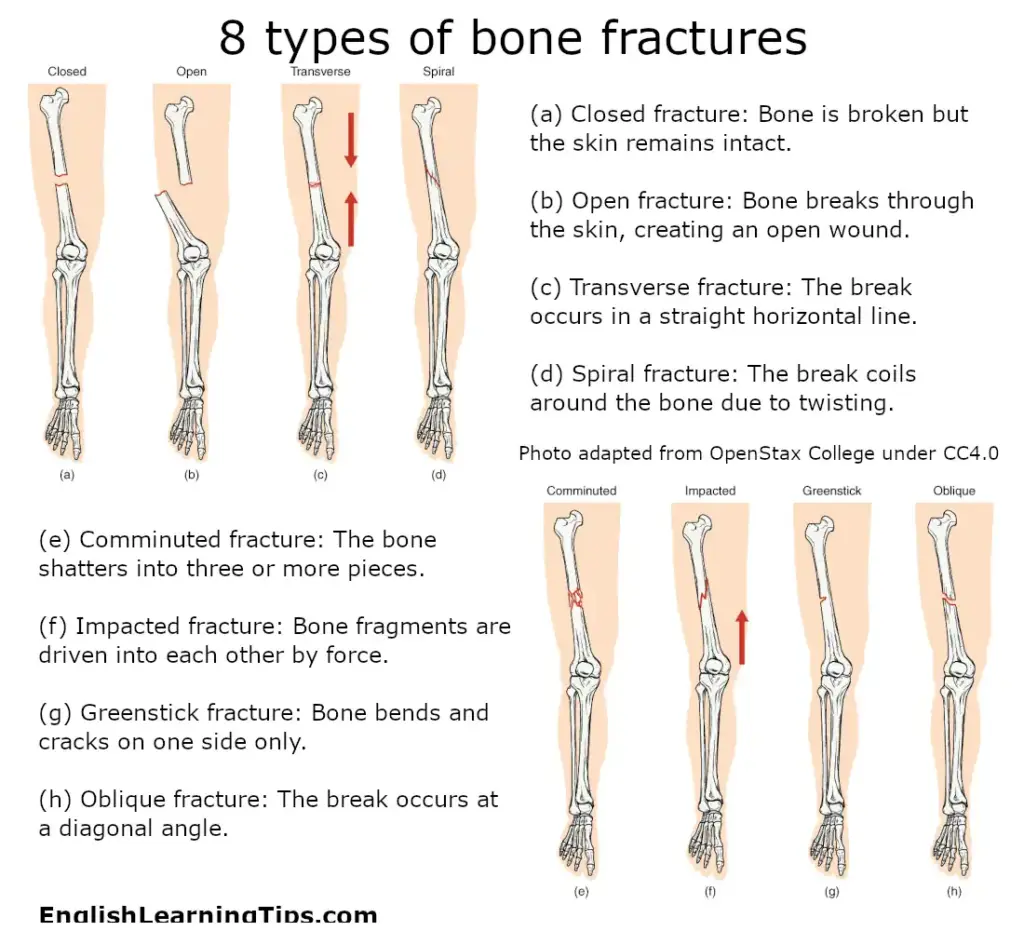
The following words match the graphic above.
- (a) Closed fracture: Bone is broken, but the skin remains intact.
- (b) Open fracture: Bone breaks through the skin, creating an open wound.
- (c) Transverse fracture: The break occurs in a straight horizontal line.
- (d) Spiral fracture: The break coils around the bone due to twisting.
- (e) Comminuted fracture: The bone shatters into three or more pieces.
- (f) Impacted fracture: Bone fragments are driven into each other by force.
- (g) Greenstick fracture: Bone bends and cracks on one side only.
- (h) Oblique fracture: The break occurs at a diagonal angle.
Body parts and systems
- Anatomy: The study of the structure of the body.
- Physiology (fiz-ee-OL-uh-jee): The study of the functions of the body.
- Artery: Carries oxygenated blood away from the heart.
- Vein: Carries blood towards the heart.
- Nerve: Fibers that transmit impulses to the brain or organs.
- Organ: A self-contained part of the body with a specific function.
- Tissue: A group of cells performing a specific function.
Mastering these systems requires visual memory. Many of our students use Netter’s Anatomy Flash Cards to quiz themselves on these terms during rotations
The 11 human organ systems
A doctor must be able to discuss all primary systems during a physical exam or review of systems (ROS).
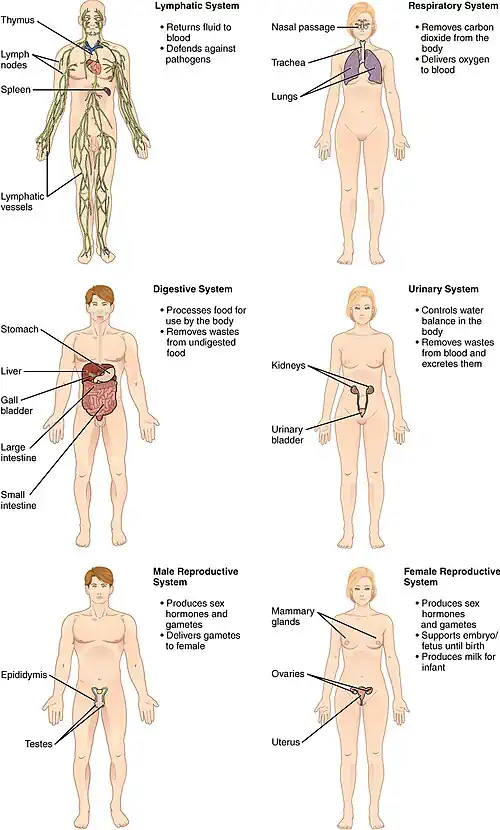
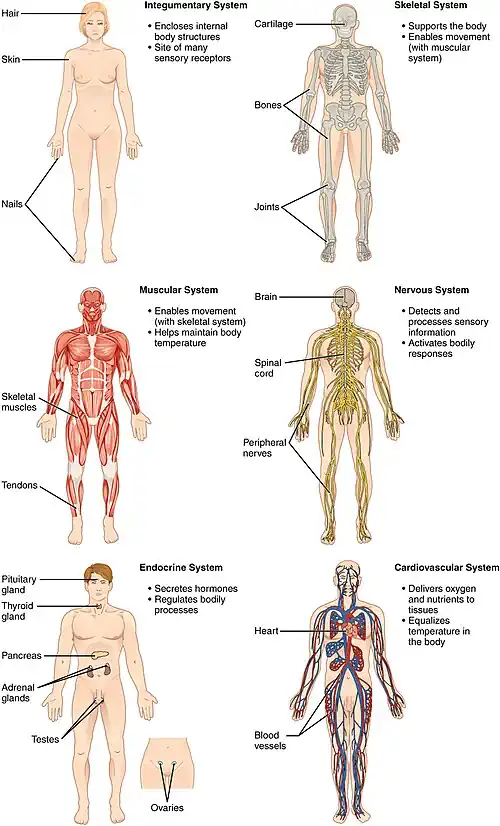
- Circulatory system (cardiovascular system): Includes the heart and blood vessels. It is responsible for circulating oxygen and nutrients.
- Respiratory system: Includes the lungs, trachea, and airways; facilitates gas exchange.
- Digestive system (Gastrointestinal/GI): Includes the stomach, intestines, liver, and gallbladder; handles nutrient absorption and waste.
- Nervous system: Includes the brain, spinal cord, and peripheral nerves; the body’s control center.
- Musculoskeletal system: The framework of muscles, bones, tendons, and joints that provides structure and movement.
- Endocrine system: The collection of glands (e.g., thyroid, pancreas, adrenals) that produce hormones to regulate metabolism and growth.
- Immune / Lymphatic system: The body’s defense network against infection, including the spleen, thymus, and lymph nodes.
- Urinary system (Renal): Includes the kidneys, ureters, and bladder; filters blood and removes liquid waste.
- Integumentary system: The skin, hair, and nails; the body’s first line of defense against the environment.
- Reproductive system: The organs involved in producing offspring.
- Hematologic system: Specifically refers to the blood and blood-forming tissues (bone marrow).
When performing an ROS (Review of Systems), doctors use these categories to screen for symptoms the patient might have missed. For example, under the Integumentary system, you might ask about new rashes or changes in mole color.
Diseases and conditions
- Allergy / Allergic: An immune response to a substance (e.g., penicillin). Anaphylaxis (ana·phy·lax·is /anəfəˈlaksəs) is a life-threatening reaction.
- Arthritis: Inflammation of the joints.
- Asthma: Chronic respiratory disease causing airway narrowing.
- Bacterial infection: Illness caused by bacteria, such as a staph infection.
- Cancer: Uncontrolled growth of abnormal cells.
- Cardiac arrest: When the heart abruptly stops beating.
- Cold: A viral infection of the upper respiratory tract.
- Cough: A reflex to clear the airways of irritants.
- Critical condition: A state where vital signs are unstable and life-threatening.
- Cyst: A sac-like structure filled with fluid or air.
- Dehydration: Occurs when the body loses more fluid than it takes in.
- Diabetes: Affects the body’s ability to use insulin (Type 1 and Type 2).
- Dislocated / Dislocation: When bones in a joint are forced out of position.
- Fever: Temporary increase in body temperature.
- Growth: An increase in size or mass (e.g., a growth on the kidney).
- Heart attack (Myocardial Infarction/MI): Blocked blood flow to the heart muscle.
- Hives (Urticaria): Itchy, raised welts on the skin.
- Hyperglycemia / Hypoglycemia: High vs. low blood sugar.
- Hypertension / Hypotension: High vs. low blood pressure.
- Inflammation: Redness, swelling, and pain in response to injury.
- Stroke: Interrupted blood flow to the brain (Ischemic, Hemorrhagic, or TIA).
- Tumor: An abnormal mass of tissue.
- Viral infection / Virus: Illness caused by a virus that replicates in host cells.
Medical procedures and tests
- Amputate / Amputation: Surgical removal of a limb.
- Biopsy: Removal of tissue for diagnostic examination.
- Blood test (Labs): Measuring substances in the blood.
- Blood count (CBC): Measures RBCs, WBCs, Platelets, Hemoglobin, and Hematocrit.
- Caesarean section (C-section)(see-ZAR-ee-an): Surgical delivery of a baby.
- CPR: Emergency chest compressions and breaths.
- Cast: A rigid device (usually plaster) to immobilize a bone.
- Chemotherapy (Chemo): Using drugs to destroy cancer cells.
- CT Scan: 3D X-ray imaging.
- MRI: Imaging using magnetic fields and radio waves.
- IV (Intravenous): Fluids or medicine delivered through a vein.
- Subcutaneous (Sub-Q): Injection into the fatty tissue below the skin.
- Life support: Technology to maintain essential functions (BLS, ALS, PALS).
- Surgery: An invasive procedure to repair or remove tissue.
- Therapy: Treatment intended to relieve or cure (e.g., physical therapy).
- X-ray: Imaging using electromagnetic radiation.
Additional healthcare terminology
- Ambulance: A vehicle for transporting the sick/injured.
- Anti-depressant: Medication for depression symptoms.
- Clinic: Facility for outpatient care.
- Crutches: Mobility aids for leg injuries.
- Doctor / Nurse / Patient: The primary roles in the clinical environment.
Frequently asked questions about medical English
Visual aids to help you learn
Whether you’re a nurse, respiratory therapist, or doctor, YouTube is a goldmine of resources for you to learn medical English. Here are some basic videos to help you on your learning journey. If you have questions, feel free to ask in the comments section.
Medical terminology made easy
Top Medical prefixes and terms you need to know
While she speaks a little quickly, remember you can adjust the playback speed.
50 advanced medical terms
These 50 medical vocabulary words will help you communicate effectively with your patients and colleagues.
Clinical case study: Emergency department triage
Scenario: A 58-year-old male is brought into the ER via ambulance after a fall from a ladder.
Part 1: Initial assessment
The nurse performs an initial assessment and records the following vital signs:
- Blood pressure: 155/95 mmHg (Hypertension).
- Heart rate: 112 bpm (Abnormal).
- Temperature: 37°C.
The patient presents with acute pain in his right lower leg. Upon inspection, the bone has pierced the skin, indicating an open fracture.
Part 2: Diagnostic procedures
The doctor reviews the patient’s medical history, noting Type 2 diabetes and chronic back pain. To assess the severity of the leg injury and check for internal head trauma, the following are ordered STAT:
- A portable X-ray of the right tibia/fibula.
- A CT scan of the head to rule out an intracranial bleed or stroke.
- Routine labs, including a CBC (complete blood count) to check the white blood cell count for potential infection.
Part 3: Treatment and prognosis
The X-ray confirms a comminuted fracture. Because the patient is hyperglycemic, the doctor orders IV saline and insulin before sending the patient to surgery. Post-operatively, the patient will require a cast and several months of physical therapy.
Interactive vocabulary check
Test your knowledge of the comprehensive guide above by answering these clinical questions:
1. Which term best describes the patient’s leg injury?
- A) Benign growth
- B) Open fracture
- C) Acute allergy
- D) Greenstick fracture
2. If the patient’s heart had stopped during the fall, which procedure would be initiated?
- A) Biopsy
- B) CPR
- C) Sub-Q injection
- D) Chemotherapy
3. What is the doctor’s “prognosis” in this case?
- A) The patient’s medical history.
- B) The scheduled surgery time.
- C) The predicted outcome and recovery path for the leg.
- D) The medication used to treat the pain.
Conclusion: Master the language of medicine
Fluency in English is a powerful tool that enhances your ability to save lives and advance the frontiers of science. While this glossary serves as a foundation, medical English is a vast and evolving field. Consistent practice with these terms—from understanding a comminuted fracture to documenting the circulatory system—is the key to clinical confidence in an international setting.
Share your thoughts and join the conversation
We want to hear from you! Healthcare is a global community, and your experience can help others.
- What terms did we miss? If there is a specific clinical term or abbreviation you use daily that isn’t on this list, let us know in the comments below.
- Have you had a “lost in translation” moment? Share a story about a time when a specific medical English term was challenging for you.
- Help a colleague: If you found this comprehensive guide helpful, please share it with your fellow IMGs, nurses, or residents who are working toward their international certifications.
I’ve updated this guide for 2026 clinical standards. If you are currently studying for the OET or IELTS, let me know in the comments which section you’d like me to expand on next—Cardiology or Neurology?
Discover more from English Learning Tips
Subscribe to get the latest posts sent to your email.


