

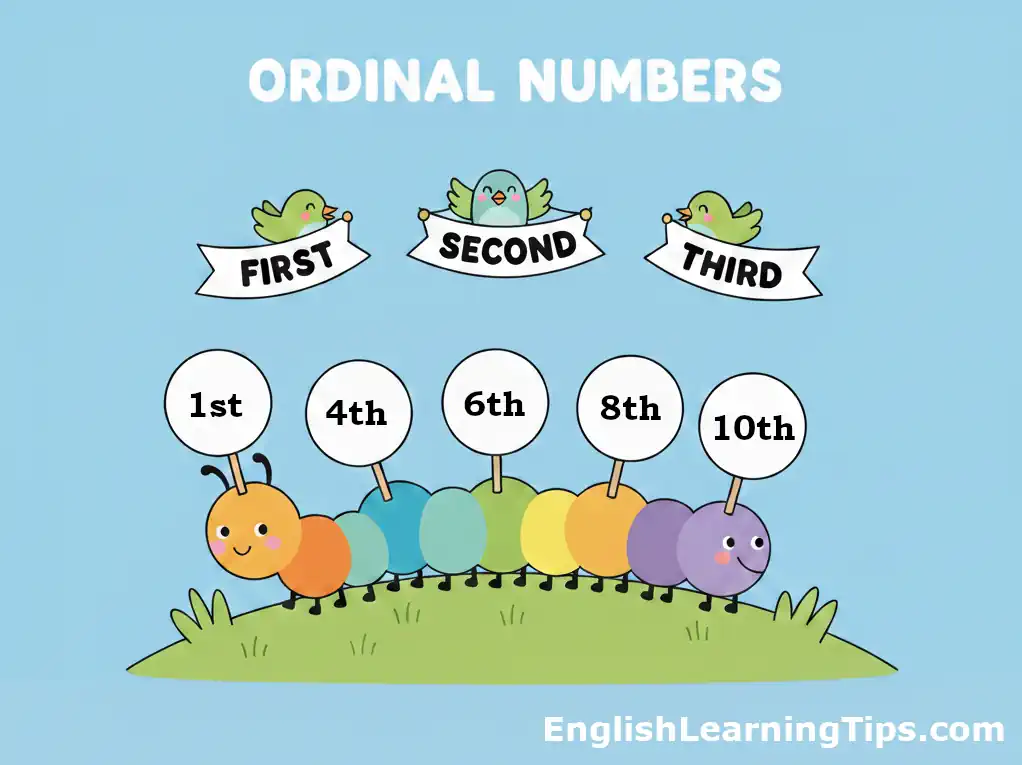
Ordinal numbers: Definition, examples, and how to use them

Coming in first place or celebrating a 21st birthday are everyday moments where we rely on ordinal numbers. Unlike cardinal numbers that count ‘how many,’ ordinals define a specific position in a sequence. From race results (1st place) to anniversary dates (the 25th), these numbers provide the necessary context for order and rank.
Quick summary of ordinal numbers
- Definition: Numbers that show rank or position (1st, 2nd, 3rd).
- The suffix rule: Most end in -th, except those ending in 1 (-st), 2 (-nd), or 3 (-rd).
- The teen exception: 11th, 12th, and 13th always end in -th.
What are ordinal numbers?
An ordinal number indicates a specific place in a defined order. While we use them daily to keep schedules and rankings in order, the mathematical theory behind them was formalized by Georg Cantor in the 1800s. He used ordinals to describe ‘well-ordered sets’—a concept that remains the foundation for how we organize everything from alphabetized lists to computer code today.
In daily life, we use these numbers to organize information. For example, in the sequence A, B, C, D:
- A is the 1st (first) letter.
- B is the 2nd (second) letter.
- C is the 3rd (third) letter.
Cardinal vs. ordinal numbers: Key differences
Knowing the difference helps avoid common grammar slips.
| Feature | Cardinal numbers | Ordinal numbers |
| Primary purpose | Counting and quantity | Ranking and position |
| Question answered | How many? | Which one? |
| Examples | 1, 5, 20, 100 | 1st, 5th, 20th, 100th |
| Usage | “I have three cats.” | “This is my third cat.” |
How to write ordinal numbers and suffixes
Writing ordinal numbers involves adding a specific suffix to the end of a cardinal number. There are four primary suffixes in English: -st, -nd, -rd, and -th.
The “th” rule and exceptions
Most ordinal numbers end in -th (4th, 10th, 100th). However, the first three numbers in every ten (except for the teens) have unique endings:
- Numbers ending in 1 use -st (1st, 21st, 31st).
- Numbers ending in 2 use -nd (2nd, 22nd, 32nd).
- Numbers ending in 3 use -rd (3rd, 23rd, 33rd).
- The “teen” exception: 11, 12, and 13 always use -th (11th, 12th, 13th). Unlike other numbers ending in 1, 2, or 3, the “teens” do not change their suffix because they are pronounced as unique words (eleventh, twelfth, thirteenth) rather than compound words like “twenty-first.”
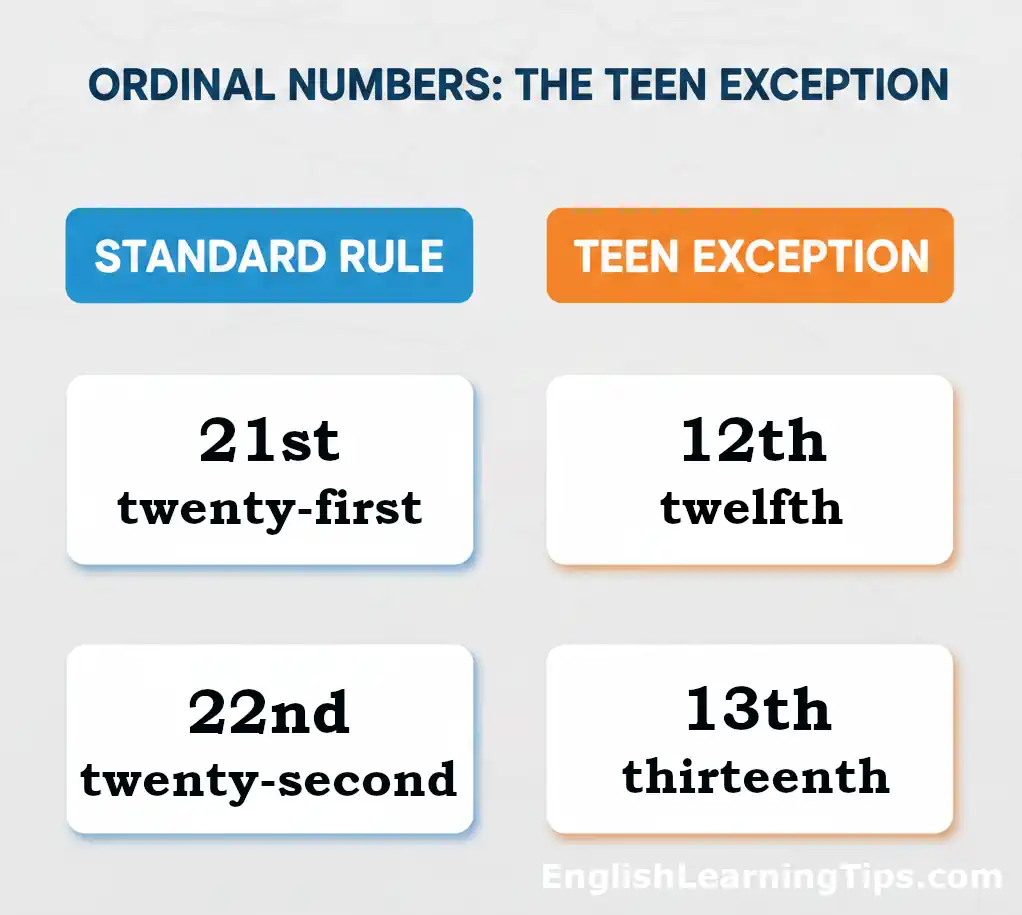
Important: Remember that for the entire group from 11 to 19, you will always use the -th suffix.
Ordinal numbers chart: 1 to 100
| Cardinal | Ordinal (numeral) | Ordinal (word) |
| 1 | 1st | First |
| 2 | 2nd | Second |
| 3 | 3rd | Third |
| 4 | 4th | Fourth |
| 5 | 5th | Fifth (v changes to f) |
| 9 | 9th | Ninth (drop the e) |
| 10 | 10th | Tenth |
| 11 | 11th | Eleventh |
| 12 | 12th | Twelfth (v changes to f) |
| 20 | 20th | Twentieth (y changes to ie) |
| 21 | 21st | Twenty-first |
| 30 | 30th | Thirtieth |
| 40 | 40th | Fortieth (no “u” in forty) |
| 100 | 100th | One hundredth |
Frequently asked questions about ordinal numbers
Conclusion: Mastering the order of things
Ordinal numbers are more than just suffixes like -st or -th; they are the framework we use to organize our world, from historical centuries to the dates on our calendars. By understanding the simple rules for suffixes and the “teen” exceptions, you can ensure your writing is both grammatically correct and easy to follow.
Whether you are teaching a student about cardinal vs. ordinal numbers or just double-checking the spelling of “fortieth,” we hope this guide cleared up the confusion.
Join the conversation
Did you find the “zeroth” rule surprising, or do you have a trick for remembering the 11th, 12th, and 13th exception? Leave a comment below and let us know which part of ordinal numbers usually trips you up!
If you found this guide helpful, please share it with a friend or colleague who might be brushing up on their grammar. Your shares help us create more free resources like this one.
Discover more from English Learning Tips
Subscribe to get the latest posts sent to your email.


