
Vowels: Short and long vowel sounds explained

Vowels are the foundation of English pronunciation, dictating the rhythm and flow of every word we speak. While there are only five primary vowels—A, E, I, O, and U—they produce a wide variety of sounds. The most fundamental distinction for any learner or student is the difference between short and long vowel sounds.
In this guide, you will learn how to identify these sounds, the spelling patterns that trigger them, and the common exceptions that often trip up readers.
What are short vowel sounds?
Short vowel sounds are typically produced with a relaxed mouth and tongue. They are most common in closed syllables, which occur when a vowel is followed by one or more consonants (e.g., mat, dish, luck).
Short vowel examples and IPA symbols
| Vowel | IPA symbol | Key word | Practice words |
| A | /æ/ | Cat | Bat, apple, snap |
| E | /ɛ/ | Bed | Pet, egg, check |
| I | /ɪ/ | Sit | Lip, fish, brick |
| O | /ɒ/ or /ɑ/ | Hot | Dog, box, clock |
| U | /ʌ/ | Cup | Sun, rug, duck |
What are long vowel sounds?
A long vowel sound is a vowel that is pronounced the same as the name of the letter itself. For example, the long “A” sound is the /eɪ/ sound found in the word bake. These usually occur in open syllables (ending in a vowel) or through specific spelling markers like the “silent e.”
Long vowel examples and IPA symbols
| Vowel | IPA symbol | Key word | Practice words |
| A | /eɪ/ | Cake | Rain, day, plate |
| E | /iː/ | Tree | Me, leaf, sleep |
| I | /aɪ/ | Bike | Time, fly, light |
| O | /oʊ/ | Boat | Home, go, rose |
| U | /juː/ or /uː/ | Cute / Blue | Tube, flute, music |
Common short and long vowel minimal pairs
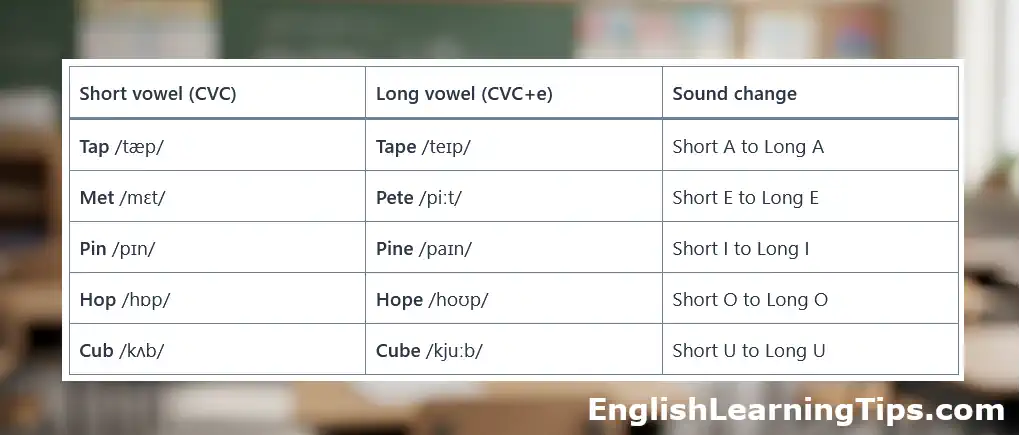
One of the most effective ways to master these sounds is by practicing minimal pairs. These are pairs of words that differ by only one phonological element—in this case, the vowel sound.
Comparing these side-by-side helps your ear distinguish the “clipped” nature of short vowels from the “gliding” nature of long vowels.
Practice table: Short vs. long vowels
Tips for improving your vowel pronunciation
- Use a mirror: Long vowels often require more movement of the jaw and lips than short vowels. Watch your mouth as you say “bit” versus “bite.”
- Record yourself: Use your phone to record yourself reading a list of minimal pairs, then play it back to see if you can hear the distinction.
- Color-code your notes: When learning new vocabulary, highlight short vowels in one color and long vowels in another to build visual recognition.
Key rules for identifying vowel sounds
Understanding the “why” behind the sound makes spelling and reading much easier. Here are the primary patterns to look for:
1. The silent e rule (Magic e)
When a word ends in a consonant followed by an “e,” the first vowel usually becomes long, and the “e” remains silent.
- Example: Bit (short I) becomes Bite (long I).
2. Vowel teams
When two vowels appear together, they often create a long vowel sound or a unique diphthong. A common mnemonic is: “When two vowels go walking, the first one does the talking.”
- Example: In Boat, the “o” is long and the “a” is silent.
3. R-controlled vowels
When a vowel is followed by the letter “r,” it creates a unique sound that is neither strictly long nor short. Educators often call this the “Bossy R.”
- Examples: Car, bird, fork, and burn.
Advanced vowel patterns to watch for
Once you have the basics down, you can look for these secondary patterns that often appear in complex English words:
- Open syllables: If a syllable ends in a vowel (like the ‘e’ in me or the ‘o’ in go), the vowel is almost always long.
- Diphthongs: These are “sliding” sounds where one vowel sound moves into another within the same syllable, such as the /oɪ/ in boy or the /aʊ/ in cloud.
- The Schwa sound (/ə/): This is a neutral, unstressed vowel sound that often replaces short or long vowels in multi-syllable words. Think of the ‘a’ in balloon or the ‘e’ in problem.
Common exceptions to vowel rules
English is famous for its “rule-breakers.” Even with a solid grasp of phonics, you will encounter words that don’t fit the standard patterns:
- The word “have”: Despite the silent “e,” it uses a short “A” sound (/æ/).
- The word “said”: Even with a vowel team (ai), it uses a short “E” sound (/ɛ/).
- The word “love”: Despite the silent “e,” it uses a short “U” sound (/ʌ/).
Frequently asked questions about vowel sounds
Test your knowledge
Practice: Short and long vowel quiz
Test your ability to recognize these patterns. Identify whether the underlined vowel in each sentence is short or long.
- The cake is cooling on the counter.
- I saw a tiny fish in the pond.
- Please help me carry these bags.
- The sky is a bright shade of blue.
- Don’t forget to shut the door.
Answer key: 1. Long | 2. Short | 3. Short | 4. Long | 5. Short
Sentence practice for pronunciation
Read these sentences aloud to practice switching between short and long vowel sounds quickly. This is a practical exercise for English language learners (English language learners) to build muscle memory.
- The cute duck swam in the blue lake. (Mix of short and long U)
- The mad hatter wore a cane and a hat. (Mix of short and long A)
- Pete and his pet went to the green tree. (Mix of short and long E)
- Sit on the pine bench and eat your fish. (Mix of short and long I)
- The rose grows near the hot rock. (Mix of short and long O)
Mastering your vowel sounds
Understanding the difference between short and long vowel sounds is one of the most effective ways to improve your English reading and speaking confidence. While the “magic e” and vowel team rules provide a solid foundation, remember that English is a living language full of unique quirks. The more you listen to native speakers and practice with minimal pairs, the more natural these sounds will become.
Join the conversation: What is your trick for remembering vowel rules?
Do you have a favorite mnemonic or a specific word that always trips you up? We want to hear from you!
- Leave a comment below with the vowel sound you find most challenging to pronounce.
- Share this guide with a friend or student who is currently working on their English phonics.
- Bookmark this page as a quick reference for the next time you encounter a tricky “silent e” word.
Your insights help our community grow, and we respond to every comment!
Discover more from English Learning Tips
Subscribe to get the latest posts sent to your email.


