
Understanding silent “e” words: The ultimate guide to the magic “e” rule (bossy “e”)

English spelling can often feel like a puzzle, especially when letters appear on the page but make no sound at all. One of the most important pieces of that puzzle is the silent “e”. Whether you call it the magic “e”, the bossy “e”, or the VCE (Vowel-Consonant-e) pattern, this single letter is responsible for changing the pronunciation and meaning of thousands of words in the English language.
Understanding how this rule works is a foundational step in literacy. It marks the transition from reading simple, three-letter words to decoding more complex vocabulary. In this guide, we will break down the mechanics of the silent “e,” provide categorized word lists, and explore the common exceptions that every reader and writer should know.
The quick answer: A silent “e” word (often called a magic “e” or bossy “e”) is a spelling pattern where an “e” at the end of a word is not pronounced, but instead changes the previous vowel from a short sound to a long sound. For example, adding an “e” turns the short vowel word cap into the long vowel word cape.
What are silent “e” words?
In English phonics, silent “e” words follow the VCE (Vowel-Consonant-e) pattern. While the “e” itself remains quiet, it acts as a signal for the reader. Educators often use the term bossy “e” because the letter “e” “bosses” the preceding vowel into “saying its name” (the long vowel sound).
How the magic “e” changes vowel sounds
The most effective way to understand this phonics rule is to compare short vowel vs. long vowel pairs. When the “e” is added, the pronunciation and the meaning of the word shift entirely.
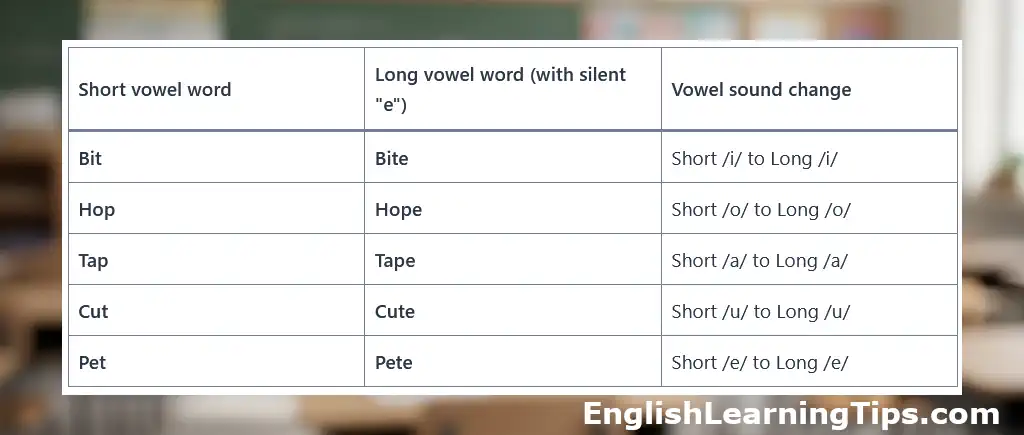
Common silent “e” word examples by vowel group
To help students recognize patterns, it is useful to categorize these words by their primary vowel. Here are the most common long vowel silent “e” examples used in elementary literacy:
- a_e words: Bake, cake, game, gate, lake, name, sale.
- e_e words: Eve, gene, these, theme, Trapeze.
- i_e words: Bike, kite, mice, pine, ride, smile, time.
- o_e words: Bone, home, nose, robe, rose, vote.
- u_e words: Cube, flute, June, mule, rude, tube.
Recommended tools for teaching the magic “e”
If you are looking for hands-on ways to practice these patterns, here are a few classroom-tested favorites:
- Coogam Magnetic Letters Kit: Perfect for physically adding an “e” to the end of CVC words.
- JSilent e Flippers: A great visual tool for showing the transformation from short to long vowels.
- Handheld Reading Pointers: Use these as your “magic wands” during group lessons.
Other reasons why words end in “e”
| The “e” job | How it works | Examples |
| The soft “c” or “g” | It makes the “c” sound like /s/ and the “g” sound like /j/. | Race, ice, cage, huge |
| The “v” and “u” rule | English words rarely end in v/u, so “e” acts as a placeholder. | Have, give, blue, true |
| The homophone helper | It helps us tell the difference between two similar words. | Or vs. Ore, Bye vs. By |
| The syllable marker | Every English syllable needs a vowel; “e” fills that role. | Apple, turtle, little |
Tricky exceptions to the rule
Not every word ending in “e” follows the bossy “e” pattern. You might know these as sight words or heart words—they simply don’t follow the standard rules.
- Have: The “a” remains short despite the “e.”
- Done, some, and come: The “o” makes an /uh/ sound instead of a long /o/.
- Give and live: The “i” remains short.
Frequently asked questions about silent “e”
Strategies for teaching silent “e”
If you are helping a struggling reader build their decoding skills, try these evidence-based techniques to improve phonemic awareness.
- The “magic wand” activity: Use a popsicle stick with an “e” on it. Place it at the end of words like mad or win and have the student read the new word (made or wine).
- Marking the text: Have students draw an arrow from the “e” back to the first vowel to visualize the “bossy” connection.
- Word sorting: Create two columns—one for CVC words and one for CVCe words—and have students categorize flashcards.
Wrapping up: The power of the silent “e”
Mastering the silent “e” is a major milestone in any literacy journey. While it may seem like a “rule breaker” at first, this little letter is actually a consistent tool that provides clarity to our spelling and rhythm to our speech. By recognizing the difference between a short vowel and a magic “e” word, readers can unlock thousands of new words with confidence.
Whether you are a teacher looking for new phonics strategies or a parent helping with homework, remember that practice and pattern recognition are the best ways to make these rules stick.
Join the conversation: What is your trickiest “magic e” word?
Do you have a favorite way to teach the bossy “e”? Or perhaps you have encountered a word that breaks all the rules we mentioned today?
We would love to hear your experiences! Drop a comment below with your best teaching tips or any “exception” words that always trip you up. If you found this guide helpful, share it with a fellow educator or parent to help spread the magic of phonics.
Discover more from English Learning Tips
Subscribe to get the latest posts sent to your email.


