


The primary diphthongs in English: A complete guide to gliding vowels

If you’ve ever noticed how some vowels seem to ‘slide’ as you say them, you’re hearing a diphthong. These aren’t just technical linguistic terms; they are the secret to a natural-sounding English accent.
While a standard vowel stays steady, a diphthong is a ‘gliding vowel‘ where your mouth physically moves from one position to another within a single syllable. Because English spelling is notoriously inconsistent, mastering these glides is one of the fastest ways to eliminate ‘choppy’ speech. In this guide, we’ll map out the 8 primary diphthongs in English, provide clear examples for each, and show you a simple physical trick to identify them in any word.
What is a diphthong?
A diphthong is a single-syllable sound created by moving from one vowel position to another. The term “diphthong” comes from the Greek word diphthongos, meaning “two sounds” (di- “two” + phthongos “sound”).
Unlike monophthongs (pure vowels), which maintain a consistent sound—like the /æ/ in “cat”—diphthongs involve a physical shift in the mouth. When you say a diphthong, your tongue, lips, and jaw transition smoothly from an “on-glide” (starting sound) to an “off-glide” (ending sound).
Teaching a child? These Phonics Flashcards use visual cues to help kids distinguish between sounds like ‘oy’ and ‘ow’—perfect for home-schooling or classroom decor.
Key characteristics of diphthong sounds
To identify these sounds in English phonology, look for these three defining features:
- One syllable: Even though you hear two vowel qualities, they occupy a single beat in a word. This distinguishes them from hiatus (two vowels in separate syllables, like “react”).
- The glide: There is a continuous movement of the articulators (tongue and lips). The sound does not “jump”; it slides.
- Stress patterns: In English, diphthongs are almost always found in stressed syllables, making them longer and more prominent than short vowels.
List of the 8 primary diphthongs in English
While accents vary, linguists generally recognize eight primary diphthongs in Received Pronunciation (British English), while American English typically focuses on the five ‘closing’ diphthongs.
| IPA symbol | Common name | Example words | Phonetic breakdown |
| /aɪ/ | Long I | My, High, Light, Sky | Starts at /a/ (father) → glides to /ɪ/ (bit) |
| /eɪ/ | Long A | Day, Face, Rain, Say | Starts at /e/ (bed) → glides to /ɪ/ (bit) |
| /ɔɪ/ | Boy sound | Boy, Coin, Voice, Toy | Starts at /ɔː/ (saw) → glides to /ɪ/ (bit) |
| /aʊ/ | Ow sound | Now, Loud, Cow, House | Starts at /a/ (father) → glides to /ʊ/ (foot) |
| /oʊ/ | Long O | Go, Home, Show, No | Starts at /o/ (hot) → glides to /ʊ/ (foot) |
| /ɪə/ | Near sound | Near, Fear, Here, Pier | Starts at /ɪ/ (bit) → glides to /ə/ (schwa) |
| /eə/ | Hair sound | Hair, Stair, Care, Bare | Starts at /e/ (bed) → glides to /ə/ (schwa) |
| /ʊə/ | Tour sound | Tour, Pure, Cure, Lure | Starts at /ʊ/ (foot) → glides to /ə/ (schwa) |
How to identify a diphthong in speech
Sometimes English spelling is misleading (the “O” in “go” is a diphthong, but the “O” in “got” is a monophthong). To spot a diphthong, use the Slow Motion Test. This works because it forces you to feel the muscle transition in your jaw.
- Say the word very slowly.
- Pay attention to your jaw and tongue.
- If your mouth moves or closes slightly toward the end of the sound, you’ve found a diphthong.
For example, in the word “ride” (/aɪ/), your tongue starts low and flat but finishes high near the roof of your mouth. Compare this to “red” (/ɛ/), where your mouth stays perfectly still.
Tips for mastering English vowel glides
If you are learning English as a second language, diphthongs are often the difference between sounding “robotic” and sounding natural.
- Exaggerate the glide: When practicing, make the transition between the two sounds longer than usual to build muscle memory.
- Record and compare: Use a phone app to record yourself saying “toy” or “play” and compare the waveform or sound to a native speaker.
- Watch the “schwa”: In British English, many diphthongs end in the /ə/ (schwa) sound. Mastering this neutral “uh” sound is key to the /ɪə/ and /eə/ glides.
If you want a structured curriculum to follow, English Pronunciation in Use is an industry standard for mastering these specific vowel glides.
Why do American and British diphthongs sound different?
The primary difference lies in rhoticity (how the “R” sound is handled) and the use of centering diphthongs:
- British (RP) English: Often uses “centering diphthongs” that glide toward the schwa /ə/. In words like near (/ɪə/) or hair (/eə/), the “r” is not pronounced as a consonant; instead, the vowel simply “centers” toward a neutral “uh” sound.
- American English: Most American dialects are rhotic, meaning the “R” is physically pronounced. Instead of a centering glide, Americans use R-colored vowels (rhotic vowels), where the tongue pulls back or bunches up to create the “R” sound simultaneously with the vowel.
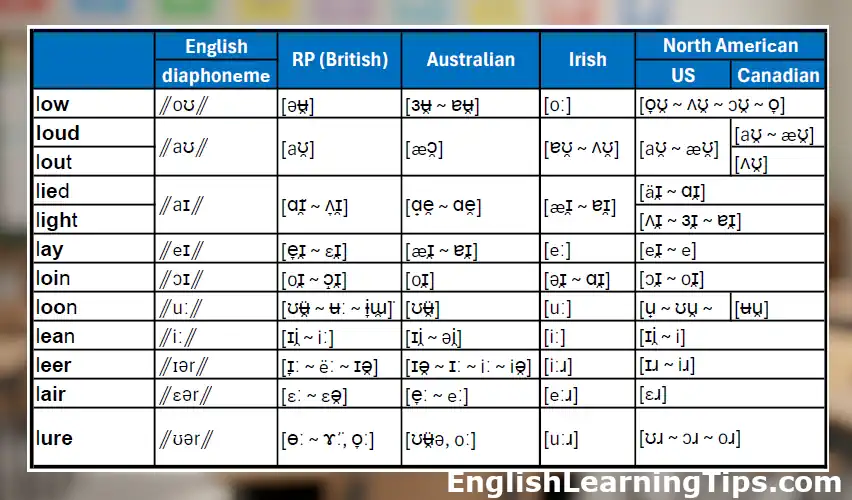
- Vowel Quality: As seen in the comparison chart, the starting position of the glide often differs; for example, the diphthong in “low” starts with a more central [ə] in British RP but a more rounded [o] in North American English.
Global English diaphonemes chart
This comprehensive chart breaks down English diaphonemes, providing a direct comparison of IPA transcriptions for British (RP), Australian, Irish, and North American dialects. Whether you are studying linguistics or practicing accent reduction (accent modification or pronunciation training), these phonetic variations in words like “lure,” “lied,” and “low” illustrate the rich diversity of the English language.
The chart highlights that while the phoneme remains the same (the idea of the sound), the realization (the actual sound made) varies:
- Irish English often uses monophthongs [o:] where others use diphthongs [oʊ].
- Canadian English exhibits “Canadian Raising” in words like “loud” or “lout”.
Frequently asked questions about diphthongs
Visual tools to help you learn
The 8 Diphthong Vowel Sounds — English with James
This video comes from a British English perspective.
5 Diphthongs of American English
44 Phonemes of American English (including Diphthongs)
Conclusion: Master the glide in your speech
Diphthongs are the “connective tissue” of English pronunciation. From the bright /aɪ/ in “time” to the rounded /oʊ/ in “home,” these sounds provide the melody and rhythm of the language. By recognizing the physical movement required for these eight primary glides, you can significantly improve both your listening comprehension and your spoken clarity.
While the International Phonetic Alphabet (IPA) can seem intimidating at first, mastering these eight sounds is one of the fastest ways to sound more natural and confident in English.
Join the conversation: Which diphthong is the hardest?
We want to hear from you! Pronunciation varies wildly depending on where you are in the world.
- Which diphthong do you find the most difficult to pronounce?
- Does your local accent change any of these sounds (like the “cot-caught” merger)?
- Are there any words you recently discovered were actually diphthongs?
Drop a comment below to share your experience! If you found this guide helpful, share it with a fellow language learner or teacher—it’s the best way to help others master the unique flow of English.
Keep learning:
- R-controlled vowels: How “R” changes vowel sounds.
- Silent E words: The magic “E” and long vowel sounds.
Discover more from English Learning Tips
Subscribe to get the latest posts sent to your email.


