


Adverbs of time: A complete guide to timing and frequency

“I go hiking with my dog daily.”
When we describe an action, the “when” is often just as vital as the “what.” Adverbs of time tell your reader exactly when an action happens, how long it lasts, and how often it repeats. They provide essential context by answering three primary questions: When?, How long?, and How often?
Whether you are discussing a past event, a current habit, or a future goal, these words ensure your communication is precise and easy to follow.
Quick guide to adverbs of time
- Primary function: Tells us when, for how long, or how often an action happens.
- Common placement: Usually at the end of a sentence (I’ll go later).
- Exception: Adverbs of frequency often go before the verb (I always go).
- Key examples: Now, soon, yesterday, daily, briefly, since.
What are adverbs of time (temporal adverbs)?
An adverb of time is a word or phrase that modifies a verb to indicate the timing of an action. Unlike adverbs of manner, which often end in “-ly” and describe how something is done, adverbs of time focus exclusively on chronological placement and repetition.
To fully understand their role, it helps to know that they primarily focus on:
- Point in time: When something happens (e.g., today).
- Frequency: How often it happens (e.g., monthly).
- Duration: For how long it happens (e.g., all year).
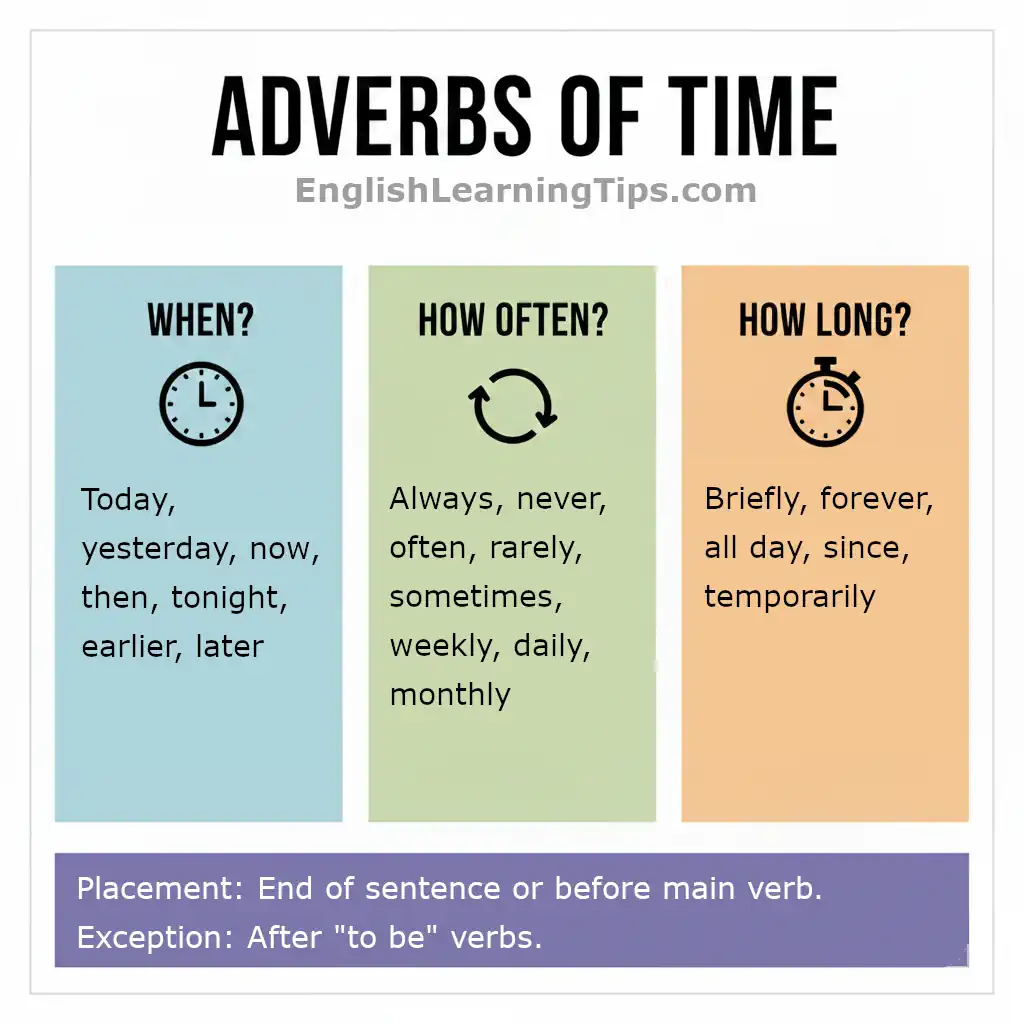
Types of adverbs of time
To use these effectively, it helps to categorize them based on the specific information they provide.
| Category | Function | Common examples |
| Points in time | Answers “When?” | Yesterday, today, tomorrow, now, then, tonight |
| Frequency | Answers “How often?” | Always, never, often, rarely, sometimes, weekly |
| Duration | Answers “How long?” | Briefly, forever, all day, since, for, temporarily |
| Relative time | Shows relationship | Soon, later, already, yet, recently, before |
If you’re serious about mastering English, having a physical reference guide can be a game-changer. We recommend the English Grammar in Use by Raymond Murphy for its clear explanations of temporal adverbs. For younger learners, these Educational Grammar Posters are excellent for visual reminders of “When” and “How often.”
Relative vs. absolute adverbs of time
Understanding the difference between these two categories will help you choose the right word for your context:
- Absolute adverbs: These refer to a specific, fixed point on a calendar or clock. They don’t change meaning based on when you say them.
- Examples: Yesterday, today, tomorrow, last year, in 1995.
- Relative adverbs: These depend entirely on when the statement is made. Their “time” is relative to the moment of speaking or another event.
- Examples: Soon, later, already, recently, formally.
Common adverbs of time list
Here are some of the most frequently used temporal adverbs to include in your writing:
| * Afterwards | * Eventually | * Next |
| * Already | * Finally | * Now |
| * Back | * Formally | * Previously |
| * Before | * Formerly | * Recently |
| * Early | * Immediately | * Soon |
| * Earlier | * Just | * Still |
| * Late | * Last | * Then |
| * Lately | * Today | * Tomorrow |
| * Later | * When | * Yet |
Placement and sentence structure
One reason English can be tricky is that the position of an adverb changes the emphasis of the sentence. Here is how to place them correctly:
- End of the sentence: This is the most common and neutral position.
- Example: “We are going to the park tomorrow.”
- Beginning of the sentence: Use this for emphasis or to set the scene.
- Example: “Yesterday, all my troubles seemed so far away.”
- Mid-sentence (before the main verb): Common for adverbs of frequency.
- Example: “She always forgets her keys.”
- After “to be” verbs: If the main verb is a form of “to be,” the adverb usually follows it.
- Example: “They are frequently late for meetings.”
Important rules to remember
While adverbs of time are versatile, keep these three nuances in mind to improve your writing:
- They don’t always end in “-ly”: While “hourly” and “monthly” end in the traditional adverb suffix, most temporal adverbs (like “soon” or “now”) do not.
- Overlap with prepositions: Words like “before,” “after,” and “since” can act as adverbs or prepositions depending on the sentence structure.
- Adverb: “I have seen this movie before.”
- Preposition: “I saw the movie before lunch.”
- Since vs. For: Both show duration, but they are used differently:
- Since: Refers to a specific point in time (since 9:00 AM, since Monday).
- For: Refers to a period of time (for two hours, for five days).
- Specific vs. general: Some provide an exact point (e.g., “at 5 PM”), while others provide a relative timeframe (e.g., “eventually”).
- Adverbs vs. Adverbial phrases: While ‘now’ is a single-word adverb, ‘in the afternoon’ is an adverbial phrase of time. Both function the same way in a sentence.
- Adverbs vs. Clauses: A single word like “soon” is an adverb, but “when the bell rings” is an adverbial clause of time. Both tell us when, but a clause contains a subject and a verb.
Frequently asked questions about adverbs of time
Test your skills: Can you place these adverbs correctly?
Common mistake: Don’t confuse ‘every day’ (adverb phrase) with ‘everyday’ (adjective). I run every day vs. These are my everyday shoes.
Part 1: Identification
Identify the adverb of time in each sentence and categorize it (When, How Long, or How Often).
- “I have lived in this city since 2010.”
- “We go to the gym daily to stay fit.”
- “The package should arrive soon.”
- “He stayed underwater briefly before coming up for air.”
Part 2: Placement challenge
Reorder these words to create a grammatically correct sentence. (Hint: Watch for the difference between beginning and mid-sentence placement!)
- (always / she / is / for / school / late)
- (we / movie / saw / that / yesterday)
- (usually / coffee / drink / I / morning / the / in)
Part 3: Multiple choice
- Which sentence uses an adverb of time to show duration?
- A) I will see you tomorrow.
- B) The snow fell all night.
- C) I never eat mushrooms.
- D) She is currently busy.
- Which of these is NOT an adverb of time?
- A) Recently
- B) Often
- C) Quickly
- D) Yet
Answer key
| Question | Answer | Category/Rule |
| 1 | Since | Duration (How long) |
| 2 | Daily | Frequency (How often) |
| 3 | Soon | When (Relative point in time) |
| 4 | Briefly | Duration (How long) |
| 5 | She is always late for school. | Adverb follows the verb “to be.” |
| 6 | We saw that movie yesterday. | End-position for specific time. |
| 7 | I usually drink coffee in the morning. | Mid-position (before the main verb). |
| 8 | B (All night) | Indicates the length of the event. |
| 9 | C (Quickly) | This is an adverb of manner (How). |
Visual tools to help you learn
Adverbs of time: complete English grammar guide
Master the use of adverbs of time to clearly explain when, how long, and how often actions occur in English. This lesson provides essential rules for sentence placement, word order, and pronunciation to help you speak more naturally and fluently.
What is an adverb: English grammar for kids
This fun lesson introduces children to adverbs by comparing them to advertisements that “hype up” verbs with exciting details. Students will learn how adverbs answer questions like when, where, how, and how often to make their storytelling more descriptive and interesting.
Master your timing: Final thoughts on temporal adverbs
Adverbs of time are more than just grammar rules; they are the tools that provide clarity to your storytelling and precision to your instructions. By mastering the placement of words like already, frequently, and soon, you ensure your audience never has to guess “when” an action occurs. Whether you are writing a professional email or a creative story, these small words are essential for clear, professional communication.
Join the conversation: What is your favorite adverb of time?
We want to hear from you! Is there a specific adverb of time that always trips you up, or perhaps a unique way you use frequency words in your writing?
- Leave a comment below with your go-to adverb or ask a question if a specific rule still feels a bit confusing.
- Share this guide with a fellow writer or student who is looking to sharpen their English grammar skills.
Your feedback helps us create better resources for the community!
Expand your grammar knowledge
If you found this guide helpful, explore our other resources on adverbial categories:
- Adverbs of degree: Learn how to intensify your descriptions.
- Adverbs of manner: Describe the “how” behind every action.
- Adverbs of place: Define where an event unfolds.
- Conjunctive adverbs: Master the art of connecting independent clauses.
Discover more from English Learning Tips
Subscribe to get the latest posts sent to your email.


