

Adverbs of place: A complete guide to spatial adverbs

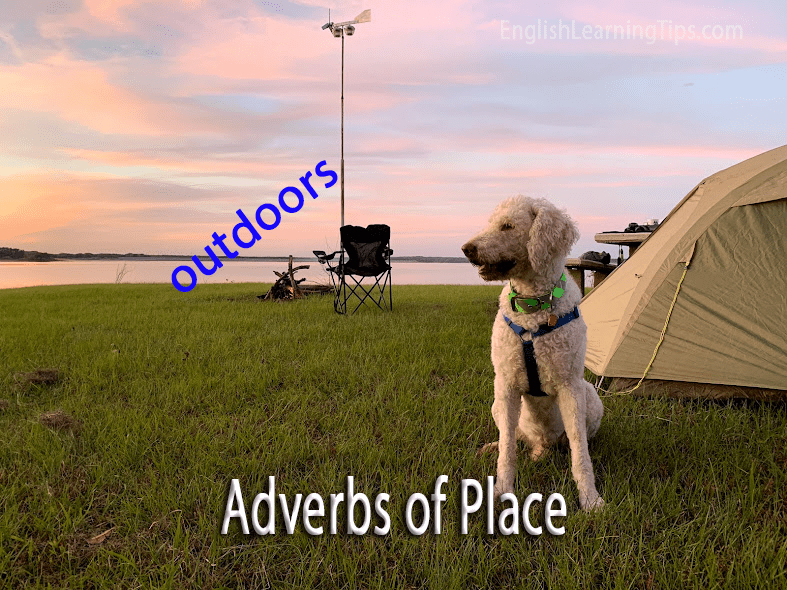
“The dog sat patiently outdoors while the sun began to set over the lake.”
Adverbs of place tell us exactly where an action happens. While a verb describes the “what,” these spatial markers provide the “where.” Whether you are describing a direction, a specific spot, or a distance, adverbs of place anchor your sentences without the need for complex prepositional phrases.
What is an adverb of place?
An adverb of place is a word that modifies a verb to indicate location, direction, or distance. These words answer the question “Where?” and typically follow the main verb in a sentence. Common examples include here, there, nearby, and upstairs.
Pro-tip: If you are serious about mastering English grammar, English Grammar in Use by Raymond Murphy is an essential desk reference. It provides visual breakdowns of adverbs and prepositions that make these rules stick.
Key characteristics
- The “where” factor: They primarily answer the question “Where?” (e.g., He is here.)
- Sentence position: They typically follow the main verb or the object. (e.g., Put the box there.)
- No “-ly” ending: Unlike adverbs of manner (like quickly), adverbs of place rarely end in “-ly.”
- Direction vs. static location: They can show movement toward a point (forward) or a fixed position (nearby).
Common examples of adverbs of place
To help you recognize these in everyday speech, here is a list of common adverbs categorized by how they describe space.
1. Direction and movement
These words indicate the path an object or person is taking.
- Up/Down: “He looked up at the stars.”
- Away: “The cat ran away from the vacuum.”
- Backwards/Forwards: “Please step backwards slowly.”
- Around: “We drove around looking for a parking spot.”
2. Specific and non-specific locations
These point to where something is currently situated.
- Here/There: “I left my keys here, but now they are there.”
- Everywhere/Nowhere: “I searched everywhere, but the remote was nowhere to be found.”
- Nearby: “A great café is located nearby.”
- Outside/Indoors: “We should go outside for some fresh air.”
3. Distance
These express how far apart things are.
- Far: “The mountains are too far to see today.”
- Near: “Don’t worry, the station is near.”
Adverbs of place vs. prepositions
One of the most common points of confusion in English grammar is distinguishing between an adverb of place and a preposition. The difference lies in whether the word is followed by a noun (an object).
| Word | Used as an adverb (no object) | Used as a preposition (has object) |
| Inside | It is cold, let’s go inside. | The keys are inside the drawer. |
| Behind | Don’t fall behind. | The broom is behind the door. |
| Down | He fell down. | She walked down the street. |
| Around | He turned around. | We ran around the track. |
Important usage notes and quirks
While these words seem simple, they have a few grammatical nuances that can improve your writing:
- Suffixes for direction: The suffixes -wards or -ward are common in adverbs of place (e.g., towards, backwards, homeward). Note that “towards” is more common in British English, while “toward” is preferred in American English.
- Emphasis and inversion: For literary effect, you can move the adverb to the beginning of the sentence. (e.g., “Down fell the rain.”)
- Adverbs as nouns (adverbial nouns): Occasionally, words like “here” or “there” function as the subject of a sentence. (e.g., “Here is a better spot.”)
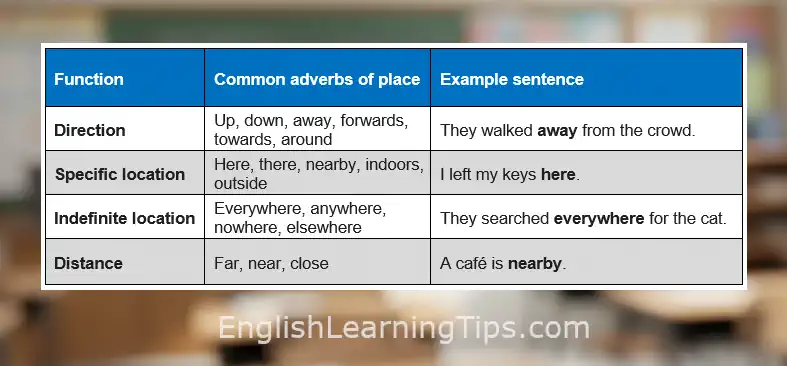
Adverbs of place: Quick reference cheat sheet
To help you master these spatial markers, here is a summarized “cheat sheet” you can reference while writing. This table breaks down the most common adverbs of place by their specific function.
Frequently asked questions about adverbs of place
Videos: Mastering spatial adverbs
If you prefer visual learning, these resources break down the rules of movement and location:
Adverbs of Place: Definition and Usage
This English grammar lesson explains how adverbs of place describe where an action occurs, covering specific locations, directions, and movements.
The “Adverbial Song” for adverbs of place
A catchy mnemonic tool perfect for students and ESL learners to memorize common spatial markers.
Top recommendation: For teachers or parents, these Parts of Speech Educational Posters are great for visual reinforcement. They help students see how adverbs of place like “outside” and “nearby” function in real-time.
Pro-tips for using adverbs of place in creative writing
To truly master these spatial markers and make your storytelling more immersive, consider these advanced techniques:
- Show, don’t just tell: Use specific adverbs like “underneath” or “abroad” to create immediate atmosphere without needing long descriptive paragraphs.
- Vary your sentence structure: While adverbs of place usually follow the verb, moving them to the beginning of a sentence (e.g., “Nearby, a wolf howled”) can shift the reader’s focus and build suspense.
- Avoid redundancy: If your verb already implies a direction (like “descended”), you often don’t need to add “down” unless you are looking for specific rhythmic emphasis.
- Create contrast: Use “here” and “there” to establish a sense of distance or emotional detachment between characters in a scene.
Master your use of adverbs of place
Adverbs of place may seem like small players in the grand scheme of language, but their ability to clarify “where” transforms our understanding of actions and scenes. Whether they are guiding a reader up a hill, placing them there in a specific moment, or stretching their imagination everywhere, these words bring essential precision to your writing.
By mastering these spatial markers, you unlock a sharper, more engaging way to tell stories and share experiences with your audience.
What is your favorite adverb of place?
We want to hear from you! Did this guide help you distinguish between adverbs and prepositions, or is there a specific word that always trips you up?
- Leave a comment below with an example sentence using the adverb of place “abroad” or “underneath.”
- Share this post with a friend who is brushing up on their English grammar.
- Bookmark this page so you can quickly reference our adverb placement table the next time you write.
Expand your grammar knowledge:
- Adverbs of degree: Learn how to intensify your descriptions.
- Adverbs of manner: Describe the “how” behind every action.
- Adverbs of time: Master the art of “when.”
- Conjunctive adverbs: Master the art of connecting independent clauses.
Discover more from English Learning Tips
Subscribe to get the latest posts sent to your email.


