


Adverbs of frequency: Rules, placement, and examples

How often do you check your phone or grab a coffee? Adverbs of frequency provide the answer. These words tell us how often something happens—helping you talk about your habits and daily routines naturally.
Take a look at the dogs in the image above: “They are always together”. In this sentence, “always” is an adverb of frequency that shows a 100% consistent habit. In this guide, we will break down the different types of frequency adverbs, where to place them in a sentence, and how to use them to improve your English fluency.
What are adverbs of frequency?
An adverb of frequency describes how often an action happens. In grammatical terms, these adverbs modify the main verb of a sentence to indicate a pattern or repetition. They are generally categorized into two groups:
- Indefinite frequency: Words like usually or seldom that give a general idea of timing.
- Definite frequency: Phrases like daily or every week that specify an exact timeframe.
To find the adverb of frequency in a sentence, ask: “How often?”
- Question: How often do you go to the gym?
- Answer: I usually go to the gym.
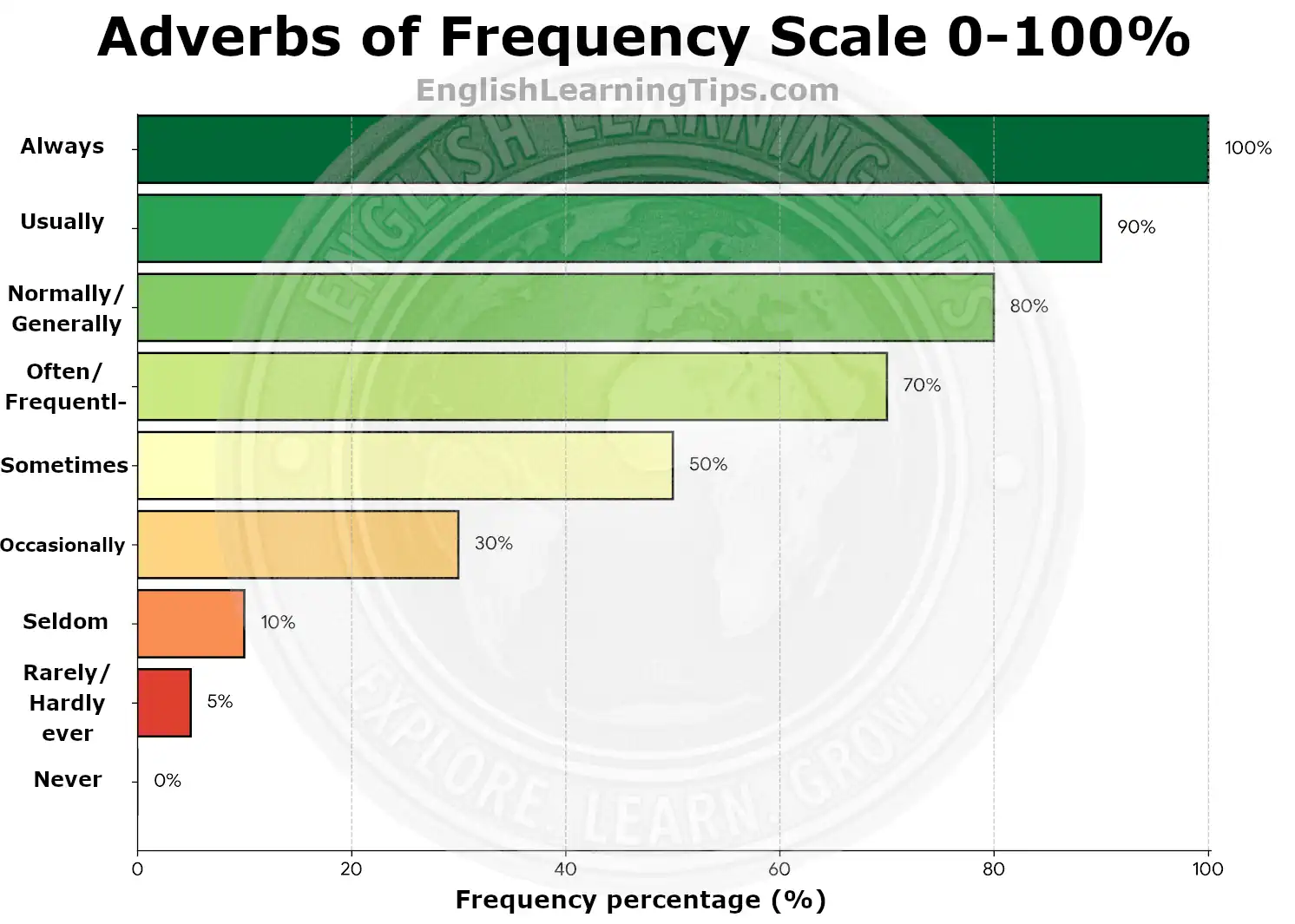
Common adverbs of frequency chart
To understand the nuance between these words, it helps to see them on a scale of probability:
| Adverb | Frequency | Example sentence |
| Always | 100% | I always brush my teeth before bed. |
| Usually | 90% | She usually walks to work. |
| Normally / Generally | 80% | We normally eat dinner at 7 PM. |
| Often / Frequently | 70% | They often go to the cinema. |
| Sometimes | 50% | I sometimes forget my keys. |
| Occasionally | 30% | He occasionally eats fast food. |
| Seldom | 10% | We seldom see our cousins. |
| Rarely / Hardly ever | 5% | It rarely snows in Florida. |
| Never | 0% | They never miss a game. |
Teacher’s note: While rarely, seldom, and hardly ever all represent about 5% frequency, “hardly ever” is the most common choice in spoken English. “Seldom” can sound a bit “old-fashioned” or overly formal in casual conversation. If you want to sound like a native speaker, stick with rarely or hardly ever. For a deeper dive into English sentence patterns, I always recommend the Murphy’s English Grammar in Use manual—it’s a staple for every serious learner’s bookshelf.
Sentence structure: Where do adverbs of frequency go?
One of the biggest challenges for English learners is knowing where to place these adverbs. The adverbial rule depends on the type of verb you are using.
Free downloadable resource: Don’t let word order trip you up. Grab our free Adverbs of Frequency Cheat Sheet (PDF) to keep as a handy reference while you study
1. Before the main verb
In most sentences, the adverb sits directly before the principal action.
- Formula: Subject + Adverb + Main Verb
- Example: She always arrives on time.
If you find it helpful to see these rules every day, these English Grammar Educational Posters are great for decorating your study space and keeping placement rules top-of-mind.
2. After the verb “to be”
If the sentence uses the verb to be (am, is, are, was, were), the adverb follows the verb.
- Formula: Subject + Verb (to be) + Adverb
- Example: He is never late for meetings.
Note: This is a common mistake for English learners. Remember: It is “I am always,” not “I always am.”
3. Between the auxiliary verb and main verb
If there is a helping verb (have, will, must, can), the adverb goes in the middle.
- Formula: Subject + Auxiliary + Adverb + Main Verb
- Example: I have often wondered about that.
Definite vs. indefinite frequency
While words like “often” are descriptive, sometimes you need to be exact. These are known as adverbs of definite frequency.
- Examples: Hourly, daily, weekly, yearly, twice a month, every Friday.
- Placement: These almost always appear at the end of a sentence.
- Correct: I check my email hourly.
- Correct: We visit my grandmother twice a year.
Frequently asked questions about adverbs of frequency
Visual tools to help you learn
Video: Mastering adverb placement
Learn the essential placement rules for adverbs of frequency, including where to position words like “always” when using the verb “to be” or complex auxiliary verb structures. This quick tutorial breaks down sentence patterns to help you avoid common grammar traps and speak more naturally.
Video: How to talk about your daily routine with frequency adverbs
Join Emma from mmmEnglish as she demonstrates how to use adverbs of frequency to describe your habits and lifestyle. This video covers everything from standard adverbs like usually and rarely to natural English expressions like once in a while and every now and again, providing a full walkthrough of a typical daily routine to show these rules in action.
Adverbs of frequency: Practice quiz
Test your understanding of the rules we’ve covered! Choose the best answer or reorder the words to create a grammatically correct sentence.
Part 1: Fill in the blanks
Choose the correct placement for the adverb in the parentheses.
- I ______ (usually) ______ drink tea in the morning.
- She ______ (is) ______ never late for her classes.
- They ______ (have) ______ always lived in London.
- We ______ (visit) ______ our grandparents twice a month.
Part 2: Sentence scramble
Rearrange these words into the correct order.
- Q1: sometimes / we / to / the / go / gym
- Q2: is / hungry / he / always / at / noon
- Q3: they / rarely / watch / television
| Question | Correct answer | Rule applied |
| P1, Q1 | I usually drink | Adverb before the main verb. |
| P1, Q2 | She is never | Adverb after the verb “to be.” |
| P1, Q3 | have always lived | Adverb between auxiliary and main verb. |
| P1, Q4 | visit… twice a month | Definite frequency goes at the end. |
| P2, Q1 | We sometimes go to the gym. | Subject + Adverb + Verb. |
| P2, Q2 | He is always hungry at noon. | Subject + Be + Adverb. |
| P2, Q3 | They rarely watch television. | Subject + Adverb + Verb. |
Mastering frequency is all about repetition. To take your skills further, check out the Practice Makes Perfect: ESL Grammar Workbook, which features hundreds of exercises specifically on adverbs and sentence structure
Final thoughts: Mastering frequency in English
Understanding adverbs of frequency is about more than just memorizing a list of words; it is about making your English sound more natural. By mastering the placement of words like always, sometimes, and never, you move beyond basic sentences and start speaking like a native. Whether you are preparing for an English exam or just want to feel more confident in conversation, these small modifiers are your best tool for clear communication.
Join the conversation: How often do you practice?
We want to hear from you! Using what you just learned, tell us about one of your daily habits in the comments below. For example: “I always drink tea in the morning” or “I rarely stay up past midnight.”
If you found this guide helpful, share it with a friend or a classmate who is also working on their English grammar. Your shares help us create more free resources for learners like you!
Expand your grammar knowledge:
- Adverbs of degree: Learn how to intensify your descriptions.
- Adverbs of manner: Describe how an action is performed.
- Adverbial positions: A deep dive into syntax and word order.
- Conjunctive adverbs: How to connect complex ideas seamlessly.
Discover more from English Learning Tips
Subscribe to get the latest posts sent to your email.


