


Adverbs of purpose and reason: Definition, examples, and usage

“We climbed the steep trail intentionally to get a better view of the valley.”
Language thrives on clarity. While we often focus on how or when something happens, adverbs of purpose and reason illuminate the “why.” These modifiers bridge the gap between an action and its underlying intent or logical cause.
Whether you are explaining a deliberate choice or a necessary consequence, mastering these connectors is essential for precise communication and cohesive writing.
Key takeaways: Adverbs of purpose and reason
If you are looking for a quick summary of how these adverbs function, here are the essential facts:
- Definition: Adverbs of purpose (or reason) explain why an action happens or the intent behind it.
- Common examples: Therefore, consequently, hence, intentionally, purposely, and thus.
- Primary function: They often act as conjunctive adverbs, linking a cause or a motive to a specific result.
- Sentence placement: They can appear at the start of a sentence (followed by a comma), in the middle (between a semicolon and a comma), or at the end.
- Punctuation rule: When joining two independent clauses, use a semicolon before the adverb and a comma after it (e.g., It rained; therefore, we stayed.).
What are adverbs of purpose and reason?
Adverbs of purpose (sometimes called adverbs of reason) are words or phrases that explain the motive, aim, or cause behind an action. They answer the primary questions: “Why?” or “For what intent?”
While single-word adverbs in this category are less common than adverbs of manner, they often function as conjunctive adverbs, linking two independent ideas to show a cause-and-effect relationship.
Key characteristics
- Function: They highlight the goal (purpose) or the cause (reason) of a verb’s action.
- Flexibility: They can appear at the beginning of a sentence for emphasis or in the middle to transition between ideas.
- Relationship to phrases: Many adverbs of purpose naturally evolve into “adverbial phrases” (e.g., “in order to”) to provide more detail.
Common examples of adverbs of purpose and reason
The following table breaks down the most frequently used adverbs and how they function in a sentence.
| Adverb | Function | Example sentence |
| Consequently | Shows a result or reason | The pipes froze; consequently, the heat turned off. |
| Intentionally | Indicates deliberate purpose | She intentionally left her phone at home to unplug. |
| Therefore | Connects a reason to an action | He was exhausted; therefore, he cancelled the meeting. |
| Hence | Shows a logical conclusion | The evidence was clear; hence, the jury reached a verdict. |
| Purposely | Indicates a specific goal | I purposely chose the scenic route for the photos. |
| Thus | Explains the result of a reason | The team practiced daily; thus, they won the trophy. |
| Deliberately | Shows conscious intent | He deliberately slowed down to let the cyclist pass. |
Beyond single words: Adverbial phrases of purpose
While single words like “therefore” are powerful, we often use phrases to express reason. Common examples include “in order to,” “so that,” and “for the purpose of.” These function exactly like adverbs of purpose but allow for more complex detail in your sentences.
Adverb or adjective: How to tell the difference
A common mistake for students is confusing an adverb of purpose with a descriptive adjective. While they may look similar, they perform very different jobs in a sentence.
The “modifier” test
- Adjectives modify nouns (people, places, or things). They describe what kind of thing it is.
- Adverbs modify verbs (actions). They explain why the action is happening.
Examples in action
Consider these two sentences using the dogs from our featured image:
- Adjective: “They are intentional hikers.”
- Analysis: “Intentional” describes the hikers (noun). It tells us what kind of hikers they are.
- Adverb: “They hiked the trail intentionally.”
- Analysis: “Intentionally” describes the hiking (verb). It explains the purpose behind the movement.
Quick comparison table
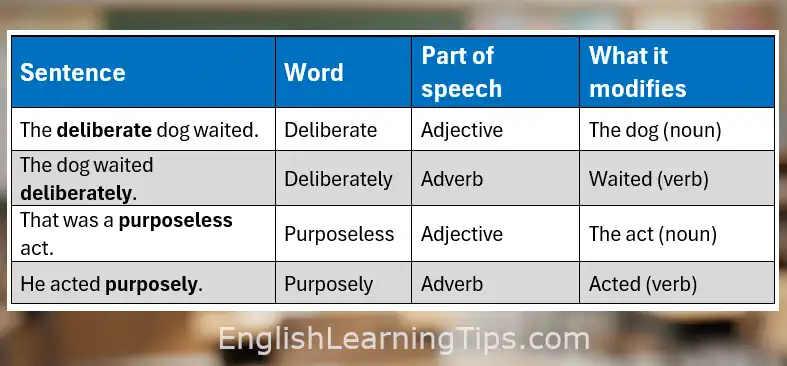
Using the chart above to understand nuances in speaking
The biggest challenge when choosing between an adjective and an adverb is often determining what sounds natural to a native speaker. In the table example above, the sentence “The deliberate dog waited” feels slightly awkward. Because of this, “The dog waited deliberately” is usually the better choice for structuring a clear, natural-sounding sentence.
In our second set of examples, “purposeless” and “purposely” have entirely different meanings. While the adjective “purposeful” exists, using it in the same context would be just as awkward as the “deliberate dog” example. Ultimately, this highlights why it is vital to learn various word forms and understand whether a word carries a positive or negative connotation.
Pro-tip for students: If you can replace the word with “happy” or “blue,” it’s an adjective. If you can’t, and it explains the “why” of an action, it’s likely an adverb of purpose.
The difference between adverbs of reason and purpose
Though often grouped together, there is a subtle nuance between “purpose” and “reason.”
- Purpose (The Goal): Focuses on the intended outcome.
- Example: “She exercised regularly to stay healthy.” (The goal is health).
- Reason (The Cause): Focuses on the logic or event that forced the action.
- Example: “The trail was washed out; consequently, we turned back.” (The trail condition caused the turn-back).
Usage tips and grammar rules
To use these adverbs effectively without making your writing feel clunky, keep these three rules in mind:
1. Watch your punctuation
When using conjunctive adverbs like therefore, hence, or consequently to join two independent clauses, you typically need a semicolon before the adverb and a comma after it.
- Correct: “The store was closed; hence, we went home.”
2. Avoid redundancy
Don’t use an adverb of purpose if the “why” is already obvious.
- Weak: “He sat down purposely to take a seat.”
- Strong: “He sat down deliberately to signal the meeting was over.”
3. Placement for emphasis
Placing the adverb at the start of the sentence creates a formal tone and puts the focus on the logic.
- “Thus, the experiment was deemed a success.”
Recommended for your desk: > If you’re serious about mastering adverbs and sentence structure, these are the two books our editors keep within arm’s reach:
- The Elements of Style – Perfect for learning concise, purposeful writing.
- The Only Grammar Book You’ll Ever Need – A great reference for adverbs, clauses, and more.
Frequently asked questions about adverbs of purpose
Video tutorial: How to use adverbial clauses of purpose
Advanced grammar: Adverbial clauses of purpose
This grammar walkthrough explains the structure and usage of adverbial clauses of purpose, showing how they identify the “why” behind an action using conjunctions like “so that” and “in order that.” The video also covers how to simplify these complex sentences into infinitive phrases or prepositional phrases using “to,” “in order to,” and “for.”
Practice exercises: Master adverbs of purpose and reason
Put your understanding to the test with these quick exercises. Try to complete them before checking the answer key at the bottom of the page.
Exercise 1: Fill in the blanks
Choose the most appropriate adverb from this list: consequently, intentionally, hence, therefore.
- The chef prepared the meal slowly and __________; he wanted every garnish to be perfect.
- The highway was under construction; __________, we had to take a long detour.
- The witness gave a false statement __________ to protect his friend.
- The budget was slashed by 50%; __________, the project was cancelled.
Exercise 2: Purpose or reason?
Identify if the highlighted word or phrase focuses on the goal (purpose) or the cause (reason).
- A. “She practiced the piano daily in order to win the competition.”
- B. “The power went out; accordingly, the computer shut down.”
- C. “He deliberately chose a seat in the back row.”
Exercise 3: Punctuation check
Which of the following sentences uses the correct punctuation for a conjunctive adverb?
- Option A: The rain was heavy, therefore, the game was delayed.
- Option B: The rain was heavy; therefore, the game was delayed.
- Option C: The rain was heavy therefore; the game was delayed.
Answer key
| Exercise | Correct Answer | Explanation |
| Ex 1: #1 | Intentionally | Focuses on the deliberate manner of the chef. |
| Ex 1: #2 | Therefore (or Consequently) | Connects the cause (construction) directly to the necessary result (detour). |
| Ex 1: #3 | Intentionally | Shows a specific motive behind the lie. |
| Ex 1: #4 | Therefore | A logical transition showing a direct cause and effect. |
| Ex 2: A | Purpose (Goal) | The intent is to win the competition. |
| Ex 2: B | Reason (Cause) | The power outage caused the shutdown. |
| Ex 2: C | Purpose (Goal) | The choice was a deliberate aim. |
| Ex 3 | Option B | Conjunctive adverbs joining two clauses require a semicolon and a comma. |
Tools to help you practice
Mastering English grammar takes repetition. We recommend using a high-quality dictionary and a dedicated space for your practice exercises:
- Oxford English Dictionary – The ultimate authority on word forms and adverbs.
- Rocketbook Smart Notebook – Great for doing your grammar drills and then scanning them to your phone.
Conclusion: Mastering the “why” in your writing
Adverbs of purpose and reason are more than just grammatical fillers; they are the logical anchors of clear communication. By using words like consequently, therefore, and intentionally, you move beyond simply stating facts and begin building a cohesive narrative. Whether you are writing an academic paper or a professional email, these tools ensure your reader never has to guess the motivation behind an action.
Effective writing is about making these connections seamless. Now that you have the rules and the examples, you can use them to add precision and authority to every sentence you craft.
Join the conversation
We want to hear from you! Grammar is constantly evolving, and the way we use these “connective tissues” in digital spaces is changing every day.
- Which adverb of purpose do you find yourself overusing? (For us, it’s definitely “therefore”!)
- Is there a specific sentence you’re struggling to punctuate correctly? Drop a comment below and our team will help you find the perfect phrasing. If you found this guide helpful, share it with a fellow writer or student—it’s the best way to help others master the nuances of the English language.
Continue your grammar journey
If you found this guide helpful, explore our other deep dives into the world of adverbs:
- Adverbs of manner (The “How”)
- Adverbs of frequency (The “How often”)
- Adverbs of degree (The “How much”)
- Adverbs of time (The “When”)
- Conjunctive adverbs (The “Connectors”)
Discover more from English Learning Tips
Subscribe to get the latest posts sent to your email.


