


Using look, see, and watch

English learners often struggle with vision verbs because they all describe using your eyes. While these verbs all involve using your eyes, picking the wrong one can make a sentence sound ‘off’ to a native speaker. Here is the breakdown of intent and duration so you never mix them up again.”
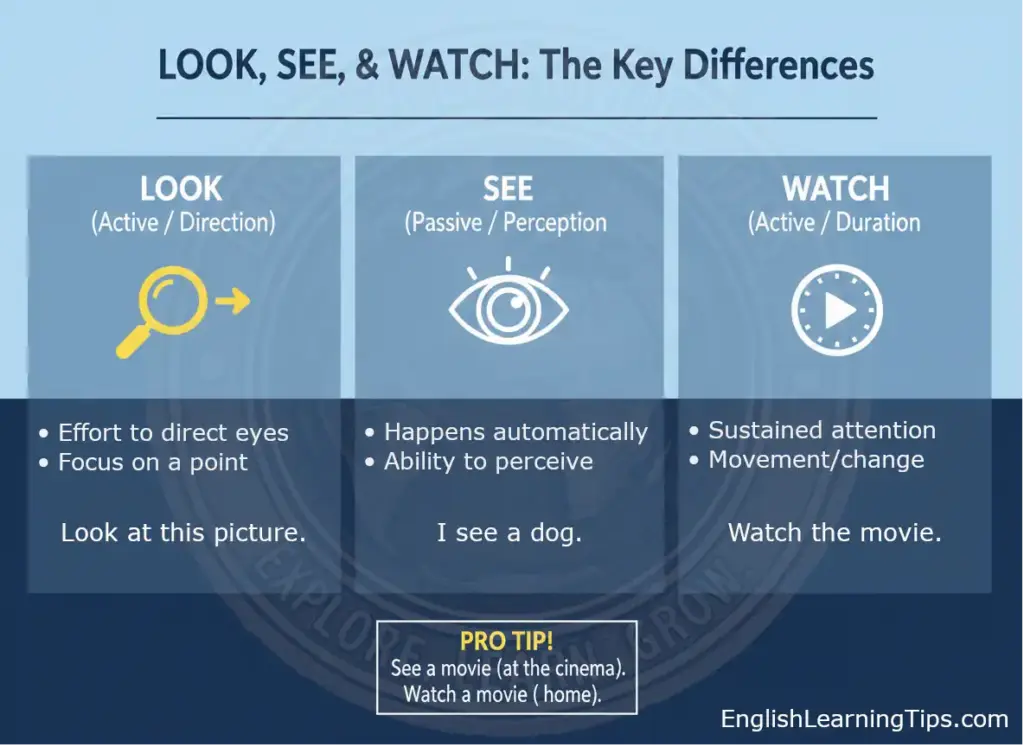
The quick rule: Active vs. passive
Before diving into the details, here is the simplest way to remember the difference:
- Look: You make an effort to direct your eyes (Active/Direction).
- See: The image comes to your eyes naturally (Passive/Perception).
- Watch: You look at something moving for a period of time (Active/Duration).
When should you use look?
Look is an active verb. It means you are physically moving your eyes or head to focus on a specific point. Because it is a directed action, it is almost always followed by the preposition “at” when there is an object.
- How to use it: Use “look” when you want someone to pay attention to a stationary or specific detail.
- Example: “Look at the map to find the fastest route.”
- Example: “I looked for my lost keys for an hour.”
When is see the correct choice?
See is a passive verb. It happens automatically. If your eyes are open, you “see” things even if you aren’t trying to. It is about the physical ability to perceive light and shapes.
- How to use it: Use “see” for things you notice suddenly or things that cross your field of vision without effort.
- Example: “I see a dark cloud in the sky; it might rain.”
- Example: “Did you see who walked through the door?”
What makes watch different?
Watch is similar to “look” because it is intentional, but it implies a duration of time. You watch things that move, change, or develop. This is why we watch sports, movies, or children playing.
- How to use it: If the subject is moving or if you are observing a process, “watch” is the correct choice.
- Example: “We watched the sunset until the sky turned black.”
- Example: “I like to watch the squirrels in the park.”
- Note: As a noun, a watch is a piece used to tell time (wristwatch, pocketwatch)
Comparison table: Look vs. see vs. watch
This table breaks down the nuance of each verb to help you choose the right one for any context.
| Verb | Action type | Focus | Common example |
| Look | Active | Direction | “Look at this photo.” |
| See | Passive | Perception | “I see a bird.” |
| Watch | Active | Duration/Movement | “Watch the game.” |
Common exceptions and tricky cases
Even with the rules above, English has a few “hidden” rules that often appear on proficiency exams like the IELTS or TOEFL.
1. Movies and performances: See vs. watch
These are tricky cases. The rule depends on the location:
- See a movie: Used for public places (cinema, theater, stadium).
- “I saw ‘Dune’ at the theater.”
- Watch a movie: Used for private places (at home, on a phone, on TV).
- “I watched a documentary on Netflix last night.”
Think of it this way: The theater is a destination. You ‘see’ a movie there because you are attending an event. At home, the focus shifts to the action on the screen. Since you are following a story over time from your couch, you are ‘watching’ the activity unfold.
2. Understanding and meeting
“See” is often used idiomatically to mean “understand” or “meet someone.”
- Understanding: “I see what you mean” (I understand your point).
- Meeting: “I’m going to see the doctor tomorrow.”
Frequently asked questions about vision verbs
Visuals to help you learn.
Watch: A 1-minute breakdown of look, see, and watch
Test your knowledge: Look, see, or watch?
Test your English fluency by choosing the best verb for each scenario. (Scroll down for the answer key!)
1. The “Netflix” dilemma
“I spent the whole rainy afternoon __________ documentaries on my laptop.”
- A) Seeing
- B) Looking
- C) Watching
2. The “Sudden” observation
“Did you __________ that flash of lightning just now? It was so bright!”
- A) See
- B) Watch
- C) Look at
3. The “Direct” command
“Hey! __________ that map on the wall. Do you know where we are?”
- A) Watch
- B) Look at
- C) See
4. The “Cinema” rule
“We went to the theater last night to __________ the new Marvel movie.”
- A) Watch
- B) Look
- C) See
5. The “Duration” test
“The security guard had to __________ the monitors for eight hours to catch the thief.”
- A) See
- B) Watch
- C) Look
- C) Watching: Because you are at home on a personal device and the action happens over a period of time.
- A) See: This was a sudden, passive perception. You didn’t plan to perceive the lightning; it just happened.
- B) Look at: You are intentionally directing someone’s attention to a stationary object (the map).
- C) See: We use “see” for public performances and organized events. You “see” a play, “see” a concert, or “see” a movie at the cinema.
- B) Watch: This is the correct choice because the security guard is paying close attention to movement and changes over a long period.
Final thoughts on using vision verbs
Precision in vocabulary is what separates intermediate speakers from advanced ones. By remembering that look is about direction, see is about perception, and watch is about duration, you can describe your world with much more clarity.
Next time you are outside, try this exercise: Look at a tree, see the colors of the leaves, and watch them move in the wind.
What do you think?
We want to hear from you! English is full of tricky “near-synonyms” that can be confusing for even the most advanced learners.
- Leave a comment: Is there a specific sentence where you still aren’t sure which verb to use? Drop it below and we’ll help you figure it out!
- Share the knowledge: If this guide helped you finally understand the “movie theater vs. home” rule, share it with a friend or your favorite English study group.
Check out our other guides: If you enjoyed this, you might also like our deep dive into the difference between hear and listen!
Discover more from English Learning Tips
Subscribe to get the latest posts sent to your email.


