

Relative pronouns: A complete guide to how they work

Relative pronouns are the essential connectors of the English language. They allow us to combine two separate thoughts into a single, cohesive sentence without being repetitive.
Technically speaking, a relative pronoun connects a dependent (relative) clause to an independent clause. It acts as a bridge, relating the information in the sub-clause back to a noun or pronoun mentioned earlier in the sentence.
Quick summary: What are relative pronouns?
A relative pronoun is a word used to connect a dependent clause to a noun or pronoun in a main clause. These words give you a way to add detail to a person, place, or thing.
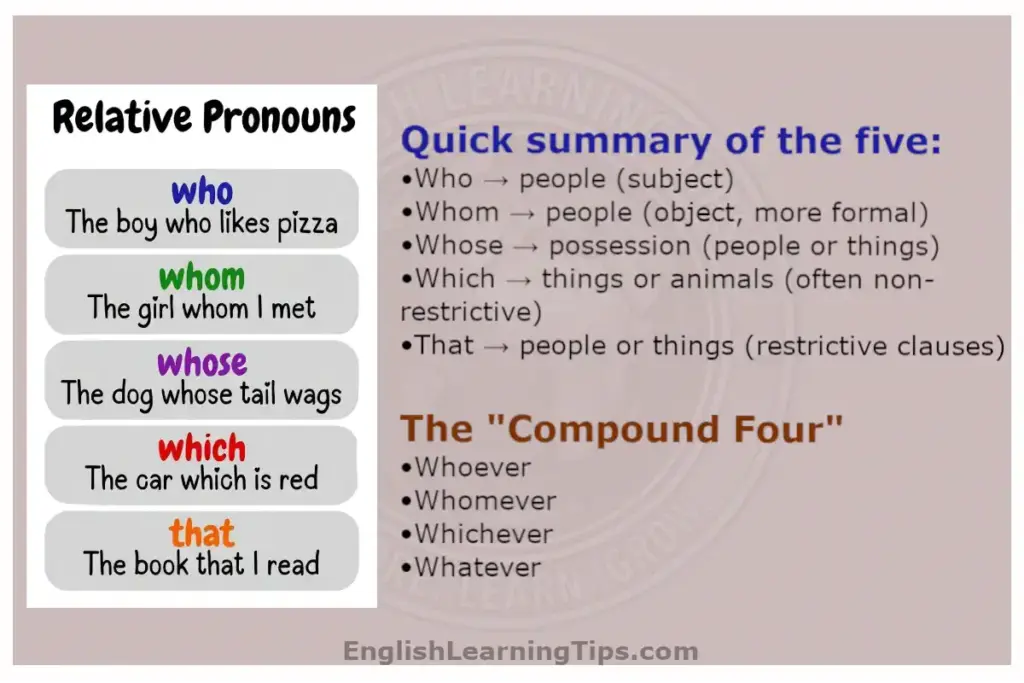
The five primary relative pronouns in English are:
- Who: Used for people (subject).
- Whom: Used for people (object).
- Whose: Used for possession.
- Which: Used for things and animals.
- That: Used for people, things, or animals (usually in essential clauses).
Note: Many grammarians dislike the use of “that” for people. However, we have included it because some dialects commonly use it. I use and prefer “who” as a strict rule
How relative pronouns function in a sentence
Relative pronouns aren’t just decorative; they perform three specific jobs at once:
- The bridge: They link the relative clause to the main part of the sentence.
- The substitute: They replace a noun (the antecedent) to avoid repetition.
- The grammatical actor: They act as the subject or object within their own clause.
The five most common relative pronouns
While there are several words that can function this way, these five are the most frequently used in English grammar.
| Relative pronoun | Used for | Grammatical role | Example sentence |
| Who | People | Subject | The athlete who won the race is my cousin. |
| Whom | People | Object | The candidate whom we hired starts Monday. |
| Whose | People/Things | Possessive | The author whose book I read is famous. |
| Which | Things/Animals | Subject or Object | The car, which is blue, belongs to Sarah. |
| That | People/Things | Subject or Object | The phone that I bought is already broken. |
Who vs. whom: Understanding the difference
One of the most common search queries is how to distinguish between “who” and “whom.”
- Who is used when the pronoun is the subject performing the action.
- Whom is used when the pronoun is the object receiving the action.
Pro-tip: If you can replace the word with “he,” use who. If you can replace it with “him,” use whom. You can find more examples of this in the standard English usage for objective case pronouns.
Using “that” vs. “which”
In American English, we use that for restrictive clauses (information essential to the sentence’s meaning) and which for non-restrictive clauses (extra information usually set off by commas). For a deeper look into the mechanics of restrictive and non-restrictive clauses, refer to the Purdue Online Writing Lab.
- Restrictive: The cookies that contain nuts are on the left. (Only those specific cookies).
- Non-restrictive: The cookies, which are delicious, are on the left. (All the cookies are delicious).
A note on compound relative pronouns
While the “core five” do most of the heavy lifting, you will often see relative pronouns combined with the suffix -ever. These are known as compound relative pronouns.
They function similarly to standard relative pronouns but are used when the person or thing being referred to is general or unknown.
- Whoever/Whomever: Use these when the specific person doesn’t matter (e.g., “Whoever broke the vase needs to come forward”).
- Whichever: Used when there is a limited choice (e.g., “Choose whichever path looks safest”).
- Whatever: Used when there is an open-ended choice (e.g., “Do whatever makes you happy”).
Defining and non-defining relative clauses
To master English syntax, you must understand the two types of clauses these pronouns introduce.
Defining (restrictive) clauses
These clauses provide essential information. If you remove the clause, the sentence no longer makes sense or its meaning changes completely.
- Example: “The teacher who graded my paper was very fair.” (Without the clause, we don’t know which teacher you mean).
Non-defining (non-restrictive) clauses
These provide “bonus” information. The sentence remains clear even if the clause is removed. These are almost always preceded by a comma.
- Example: “My brother, who lives in New York, is a chef.” (The fact that he lives in New York is extra detail).
Frequently asked questions about relative pronouns
Why relative pronouns matter for clear writing
Using these connectors effectively eliminates “choppy” sentences. Instead of saying, “I have a friend. She lives in Spain. She speaks three languages,” you can say, “My friend who lives in Spain speaks three languages.” This creates a sophisticated flow that improves readability and engagement.
By mastering “who,” “whom,” “whose,” “which,” and “that,” you gain the tools to build complex, descriptive, and grammatically correct sentences that convey your ideas with precision.
Visual tools to help you learn
Video: Relative pronouns, relative clauses (adjective clauses)
Mastering relative pronouns in your writing
Mastering the use of who, whom, whose, which, and that is more than just a grammar exercise—it is about making your writing professional and easy to read. Whether you are distinguishing between restrictive and non-restrictive clauses or deciding if a pet deserves a “who” or a “which,” these small words are the secret to writing sentences that flow.
By applying the rules we’ve covered, you can eliminate wordiness and ensure your sentences flow naturally, whether you are writing a formal essay or a casual email.
Join the conversation: How do you use relative pronouns?
Grammar rules can be tricky, and even the most seasoned writers sometimes struggle with the “who vs. whom” debate. We want to hear from you:
- Is there a specific grammar rule for relative pronouns that always trips you up?
- Do you prefer using “that” or “who” when referring to people in casual writing?
- Did this guide help clear up any confusion about your most-hated grammar pet peeve?
Drop a comment below and let’s discuss! If you found this guide helpful, please share it with a fellow writer or student who wants to sharpen their English skills. Every share helps us create more free resources like this one.
Discover more from English Learning Tips
Subscribe to get the latest posts sent to your email.


