


Neither vs. either: How to use them correctly

“Neither the sun nor the moon had shone in the sky yesterday.”
Confused about when to use either vs. neither? You aren’t alone. While they look nearly identical, using the wrong one can completely flip the meaning of your sentence.
What is the difference between either and neither?
At its simplest, either is positive and neither is negative. You use “either” to talk about one of two possibilities, and “neither” to say that not one of the two possibilities is true.
Our top picks for mastering English:
- The Blue Book of Grammar and Punctuation: The best all-in-one guide for quick rules and quizzes.
- English Grammar in Use (with Answers): Ideal for self-learners who want clear, visual explanations.
- The Elements of Style: A classic must-have for every writer’s desk.
Quick comparison: Either vs. neither
| Feature | Either | Neither | Quick example |
| Meaning | One or the other | Not one and not the other | “Either day works for me.” |
| Partner word | Or | Nor | “Neither the car nor the bike.” |
| Context | Positive/Choice | Negative/Rejection | “I don’t like either option.” |
| The “N” rule | No “N” = Positive | Includes “N” = Negative | “Neither of them is here.” |
When to use either: Rules and examples
The word “either” is versatile. It can function as a conjunction, a pronoun, or an adverb depending on your sentence structure.
1. As a conjunction (Either… or)
When used with “or,” it connects two distinct choices.
- Example: “You can either call me tonight or send an email tomorrow.”
2. As a pronoun
It refers to one of two people or things.
- Example: “Either of these two roads will lead you to the city center.”
3. As an adverb
In negative sentences, “either” is used to agree with a previous negative statement.
- Example: “I don’t like spicy food, and I don’t like extremely salty food either.”
How to use neither without making mistakes
“Neither” is essentially “not either.” It functions as a negative word, so you should avoid using it with other negative words like “don’t” or “can’t” to prevent a double negative.
A helpful trick: If your sentence already has a negative word like don’t or can’t, you must use either. Save neither for sentences that don’t already have a ‘not’ in them.
1. As a conjunction (Neither… nor)
When used with “nor,” it rejects both options provided.
- Example: “Neither the sun nor the moon was visible through the thick clouds.”
2. As a pronoun
It means “none of the two.”
- Example: “Neither of the candidates passed the initial screening.”
3. As an adverb
It can be used to show agreement with a negative statement.
- Example: “I haven’t seen that movie.” “Neither have I.”
Common grammar rules: Singular or plural?
One of the most frequent questions is whether to use a singular or plural verb with these words.
- The Rule: When “either” or “neither” is the subject, use a singular verb.
- Correct: “Neither of the boys is going.”
- Incorrect: “Neither of the boys are going.”
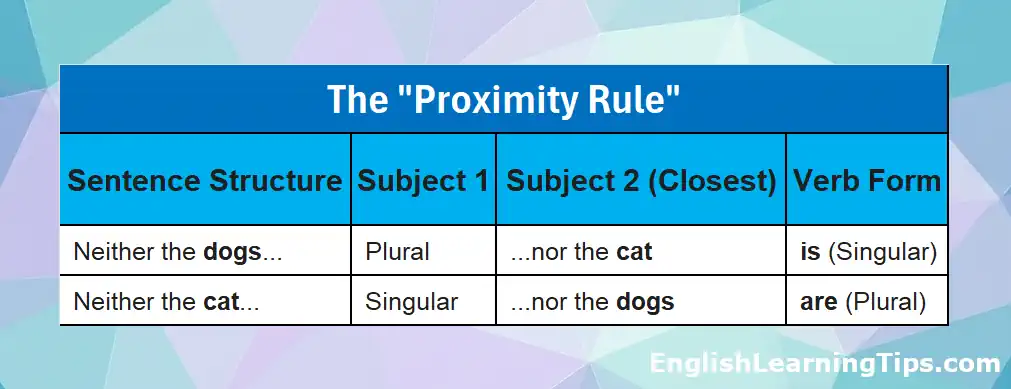
- The Exception: When using “either… or” or “neither… nor” with two different subjects, the verb should agree with the subject closest to it.
- Example: “Neither the teacher nor the students are coming.” (The verb is plural because “students” is closer).
Frequently asked questions about either and neither
The decision tree: Either vs. neither
When you’re stuck between the two, ask yourself these two questions:
- Is the sentence already negative? (Does it have not, don’t, or can’t?)
- Yes: Use Either. (“I don’t want either.”)
- No: Proceed to question 2.
- Am I offering a choice or a total rejection?
- Choice: Use Either. (“Either shirt is fine.”)
- Rejection: Use Neither. (“Neither shirt fits.”)
Video: Either or/Neither nor in English
Conclusion: Master your grammar with the “N” rule
Choosing between either and neither doesn’t have to be a guessing game. By remembering that neither is simply the negative version of either, you can avoid common pitfalls like double negatives and incorrect verb agreement. Whether you are choosing between two options or rejecting them both, using these terms correctly will immediately elevate the clarity of your writing.
Join the conversation
Is there a specific grammar rule that always trips you up? Or perhaps you’ve heard a unique regional way to use either and neither?
We want to hear from you! Drop a comment below with your toughest grammar questions, and don’t forget to share this guide with a friend or colleague who wants to sharpen their English skills.
Discover more from English Learning Tips
Subscribe to get the latest posts sent to your email.


