


Who, whom, whose, whoever, or whomever: The definitive guide

“Who is that?”
Navigating relative pronouns can be surprisingly tricky. Whether you are drafting a formal email or writing the next great novel, knowing the difference between who and whom—or whoever and whomever—is a great way to level up your writing.
This guide breaks down the rules, provides a foolproof “substitution trick,” and explains the nuances of possession with whose.
Understanding subjects vs. objects
To choose the right word, you first need to identify the “actor” in your sentence.
- Subjects (The doers): These perform the action. (Who, Whoever)
- Objects (The receivers): These receive the action or follow a preposition. (Whom, Whomever)
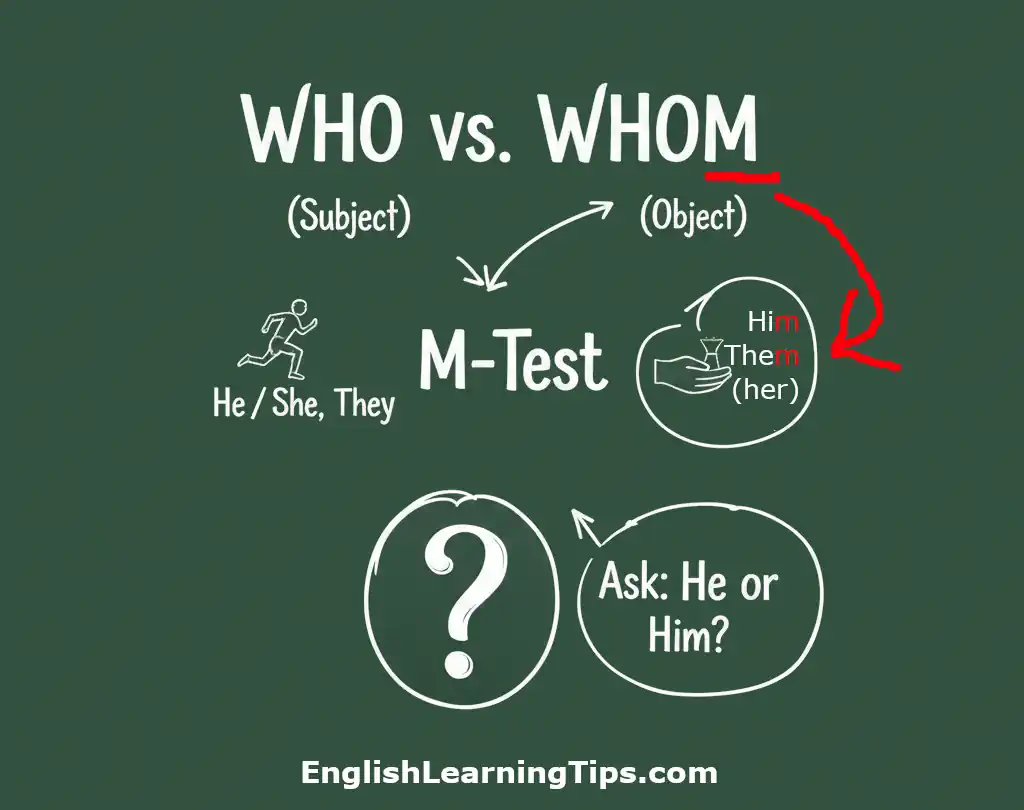
Who vs. whom: The “m” test
The easiest way to identify the correct pronoun is the he vs. him substitution. This trick works because him ends in m, just like whom.
The central rule: If you can answer the question with “him,” use “whom.” If you answer with “he,” use “who.”
1. Who (Subject)
Use who when the pronoun acts as the subject of a verb. If you can replace the word with he, she, or they, use who.
- Example: Who ate the last slice of pizza? (Check: He ate it.)
- Example: The person who called was my boss. (Check: He called.)
2. Whom (Object)
Use whom when the pronoun is the object of a verb or a preposition (like to, with, by, for). If you can replace it with him, her, or them, use whom.
- Example: Whom did you invite to the gala? (Check: I invited him.)
- Example: To whom should I address this package? (Check: Address it to him.)
Why we say “To whom it may concern”
If you’ve ever started a formal cover letter or a legal inquiry, you’ve likely used this phrase.
We use whom here because it follows the preposition to. Even though modern business writing sometimes leans toward “Dear Hiring Manager,” using “To whom it may concern” is still a safe, grammatically correct way to address a professional document when you don’t have a specific contact name.
Whose vs. who’s: The key to possessive pronouns
While who and whom deal with subjects and objects, whose is about ownership. This is where most people get stuck because the two words sound exactly the same.
1. Whose (Possessive)
Whose is the possessive form of the pronoun “who.” Use it when you are asking or telling to whom something belongs. It functions exactly like his, her, or their.
- Example: Whose umbrella is this? (Check: Is it his umbrella?)
- Example: The actor whose name I forgot was brilliant. (Check: His name.)
2. Who’s (Contraction)
Who’s is not a possessive. It is a contraction—a shorter way of saying who is or who has.
- Example: Who’s calling at this hour? (Who is calling?)
- Example: Who’s been eating my lunch? (Who has been eating?)
The “Who Is” Test: If you can replace the word with “who is” and the sentence still makes sense, use who’s. If it doesn’t, you likely need whose.
Whoever vs. whomever: Complex sentence structures
The same logic applies to these compound pronouns, but they often appear in more complex sentences.
1. Whoever (Subject)
Use whoever when the pronoun is the subject of its own clause, even if that entire clause acts as an object.
- Example: Give the award to whoever finishes first.
- Why? Even though the award is being “given to” someone, the word is the subject of the verb “finishes.” (He finishes first.)
2. Whomever (Object)
Use whomever when the pronoun is the object of a verb or preposition within its clause.
- Example: I will go with whomever you recommend.
- Why? “You” are the subject, and the person being hired is the object. (You choose him.)
Quick reference chart for relative pronouns
| Pronoun | Category | Replacement test | Example |
| Who | Subject | He / She | Who fixed the sink? |
| Whom | Object | Him / Her | For whom is this? |
| Whoever | Subject | He / She | Whoever is hungry can eat. |
| Whomever | Object | Him / Her | I’ll talk to whomever I want. |
| Whose | Possessive | His / Her | Whose phone is this? |
| Who’s | Contraction | Who is | Who’s calling so late? |
Frequently asked questions about who vs. whom
Visuals to help you learn
Video: Who, whom, who’s, and whose
Video: Whoever or whomever – The Office
A description of how to use them properly from a television comedy.
Conclusion: Mastering the “m” trick and beyond
Grammar rules like who vs. whom don’t have to be a headache. By using the he vs. him substitution, you can navigate even the most complex sentences with confidence. English is always changing, but these rules still matter if you want your writing to look professional.
We want to hear from you: Which grammar rule trips you up the most?
Is there a specific sentence where you still aren’t sure whether to use who or whom? Drop your toughest grammar questions in the comments below, and our team will help you break them down!
If you found the “m” test helpful, please share this guide with a student, coworker, or fellow word-nerd. Let’s make confusing grammar a thing of the past.
Discover more from English Learning Tips
Subscribe to get the latest posts sent to your email.


