
Mastering compound verbs in English: A complete guide

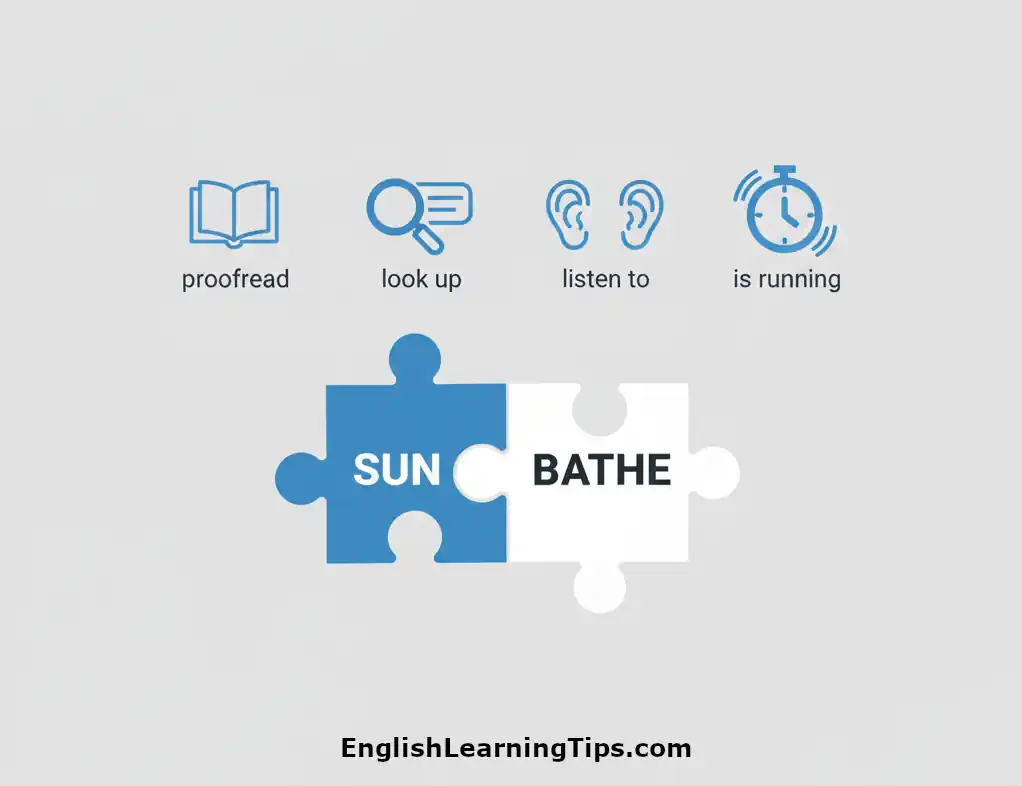
While lounging on a beach, you might say, “We sunbathe a lot.” Without realizing it, you’ve just used a compound verb.
In English grammar, a compound verb is a multi-word unit that functions as a single verb. These linguistic “power couples” combine a base verb with particles, prepositions, or auxiliaries to create a specific meaning that the base verb couldn’t achieve alone.
What is a compound verb?
A compound verb consists of more than one word working together to express a single action or state. By combining a main verb with another element—like an adverb, preposition, or another verb—you create a new, distinct meaning.
Want to master every verb form in English? The English Grammar in Use by Raymond Murphy is the world’s best-selling grammar guide and includes dedicated sections on phrasal and compound verbs.
Quick comparison: Simple vs. compound verbs
| Verb type | Example | Why it’s different |
| Simple verb | I read the book. | A single word expressing a basic action. |
| Compound verb | I proofread the paper. | Combines “proof” + “read” for a specific technical action. |
| Phrasal verb | I looked up the word. | The meaning “to search” is different from the act of “looking.” |
The 4 main types of compound verbs
English uses four primary structures to form these verbs. Understanding these categories is the key to mastering English syntax and improving your writing flow.
1. Compound single-word verbs
These occur when two words merge into one. They are often the most straightforward because they function like a standard verb.
- Closed compounds: No space or hyphen (e.g., babysit, overcome, proofread).
- Hyphenated compounds: Words joined by a dash (e.g., stir-fry, water-cool, free-associate).
2. Phrasal verbs
Phrasal verbs are the most common (and often the most challenging) type of compound verb. They consist of a verb plus an adverb or a preposition.
- Idiomatic meaning: The meaning is usually different from the individual words. For example, to “break down“ means to fail or cry, not to literally break something into pieces.
- Examples: Turn on, take off, give up, run out of.
If phrasal verbs feel like a second language of their own, we recommend a focused workbook like English Phrasal Verbs in Use to help you memorize the most common idiomatic expressions.
3. Prepositional verbs
These consist of a verb followed by a specific preposition that “belongs” to it. Unlike phrasal verbs, the meaning is usually more literal.
- Usage: You believe in a cause, listen to music, or rely on a friend.
- Structure: [Verb] + [Preposition] + [Object].
4. Verbs with auxiliary (helping) verbs
In many English tenses, a main verb needs a “helper” to indicate time, mood, or voice. These are technically compound verb phrases.
- Auxiliaries include: be, have, will, can, must.
- Examples: Is running (present continuous), has been seen (passive voice), will go (future tense).
Key rules for using compound verbs correctly
To use these verbs like a native speaker, keep these three linguistic factors in mind:
- Separability: In some phrasal verbs, you can put the object in the middle. You can “call off the meeting” or “call the meeting off.”
- Meaning shifts: Adding a particle can change a verb entirely. Break (to fracture) is very different from break in (to enter illegally).
- Conjugation: Only the main verb changes its form. In “he is sunbathing,” sunbathe takes the suffix, not the “sun” part.
Frequently asked questions about compound verbs
Conclusion: Mastering the building blocks of English
Whether you are breaking down complex grammar or sunbathing on a beach, compound verbs are the essential tools that give English its flexibility. By understanding the four main types—single-word compounds, phrasal verbs, prepositional verbs, and auxiliary pairings—you can move past basic sentences and start speaking with the nuance of a native speaker.
Language is constantly evolving, and these multi-word units are at the heart of that change. The more you “look into” these structures, the more natural your English will become.
Join the conversation
We want to hear from you! Compound verbs can be one of the trickiest parts of learning English because their meanings change so quickly.
- What is one phrasal verb or compound verb that always trips you up?
- Do you have a favorite “weird” English compound verb?
Drop a comment below and let’s discuss! If you found this guide helpful, share it with a fellow language learner or teacher—it helps more than you know.
Discover more from English Learning Tips
Subscribe to get the latest posts sent to your email.


