
Interjections in English: A complete guide to emotional punctuation

“Wow! That’s incredible!”
Interjections are the verbal equivalent of a facial expression. They add immediate context to a sentence that a period or comma just can’t provide. But what exactly are they, and how do you use them correctly without overdoing it?
What is an interjection?
An interjection is a word or phrase used to express a strong feeling or sudden emotion. Unlike nouns or verbs, interjections are grammatically independent. This means they don’t have a structural connection to the rest of the sentence; you could remove them, and the sentence would still be grammatically “correct,” though it would lose its emotional impact.
Think of them as emotional punctuation marks. They are most common in spoken English and informal writing, such as texting, fiction, or creative blogging. Unlike other parts of speech—such as conjunctions or prepositions—interjections don’t help build the sentence’s structure; they just add to its mood.
If you’re looking to master all parts of speech beyond just interjections, a reliable desk reference like The Blue Book of Grammar and Punctuation is an essential tool for any writer’s desk.
Common types of interjections and their functions
Interjections do more than just show excitement. They serve several distinct roles in communication.
| Category | Purpose | Examples |
| Volitive | To express a command or request | Shh, Psst, Yo |
| Emotive | To express a spur-of-the-moment emotion | Eww, Ouch, Yay, Ugh |
| Cognitive | To show a thought process or realization | Aha, Oh, Um, Uh |
| Greetings | To initiate or end an interaction | Hello, Hey, Hi, Bye |
1. Expressing immediate reactions
The most common use of an interjection is to show how you feel about something the moment it happens.
- Disgust: “Yuck! This milk is sour.”
- Pain: “Ouch! I stubbed my toe.”
- Surprise: “Whoa! I didn’t see you there.”
2. Managing the flow of speech (Pauses)
Sometimes called “fillers,” these interjections help a speaker think of what to say next.
- “I think we should go at, um, six o’clock.”
- “Uh, I’m not sure that’s a good idea.”
3. Capturing attention
Interjections can be used to signal someone or demand silence.
- “Ahem! Can I have everyone’s attention?”
- “Hey! Watch where you’re going.”
How to punctuate interjections
Because interjections represent a sudden burst of feeling, they are often followed by an exclamation point (!). However, the punctuation depends on the intensity of the emotion:
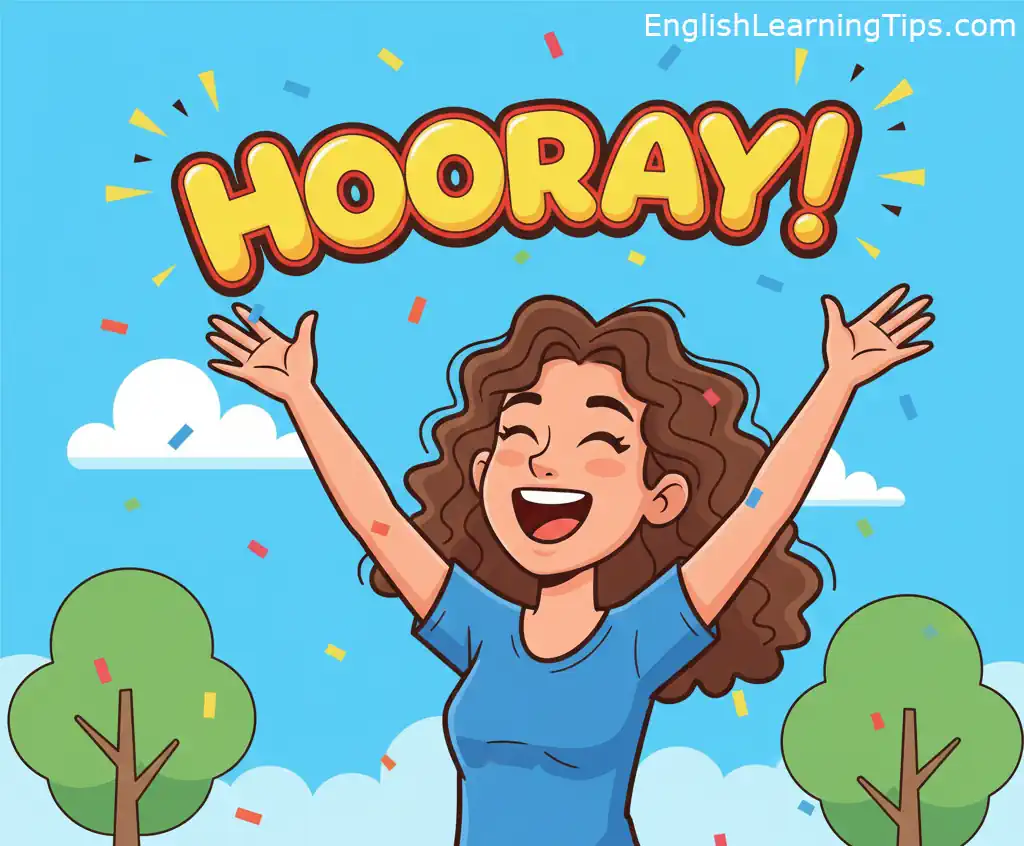
- Strong emotion: Use an exclamation point for high-energy reactions. (“Hooray! We won the championship!”)
- Mild emotion: Use a comma for a softer tone or when the interjection is part of a larger thought. (“Oh, I didn’t know you were coming.”)
- Uncertainty: Use an ellipsis for hesitation. (“Well… I suppose we could try.”)
The ultimate list of 50 common interjections by emotion
To help you choose the right “flavor” for your writing, here is a categorized breakdown of 50 common interjections. Using these correctly can make your dialogue sound more natural and less like a textbook.
Positive emotions (Joy, surprise, and relief)
- Aha! (Discovery or realization)
- Amazing! (Great wonder)
- Bingo! (Correctness or success)
- Bravo! (Approval of a performance)
- Cheers! (A toast or a friendly goodbye)
- Eureka! (A sudden discovery)
- Hooray! (Celebration)
- Oh! (Surprise or sudden shift in thought)
- Phew! (Relief after a stressful moment)
- Presto! (Showing something quickly)
- Wait! (Surprise or calling for a stop)
- Whoa! (Amazement or telling someone to slow down)
- Wow! (Strong astonishment)
- Yay! (High excitement)
- Yippee! (Childlike joy)
Negative emotions (Disgust, pain, and frustration)
- Argh! (Extreme annoyance)
- Bah! (Dismissiveness)
- Blah! (Boredom or feeling unwell)
- Boo! (Disapproval or trying to scare someone)
- Darn! (Mild frustration)
- Drat! (Disappointment)
- Eek! (Fear or being startled)
- Eww! (Disgust)
- Grrr! (Anger or growling)
- Humph! (Indignation or skepticism)
- Lordy! (Shock or frustration)
- Ouch! (Physical pain)
- Oy! (Annoyance or calling out)
- Ugh! (Dislike or exhaustion)
- Yikes! (Mild fear or alarm)
- Yuck! (Strong distaste for food or smells)
Hesitation and thinking (Cognitive fillers)
- Er… (Uncertainty)
- Hmm… (Deep thought or curiosity)
- Huh? (Confusion or asking for a repeat)
- Mhm… (Agreement or “I’m listening”)
- Uh-huh. (Affirmative)
- Uh-oh. (Realizing a mistake happened)
- Uh… (Pausing for a word)
- Um… (The most common filler during a speech)
- Well… (Introducing a hesitant thought)
Attention-getting and commands (Volitive)
- Ahem! (Clearing the throat to get attention)
- Halt! (Ordering a stop)
- Hey! (Calling out to someone)
- Hi! (Greeting)
- Hush! (Ordering silence)
- Look! (Directing focus)
- Psst! (Whispering for attention)
- Shh! (Requesting quiet)
- Tsk-tsk! (Expressing shame or disapproval)
- Yo! (Casual greeting)
Frequently asked questions about interjections
Visual tools to help you learn
Video: Common types of interjections
Video: Interjections for kids
Conclusion: Why interjections matter in your writing
Mastering interjections is about more than just knowing when to shout “Ouch!” or “Yay!” Interjections might be tiny, but they do the heavy lifting when it comes to showing how a person actually feels. They turn a static sentence into a lived-in moment.
While they may not belong in your next legal brief or scientific report, interjections are the heartbeat of creative expression. Whether you are a student perfecting your English or a writer looking to add “soul” to a character, these emotional punctuation marks are your best tool for clarity and impact.
Join the conversation
Is ‘like’ an interjection or just a bad habit? And what’s the one interjection that drives you crazy when you hear it? Drop your thoughts in the comments—I’m curious to see which ones we all love (and hate) the most!
Discover more from English Learning Tips
Subscribe to get the latest posts sent to your email.


