


All about nouns in English: Types, examples, and usage

Nouns do more than just name things—they provide the subject for every story we tell. Whether you’re identifying a physical object like a dog or an intangible concept like democracy, nouns are the bedrock of English sentences.
Nouns are categorized based on their specific roles. You’ll use different types—like proper, common, concrete, or abstract—depending on how specific or tangible your subject needs to be. They are one of the fundamental building blocks of sentences—giving us something to talk about—like “dog,” “city,” “happiness,” or “teacher.”
This ultimate guide on nouns is designed as a resource for nouns for beginners and advanced learners alike, exploring how they provide the subject or object for our thoughts. Whether it is a person (Sarah), a place (the park), a thing (a book), or a concept (freedom), if it names something, it is a noun.
- All about nouns in English: Types, examples, and usage (this article)
- Compound nouns in English: Rules, examples, and types
- Nominalization: Definition, examples, and how to improve your writing
- Uncountable nouns: A complete guide to mass nouns in English
- Countable nouns: A complete guide to grammar and usage
- Collective nouns: The ultimate guide to group names and usage
- Abstract nouns: Definition, examples, and how to use them
- What are concrete nouns? Definition, examples, and usage
- Proper nouns: Definition, examples, and usage rules
- Infinitives: A complete guide to understanding and using the base verb form
- Understanding gerunds: A complete guide to grammar, rules, and examples
How many types of nouns are there?
In English grammar, nouns are categorized by what they represent and how they function within a sentence. While there are many sub-categories, we generally focus on these primary types:
1. Proper nouns
Proper nouns are specific names of unique people, places, or organizations. These are always capitalized regardless of where they appear in a sentence.
- Examples: Sarah, London, Google, Eiffel Tower, Christmas
2. Common nouns
Common nouns are general names for items, people, or places rather than specific ones. They are only capitalized if they start a sentence.
- Examples: teacher, city, book, dog, table
3. Concrete nouns
These refer to physical things that you can perceive through the five senses: sight, hearing, touch, taste, or smell.
- Examples: flower, music, pizza, chair, perfume
4. Abstract nouns
Abstract nouns represent ideas, qualities, or abstract concepts—things that have no physical reality and cannot be touched.
- Examples: freedom, love, justice, beauty, anger
5. Collective nouns
A collective noun refers to a group of people or things that act as a single unit.
- Examples: team, family, flock, herd, crowd
6. Countable vs. uncountable nouns
- Countable nouns: These refer to things that can be counted as individual units and have both singular and plural forms (e.g., one apple, two apples).
- Uncountable nouns: Uncountable nouns (also known as mass nouns) refer to substances or concepts that cannot be divided into separate units.
Writer’s tip: The biggest mistake with uncountable nouns is trying to pluralize them. Words like ‘advice’ or ‘equipment’ never take an ‘s,’ no matter how many of them you have.
7. Compound nouns
These are created when two or more words combine to form a single noun with a new, distinct meaning.
- Examples: toothpaste, six-pack, bus stop
8. Possessive nouns
By adding an apostrophe (and usually an “s”), these nouns show ownership or a direct relationship.
- Examples: the dog’s bone, the city’s lights
Summary of noun types and examples
| Type of noun | Description | Examples |
| Proper | Specific, unique names (capitalized) | John, Paris, Amazon |
| Common | General names for things | dog, city, idea |
| Concrete | Physical things perceived by senses | table, music, flower |
| Abstract | Concepts, feelings, or qualities | love, freedom, justice |
| Collective | Names for groups of things/people | team, family, crowd |
| Countable | Items that can be counted | car, book, apple |
| Uncountable | Items that cannot be counted | water, air, information |
Master your grammar: If you want a physical workbook to practice these noun rules, we highly recommend English Grammar in Use. It is widely considered the most authoritative self-study book for English learners.
How nouns function in sentences
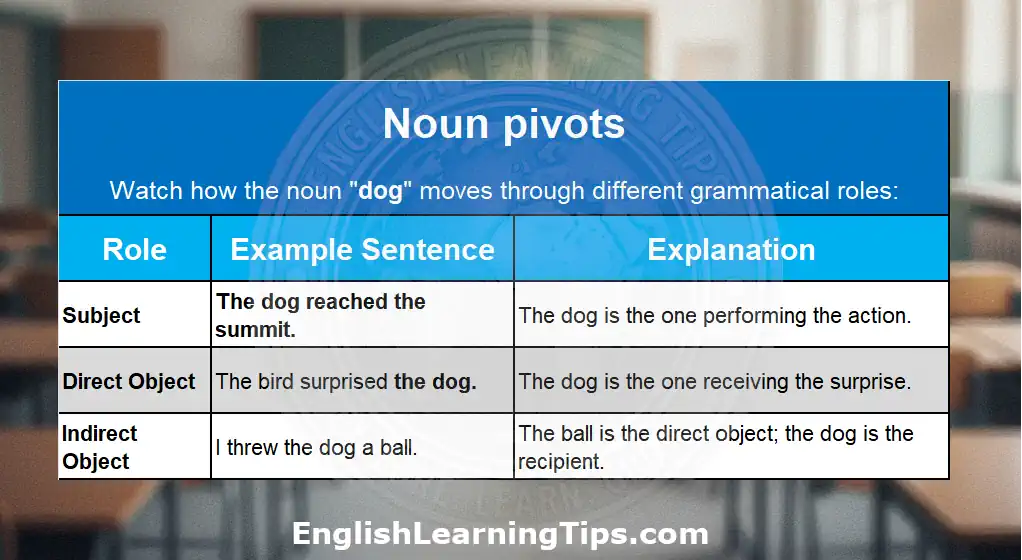
Nouns are versatile; their grammatical role changes based on their position in a sentence. Mastering these functions is key to understanding English syntax.
- As a subject: The noun performs the action of the verb (e.g., “The cat slept”).
- As an object: The noun receives the action (e.g., “She pet the cat“).
- The subject/object pivot: A noun can transition between these roles without changing its spelling.
- Subject: “The baker made the bread”.
- Direct object: “The family visited the baker“.
- As an indirect object: The noun identifies to whom or for whom the action is performed. It usually sits between the verb and the direct object.
Writer’s tip: Proper noun usage is the key to clear writing. For a deep dive into using nouns to create a professional tone, check out the classic guide The Elements of Style.
A note on pluralization
Most countable nouns become plural by adding “-s” or “-es”. However, English is famous for irregular nouns that change completely (e.g., child to children) or stay the same (e.g., sheep). Check out the guide on English plurals for more information.
Frequently asked questions about nouns
Test your knowledge: The noun mastery quiz
Test your understanding of English nouns with these five questions. These cover everything from basic pluralization to advanced grammatical functions.
1. Which of these is the correct plural form for a compound noun?
- A) Mother-in-laws
- B) Mothers-in-law
- C) Mothers-ins-laws
2. Where is the word stress usually placed in a compound noun to distinguish it from a phrase?
- A) On the first word (e.g., greenhouse)
- B) On the second word (e.g., green house)
- C) Equally on both words
3. “Ice cream” is an example of which type of compound noun?
- A) Closed
- B) Hyphenated
- C) Open
4. In the sentence “The committee has reached its decision,” how is the collective noun “committee” acting?
- A) As a plural unit with individual actions
- B) As a single, collective unit
- C) As an abstract concept
5. Which of these words is a mass (uncountable) noun that often confuses English learners?
- A) Suggestion
- B) Fact
- C) Information
- B (Mothers-in-law): Always pluralize the “headword” or the primary noun in a compound.
- A (On the first word): In English, stressing the first word indicates the two words have merged into a single noun identity.
- C (Open): Open compound nouns are written as two words with a space but represent a single idea.
- B (Single, collective unit): Because the verb “has” and the pronoun “its” are singular, the committee is acting as one body.
- C (Information): Unlike “suggestion” or “fact,” you cannot have “three informations.” It is always singular in English.
Visual tools for learning
Video: Making a types of nouns chart
Putting your noun knowledge into practice
Nouns are the anchors of our thoughts. Whether you are naming a specific person like Einstein, a concrete object like a guitar, or an abstract idea like hope, nouns allow us to categorize and navigate the world. By mastering the nuances of proper vs. common nouns, abstract vs. concrete nouns, and the rules of countable and uncountable nouns, you gain the power to communicate with far greater precision and clarity.
We want to hear from you
Understanding nouns is just the first step in mastering English grammar. Did any of these categories surprise you, or do you have a tricky noun you’re struggling to pluralize?
- Leave a comment below with your favorite collective noun (like a “murder” of crows or a “pride” of lions).
- Share this guide with a fellow learner or teacher who wants to sharpen their writing skills.
- Ask a question if there is a specific noun type you’d like us to cover in more detail.
Your insights help us create better resources for the community—let’s start a conversation!
Discover more from English Learning Tips
Subscribe to get the latest posts sent to your email.


