
Asking for and giving directions in English: A complete guide

There is nothing more stressful than being lost in a busy city and not knowing how to ask for help—or worse, not understanding the help you receive.
This guide covers everything from polite inquiries to using landmarks and prepositions to ensure you reach your destination.
How to ask for directions politely
When approaching a stranger, it is best to start with a “softener” or a polite greeting. This makes the person more likely to stop and help you.
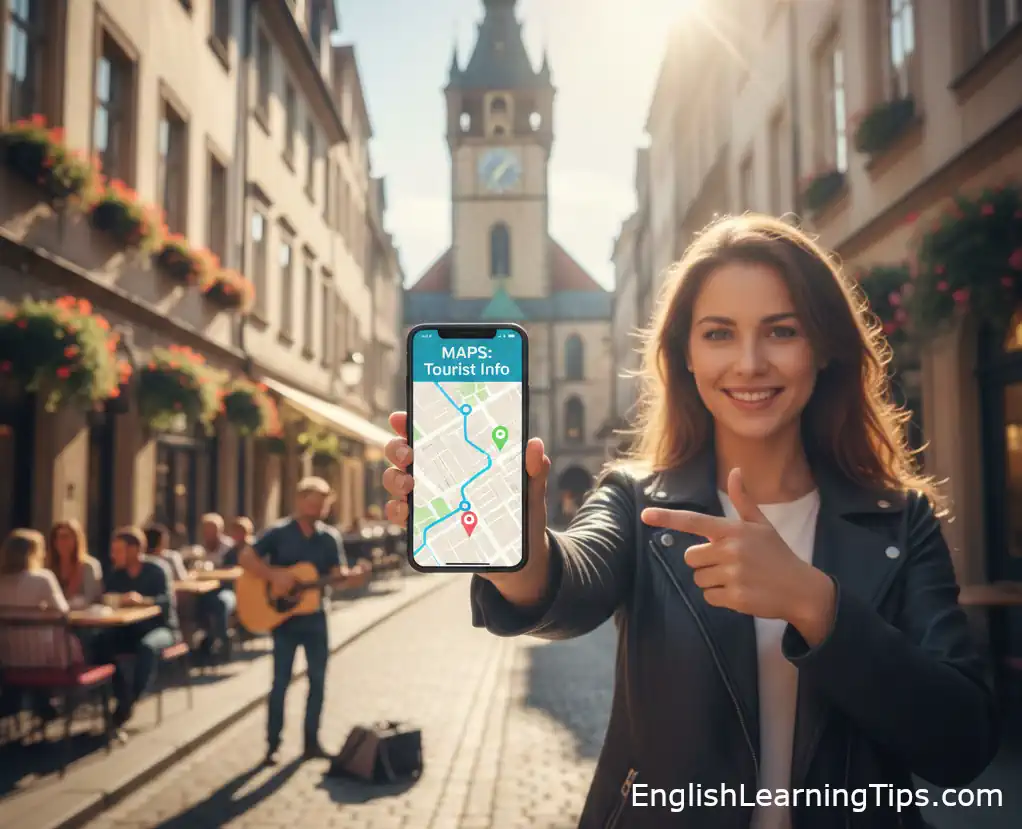
Polite phrases for asking for directions
- “Excuse me, could you tell me how to get to…?” (The most common formal way).
- “Pardon me, I’m looking for…”
- “Excuse me, am I going the right way for…?”
- “Could you direct me to the nearest [landmark]?”
Informal inquiries
If you are in a rush or speaking to someone your own age in a casual setting, you might use:
- “Where is the…?”
- “How do I find the…?”
- “Which way is the…?”
How to give clear directions in English
Giving directions requires a logical flow. You should start with the general direction, move to specific actions (turning), and finish with landmarks to confirm the location.
Essential movement verbs and phrases
| Action | Phrase examples |
| Straight | Go straight ahead, walk along the street, keep going until… |
| Turning | Turn left/right, take the first exit, make a U-turn |
| Passing | Go past the library, go over the bridge, go through the park |
| Crossing | Cross the road, go across the intersection |
While these phrases will help you communicate, having a few physical tools can be a lifesaver when your phone battery dies or you lose signal.
Using landmarks for clarity
Landmarks are often more helpful than street names. Use phrases like:
- “You will see a large blue building on your left.”
- “Look for the Starbucks on the corner.”
- “It is right at the intersection of 5th Avenue and Main Street.”
Using prepositions of place
To describe exactly where a building is located, you must use the correct prepositions. This prevents the “it’s over there” confusion.
- Next to: The pharmacy is next to the bank.
- Opposite / Across from: The station is opposite the cinema.
- Between: The cafe is between the library and the post office.
- On the corner: The hotel is on the corner of the block.
- Behind / In front of: The parking lot is behind the mall.
Pro Tip: If someone tells you to “go two blocks,” they mean the distance between two street intersections. In the UK, people rarely use “blocks” and will instead tell you to “take the second exit” at a roundabout.
Estimating distance and time
Providing a timeframe helps the person know if they should walk or take a taxi.
- “It’s about a five-minute walk.”
- “It’s roughly two blocks away.”
- “It’s quite a long way; you might want to take the bus.”
- “It’s just around the corner.”
Example dialogue: Finding the museum
Tourist: “Excuse me, could you tell me how to get to the Natural History Museum?”
Local: “Certainly. Go straight ahead for two blocks, then turn left at the traffic lights. Walk past the post office, and you’ll see the museum on your right. It’s right across from a large park.”
Tourist: “Thank you. Is it a long walk?”
Local: “No, it’s only about five minutes from here. You can’t miss it!”
Tourist: “Perfect, thanks for your help.”
Local: “You’re welcome! Enjoy your visit.”
Frequently asked questions about English directions
Mastering your next English conversation
Learning how to ask for and give directions in English is about more than just finding a destination; it is about building the confidence to interact with people in any city in the world. By practicing these polite phrases, using clear landmarks, and mastering prepositions of place, you ensure that you—and those you help—will never be truly lost.
We want to hear from you: What is your experience?
Have you ever had a funny or interesting experience while asking for directions in a foreign country? Or is there a specific phrase you find most helpful when navigating a new city?
Also see: Real-life conversation starters for English as a second language students
Leave a comment below and share your story! If you found this guide helpful, please share it with a friend who is practicing their English or preparing for a trip. Your engagement helps our community grow and stay helpful for language learners everywhere.
Discover more from English Learning Tips
Subscribe to get the latest posts sent to your email.


