

Homonyms: Definition, examples, and how they work

“Did the dog bark at the tree bark?”
In the English language, words aren’t always what they seem. You might read a word or hear a sound that you recognize, only to realize the context has shifted entirely. These linguistic double-agents are known as homonyms.
What is a homonym?
A homonym is a word that shares the same spelling or the same pronunciation as another word but carries a different meaning.
Think of “homonym” as an umbrella term. Underneath this umbrella, we categorize words based on whether they look the same, sound the same, or both. Understanding these nuances is key to mastering English grammar.s.
The difference between homophones and homographs
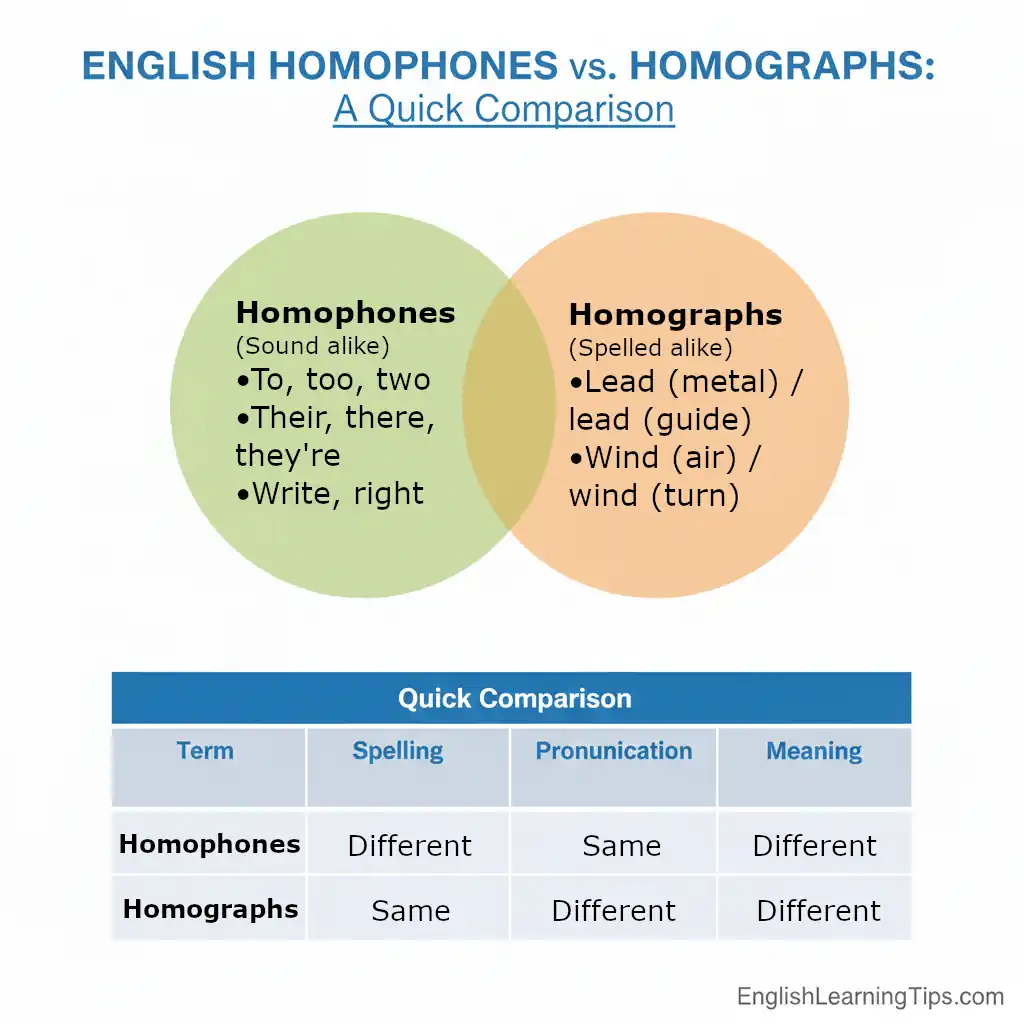
To truly understand how homonyms work, we have to look at their two main components:
- Homophones: These words sound identical when spoken but have different spellings and meanings.
- Examples: To, too, and two; there, their, and they’re.
- Homographs: These words are spelled exactly the same but have different pronunciations and meanings.
- Examples: Lead (to guide) and lead (the heavy metal); wind (the breeze) and wind (to turn a key).
Note: Some words are both homophones and homographs—spelled and pronounced the same, but with different meanings. You can find more examples of these tricky word categories at Merriam-Webster, such as the dual use of the word “bat.”
Quick comparison of homonym types
| Term | Spelling | Pronunciation | Meaning |
| Homonym | Same | Same | Different |
| Homophone | Different | Same | Different |
| Homograph | Same | Different | Different |
Why homonyms matter in the English language
Homonyms aren’t just there to trip you up during a spelling bee; they serve several functional and creative purposes in communication:
- Creative wordplay: Most puns and “dad jokes” rely on homonyms to create a humorous twist.
- Literary depth: Authors use linguistic ambiguity to create double meanings or foreshadowing in poetry and prose.
- Contextual learning: Mastering homonyms forces a reader to rely on context clues, which improves overall reading comprehension and cognitive flexibility.
However, they can also lead to confusion. In professional writing, misusing a homophone (like writing “it’s” instead of “its”) can undermine your credibility. Always proofread carefully to ensure your intended meaning is clear.
Frequently asked questions about homonyms
Master the nuance of homonyms
Understanding the difference between a homophone and a homograph is more than just a grammar lesson; it is a way to sharpen your communication skills. While these words can be a source of confusion, they also provide the humor and depth that make the English language so unique. By paying close attention to context and spelling, you can avoid common pitfalls and write with greater confidence.
Join the conversation: What is your favorite homonym?
We want to hear from you! The English language is full of tricky word pairs that keep us on our toes.
- Which homonym always trips you up when you are writing?
- Do you have a favorite pun or “dad joke” that uses a clever homophone?
- Is there a specific word you think we should add to our list?
Leave a comment below to share your thoughts, and if you found this guide helpful, share it with a friend or a fellow word-nerd who loves linguistics as much as we do!
Discover more from English Learning Tips
Subscribe to get the latest posts sent to your email.


