

Homophones: What they are and how to use them

“Dear Deer, you are beautiful.”
While that sentence sounds perfectly normal when spoken, the spelling tells a different story. English is full of these linguistic “twins”—words that sound identical but mean entirely different things. These are known as homophones.
Understanding homophones is essential for mastering English grammar, improving spelling, and avoiding embarrassing typos in professional writing.
What is a homophone?
A homophone is a word that is pronounced the same as another word but differs in meaning. Homophones may have the same spelling (like rose the flower and rose the past tense of rise) or different spellings (like to, too, and two).
The term comes from the Greek roots homo- (same) and phonos (sound).
If you’re teaching homophones to kids, this classic book, Dear Deer: A Book of Homophones by Gene Barretta, is a standard for visual learners.
Homophones vs. homonyms vs. homographs
It is easy to get these confused, as they all fall under the umbrella of ‘ambiguous words’ in English grammar.
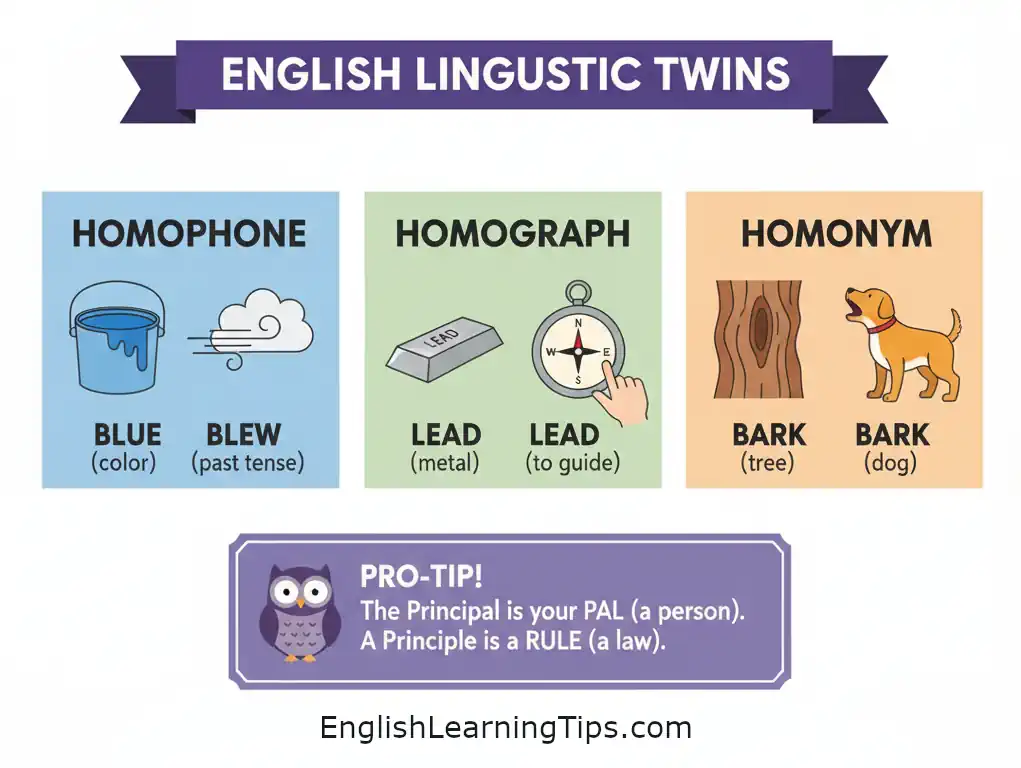
| Term | Sound | Spelling | Meaning | Example |
|---|---|---|---|---|
| Homophone | Same | Same or Different | Different | Blue / Blew |
| Homograph | Same or Different | Same | Different | Lead (metal) / Lead (to guide) |
| Homonym | Same | Same | Different | Bark (tree) / Bark (dog) |
Why homophones matter in the English language
Homophones aren’t just a quirk of linguistics; they serve several functions in how we communicate:
- Wordplay and humor: Most puns rely on homophones to create a double meaning (e.g., “I’ve been to the dentist many times, so I know the drill“).
- Contextual listening: They force listeners to rely on the surrounding sentence to determine meaning, which is a key part of cognitive language processing.
- Writing precision: Choosing the wrong homophone (like writing their instead of there) can change the entire tone of a document and affect the writer’s credibility.
Common homophone examples and their meanings
To help you avoid common writing errors, here are some of the most frequently confused sets in the English language.
Their, there, and they’re
- Their: A possessive pronoun (e.g., It is their house).
- There: Refers to a place or a point (e.g., Look over there).
- They’re: A contraction of “they are” (e.g., They’re going to the park).
To, too, and two
- To: Used for direction or as part of a verb (e.g., Go to the store).
- Too: Means “also” or “excessive” (e.g., I ate too much).
- Two: The number 2.
Your and you’re
- Your: A possessive pronoun (e.g., Is this your book?).
- You’re: A contraction of “you are” (e.g., You’re doing a great job).
A comprehensive list of English homophones
Below is an alphabetical reference list of common homophones to help you check your spelling and usage.
- A-B: Air / heir, aisle / I’ll / isle, ate / eight, bare / bear, be / bee, board / bored, born / borne, brake / break, by / buy / bye.
- C-D: Cell / sell, cent / scent / sent, cereal / serial, coarse / course, dear / deer, dew / due, die / dye, doe / dough, done / dun.
- F-H: Fair / fare, flea / flee, flour / flower, for / four, groan / grown, hair / hare, heal / heel, hear / here, him / hymn, hole / whole, hour / our.
- I-M: In / inn, knead / need, knew / new, knight / night, knot / not, know / no, mail / male, meat / meet.
- N-S: None / nun, one / won, pail / pale, pair / pear, peace / piece, plain / plane, pour / poor, rain / reign / rein, read / red, right / write, road / rode, rose / rows, sea / see, sew / so, sight / site, son / sun, steal / steel.
- T-W: Tail / tale, waist / waste, wait / weight, way / weigh, weak / week, wear / where, which / witch, who’s / whose, wood / would.
Frequently asked questions about homophones
Visual tools to guide your learning
Video: Learn 17 homophone pairs in English
Video: The top 10 British English homophones
Video: What are homophones? A children’s lesson
Conclusion: Mastering the sounds of English
Getting your homophones right isn’t just about passing a spelling test—it’s about making sure your message doesn’t get lost in translation. While these “sound-alike” words can be a source of frustration for students and writers alike, they also provide the linguistic texture that makes English so unique. By paying close attention to context and using tools like a dictionary or a dedicated homophone list, you can ensure your writing remains professional and error-free.
Whether you are navigating the “there, their, they’re” trap or curious about how your accent changes the way words sound, mastering these pairs is a major step toward English fluency.
Join the conversation
Which homophone pair always trips you up? Or better yet, do you have a favorite pun that relies on a clever homophone?
Drop a comment below and let’s see if we can build the ultimate community list of the trickiest words in the English language. If you found this guide helpful, share it with a fellow writer or student who wants to level up their grammar game!
Discover more from English Learning Tips
Subscribe to get the latest posts sent to your email.


