

If clauses in English: A complete guide to conditional sentences

“If the mountains could speak, they would tell tales of ancient winds and forgotten climbers.”
If clauses (also known as conditional sentences) allow you to describe everything from scientific facts to hypothetical regrets. They allow you to discuss everything from scientific facts and daily habits to “what-if” scenarios and past regrets.
Understanding how to use “if” clauses correctly is essential for achieving fluency. In this guide, we’ll cover the four main types of conditionals, plus mixed variants, to help you master their structure and usage.
What is an if clause?
An if clause is a subordinate clause that sets up a condition. For a sentence to be complete, this condition is paired with a main clause that explains the result.
Pro tip: You can change the order of the clauses. If the “if” clause comes first, use a comma. If the main clause comes first, no comma is needed.
- With comma: If it rains, we will stay inside.
- Without comma: We will stay inside if it rains.
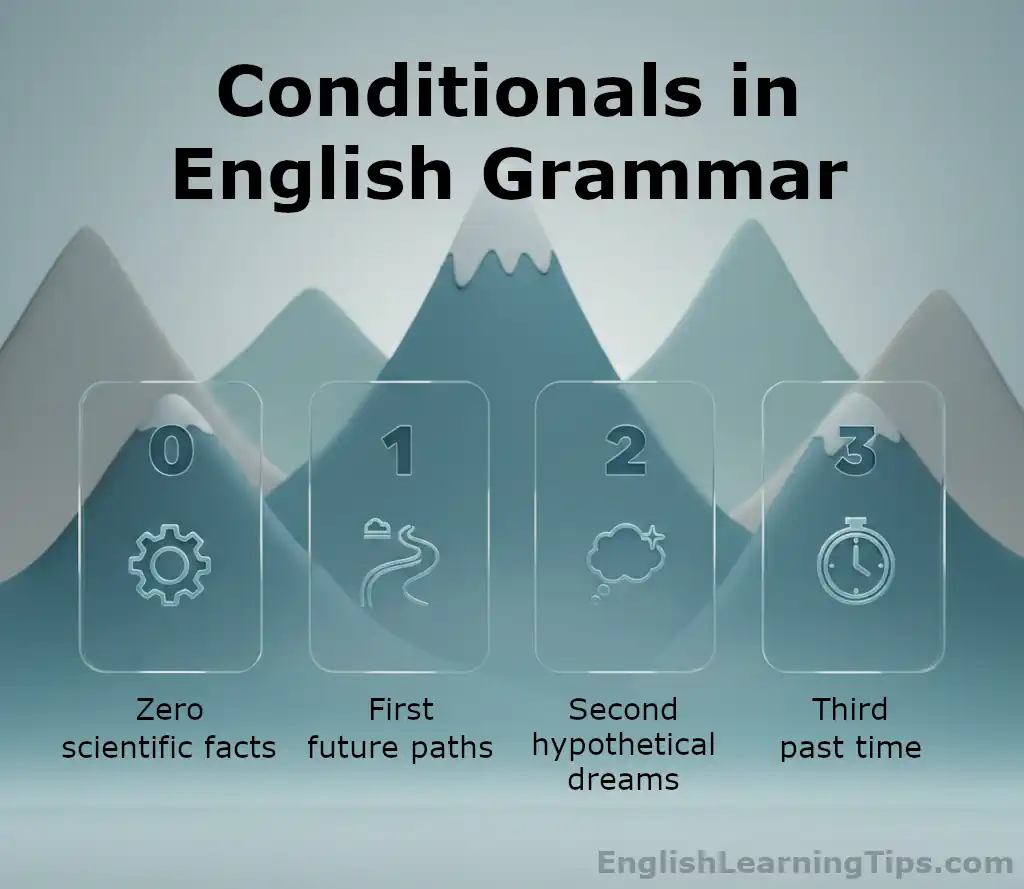
Love the visuals? If you found our infographic helpful, you’ll love the English for Everyone Grammar Guide. It uses 3D illustrations to make complex rules like mixed conditionals easy to see.
The four types of conditional sentences
English uses four primary structures to talk about different levels of probability.
1. Zero conditional: General truths
The zero conditional describes things that are always true, such as scientific laws or routine habits.
- The formula: If + present simple, present simple
- Example: If you heat ice, it melts.
2. First conditional: Real possibilities
Use the first conditional for things that are likely to happen in the future if a specific condition is met.
- The formula: If + present simple, will + base verb
- Example: If I finish my work early, I will go to the gym.
3. Second conditional: Unreal present or future
This structure is for “dreaming” or hypothetical scenarios that are unlikely or impossible right now.
- The formula: If + past simple, would + base verb
- Example: If I lived in Tokyo, I would eat sushi every day.
4. Third conditional: Past regrets
The third conditional looks back at the past and imagines a different outcome that never actually happened.
- The formula: If + past perfect, would have + past participle
- Example: If she had arrived on time, she wouldn’t have missed the flight.
Master the rules: If you want to dive deeper into these formulas, the English Grammar in Use workbook is the #1 tool used by learners worldwide to lock in these structures.
Comparison of if clause structures
| Conditional type | Usage | Verb tense in if clause | Verb tense in main clause |
| Zero | Facts/Habits | Present simple | Present simple |
| First | Possible future | Present simple | Will + base verb |
| Second | Hypothetical | Past simple | Would + base verb |
| Third | Past regret | Past perfect | Would have + past participle |
Advanced conditional usage: Mixed and alternatives
Mixed conditionals
Sometimes, a past action has a direct effect on the present. In these cases, we mix the second and third conditionals.
- Example: If I had moved to London last year (past condition), I would be fluent in English now (present result).
Using “unless”
You can often replace “if… not” with unless. It simplifies the sentence while keeping the same meaning.
- If not: If it doesn’t rain, we’ll have a BBQ.
- Unless: Unless it rains, we’ll have a BBQ.
Modal verbs in conditionals
While “will” and “would” are the most common, you can swap them for other modal verbs to change the “flavor” of the sentence:
- Can/Could: Ability (If I have time, I can help you.)
- Might/May: Possibility (If it clears up, we might go for a walk.)
- Should: Advice (If you want to pass, you should study.)
Frequently asked questions about if clauses
Visual tools to help you master conditionals
Video: The Contitionals 0, 1, 2, 3,
Video: English conditional sentences
Conclusion: Master your English conditionals
Understanding if clauses is about more than just memorizing formulas; it is about using these to talk about your dreams, your regrets, and your future plans. Whether you are prepping for an English proficiency exam like the IELTS or simply want to sound more natural in conversation, mastering these conditional sentence structures is a major step forward.
By practicing the transition from the first conditional (real possibilities) to the third conditional (past hypotheticals), you will find that your English becomes more nuanced and professional.
Ready to test your skills? Consistent practice is the only way to make these “if” clauses second nature. We recommend The English Grammar Workbook for Adults for its excellent bite-sized exercises.
Join the conversation: What is your “if”?
We want to hear from you! Practicing in the comments is one of the best ways to lock in what you have learned.
- The challenge: Write one sentence using the second conditional (hypothetical) about something you would do if you had more free time.
- Have a question? If you are stuck on a specific “if” clause or a tricky mixed conditional, drop a comment below and our team will help you clear it up.
If you found this guide helpful, please share it with your fellow learners or on LinkedIn and Twitter. Your shares help us create more free grammar resources for everyone!
Discover more from English Learning Tips
Subscribe to get the latest posts sent to your email.


