


Inversion in English grammar: A complete guide to inverted sentence structure

“The wild river runs into the deep forest.” –> “Into the forest deep, runs the river wild.”
“Ever noticed how a simple sentence feels more powerful when you move the words around? While standard English typically follows a Subject-Verb-Object pattern, we sometimes flip the script to grab attention.
While it might sound like something out of a Shakespearean play, inversion is a practical tool used for asking questions, adding emphasis, and creating a formal tone in academic writing.
What is inversion in English?
Inversion simply means flipping the usual subject-verb order to create a different emphasis. According to the Cambridge Dictionary, this structure is most commonly used in formal styles or to form specific question types.
- Standard order: “The sun comes here.”
- Inverted order: “Here comes the sun.”
In the second example, the adverb “here” triggers the verb to move in front of the subject “the sun.” This isn’t just a stylistic choice; in many cases, English grammar actually requires this flip to function correctly.
Why do we use inverted word order?
Think of inversion as a way to control the ‘volume’ or ‘impact’ of your message.
- Forming questions: This is the most common use of the auxiliary verb inversion.
- Adding emphasis: Placing an adverbial at the start of the sentence draws the reader’s eye to it immediately.
- Formal or literary tone: It makes prose feel more sophisticated or dramatic.
- Grammatical necessity: Some phrases, like negative adverbials, demand inversion to be grammatically correct.
If you want to use inversion to improve your prose, classic style guides can help you find the right balance. Check out The Elements of Style for timeless advice on sentence variety.
When so you use inversion in English? (4 common scenarios)
Let’s look at the most common ways you’ll see this in action.
1. Inversion in questions
In almost all English questions, the auxiliary verb (be, do, have, or a modal) moves before the subject.
- Standard: “You are ready.”
- Inverted: “Are you ready?”
2. Negative inversion (after negative adverbials)
When you start a sentence with a negative or restrictive adverb, you must invert the subject and the auxiliary verb. This is highly effective for persuasive or dramatic writing.
| Trigger word | Standard sentence | Inverted (emphasized) sentence |
| Never | I have never seen such a mess. | Never have I seen such a mess. |
| Seldom | He seldom goes out. | Seldom does he go out. |
| Rarely | They rarely complain. | Rarely do they complain. |
| Not only | He is smart and kind. | Not only is he smart, but he is also kind. |
For a full list of negative adverbials that trigger this flip, the British Council offers an excellent guide for advanced learners
3. Conditional sentences (replacing “if”)
In formal English, you can drop the word “if” by inverting the verb. This is common with “had,” “were,” and “should.” This specific type of ‘if-less’ conditional is a staple of professional and academic English; you can see more examples of these advanced conditional structures here.
- Standard: “If I had known, I would have helped.”
- Inverted: “Had I known, I would have helped.”
4. Adverbials of place (here and there)
When “here” or “there” starts a sentence to indicate location or arrival, the main verb moves before the subject.
- Standard: “The bus comes here.”
- Inverted: “Here comes the bus.”
When to avoid inversion
Because inversion is so stylistically heavy, it is easy to overdo.
- Avoid in casual conversation: Saying “Never have I been so hungry” at a fast-food counter sounds out of place.
- Don’t force it: Only use inversion when you want to draw specific attention to a negative frequency (like “rarely”) or when the grammar rules strictly require it.
Pro-tip: If you’re writing a formal cover letter, inversion can make you sound confident, but in a text message to a friend, it might make you sound like a 19th-century novelist.
Mastering inversion: A guide for ESL learners
Inversion is often one of the last structures English learners tackle because it feels counterintuitive. In many languages, word order is flexible, but in English, it is very strict. When we break the rules with inversion, we do it for a specific reason.
To master advanced structures like inversion, we recommend keeping a reliable reference handy. English Grammar in Use by Raymond Murphy is widely considered the gold standard for self-study.
The “auxiliary verb” rule
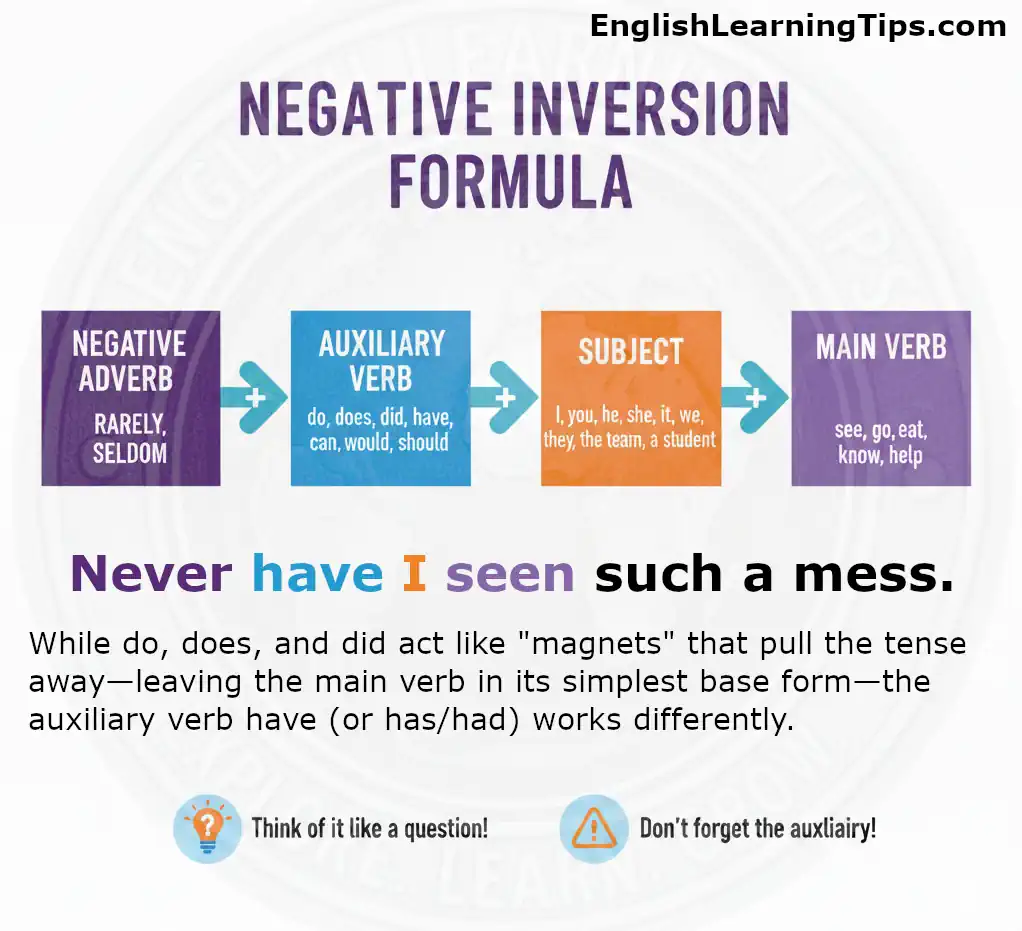
The biggest mistake ESL students make is forgetting the auxiliary verb (helper verb). When you invert a sentence for emphasis, you can’t just flip the subject and the main verb. You must use a helper like do, does, did, or have.
The inversion formula: > [Negative Adverb] + [Auxiliary Verb] + [Subject] + [Main Verb]
Example: Never + have + I + seen…
| Instead of saying… | Say this (Inverted)… | Why? |
| “Never I saw that.” | “Never did I see that.” | Use did for the past tense. |
| “Rarely he eats meat.” | “Rarely does he eat meat.” | Use does for the third person. |
| “Only then I knew.” | “Only then did I know.” | “Only then” triggers the auxiliary. |
3 tips to remember the rules
- Think of it like a question: If you know how to ask a question, you know how to use inversion.
- Question: “Do you like pizza?”
- Inversion: “Little did I know he liked pizza.”
- Watch the pronoun “trap”: Remember, if your subject is I, you, he, she, it, we, or they, you usually cannot flip the main verb.
- Right: “Away they went!”
- Wrong: “Away went they!”
- The “negative start” trigger: If you start a sentence with a “No” word (Never, Not only, No sooner), your brain should automatically prepare to swap the next two words.
Practice exercise
Try rewriting these standard sentences into inverted ones in the comments below:
- I have never heard such a beautiful song. (Start with Never)
- He had hardly finished his lunch when the phone rang. (Start with Hardly)
Practice makes perfect. We like using Oxford Ruled Index Cards for drilling inversion formulas until they become second nature
Common mistakes with inversion
Even advanced learners often slip up when applying these rules. Use this table to check your own writing.
| The error | Incorrect sentence | Correct sentence | Why? |
| The double-tense trap | “Never did I saw him.” | “Never did I see him.” | When you use the auxiliary did, the main verb must return to its base form. |
| The pronoun flip | “Here comes he.” | “Here he comes.” | Do not invert the verb if the subject is a pronoun (he, she, it, they). |
| Missing the auxiliary | “Seldom he goes out.” | “Seldom does he go out.” | Negative adverbs require an auxiliary verb (do/does/did/have) to function. |
| Wrong “Only” placement | “Only I saw him then.” | “Only then did I see him.” | The inversion happens after the time expression (then, after, when), not the subject. |
Frequently asked questions about inversion
Visual tools to help you learn about inversions
Video: Inverted sentences: Verb before subject
Video: Inversion: After negative or limiting adverbs
Final thoughts: Why mastering inversion improves your writing
Inversion is more than a way to sound fancy; it’s a functional tool for precise communication. Whether you are using negative inversion to make a point or simply asking a question, understanding how to flip the subject and verb will make your English sound more natural and sophisticated.
While it may feel formal at first, practicing these structures will help you recognize them in literature and academic texts, ultimately improving both your reading comprehension and writing versatility.
Join the conversation
Did you find these inversion examples helpful, or is there a specific grammatical structure that still feels a bit tricky?
- Leave a comment below with your own example of an inverted sentence—we would love to see how you use “never” or “seldom” for emphasis!
- Share this guide with a fellow student or writer who wants to polish their English grammar.
Discover more from English Learning Tips
Subscribe to get the latest posts sent to your email.


