

The doubling rule: When to double consonants in English spelling

“The dog is running.”
Ever wonder why we spell it running but jumping? The difference comes down to a simple English spelling rule called the doubling rule or the 1-1-1 rule.
The doubling rule states that you must double the final consonant of a word when adding a suffix that starts with a vowel, provided the base word meets specific “1-1-1” criteria.
What is the 1-1-1 rule for spelling?
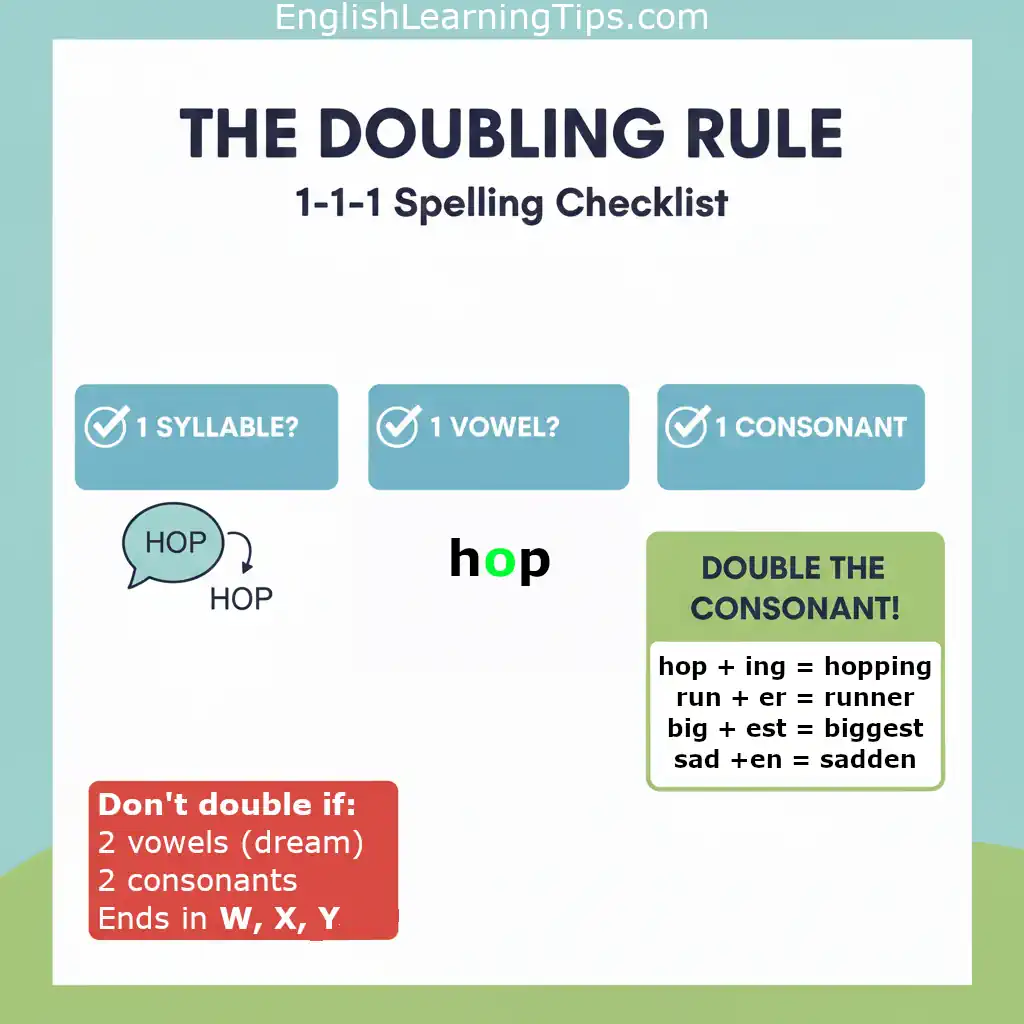
The 1-1-1 rule is a simple checklist used to determine if a word’s final consonant should be doubled before adding a suffix. For the rule to apply, a word must meet three specific criteria:
- 1 syllable: The word must be short (e.g., hop, sit, run).
- 1 vowel: The word must have only one vowel (a, e, i, o, u).
- 1 consonant: The word must end in a single consonant (any letter that isn’t a vowel).
How to apply the rule
If a word passes the 1-1-1 test and you are adding a suffix that starts with a vowel (like -ing, -ed, -er, or -est), you must double the final consonant.
| Base word | Fits 1-1-1? | Suffix | Final spelling |
| Hop | Yes | -ing | Hopping |
| Run | Yes | -er | Runner |
| Big | Yes | -est | Biggest |
| Sad | Yes | -en | Sadden |
Pro-tip: Think of the double consonant as a ‘shield’ that keeps the vowel short. Without it, ‘hopping’ would sound like ‘hoping’!”
When not to double the consonant
Not every word gets a double consonant. Here is when you should leave the spelling as-is:
- The suffix starts with a consonant: If you are adding -ly, -ness, or -ful, leave the base word alone (e.g., sad + ness = sadness).
- The word ends in two consonants: Words like jump or lift already have two consonants at the end, so no doubling is needed (jumping, lifted).
- The word has two vowels: Words like dream or seat have a “vowel team,” so the consonant stays single (dreaming, seated).
- The word ends in w, x, or y: These letters are never doubled in English spelling (e.g., snowing, taxing, playing).
Doubling consonants in multisyllabic words
As words get longer, the doubling rule shifts slightly. For words with two or more syllables, you only double the final consonant if the stress (accent) is on the last syllable.
Examples of stressed vs. unstressed syllables
- Begin: The stress is on the second syllable (be-GIN). Since the last syllable is stressed, we double it: Beginning.
- Open: The stress is on the first syllable (O-pen). Since the end is unstressed, we do not double it: Opening.
- Refer: The stress is on the second syllable (re-FER). Result: Referring.
Common FAQs about the doubling rule
Visual tools to help you learn
Video: The 1-1-1- rule in spelling and grammar
Conclusion: Master the 1-1-1 rule for better writing
Understanding the doubling rule is one of the most effective ways to transition from a hesitant speller to a confident writer. By simply checking if a word has one syllable, one vowel, and one consonant, you can eliminate common errors like “runing” or “sited” instantly. While exceptions like the letters w, x, and y exist, the 1-1-1 rule remains a reliable foundation for most English suffixes.
We want to hear from you
Did the 1-1-1 rule help clear up a spelling mystery for you? Or is there a specific word that always trips you up?
Drop a comment below with the word you find hardest to spell—our community loves to help break down the logic behind tricky English patterns! If you found this guide helpful, share it with a student or a fellow writer who wants to sharpen their spelling skills.
Discover more from English Learning Tips
Subscribe to get the latest posts sent to your email.


