

British English vs American English: Key differences and examples

While English is a global language, it has branched into two primary dialects: British English (BrE) and American English (AmE). For students, travelers, and business professionals, understanding these nuances is essential for clear communication and avoiding “lost in translation” moments.
Most of the time, a Brit and an American can chat without an interpreter. However, using the wrong word in the wrong place—like an American asking where to buy a ‘fanny pack’ in a London shop—might lead to some pretty shocked expressions, as that word refers to a very different part of the anatomy in the UK.
At a glance: The 3 biggest differences
- Vocabulary: Americans say apartment; the British say flat.
- Spelling: Americans use color; the British use colour.
- Dates: The US uses Month/Day; the UK uses Day/Month.
Why is it important to know the difference between American and British English?
If you are an ESL (English as a Second Language) student or a global professional, knowing your way around both dialects isn’t just a party trick—it’s a massive help for your career and your social life.
- Enhanced media comprehension: From Hollywood blockbusters to BBC dramas, you will better understand puns, slang, and cultural references. To truly hear the difference in rhoticity and vowel sounds, listening to audiobooks is a game-changer. Try a Kindle Paperwhite for English Learners.
- Professional credibility: Using the correct localized English (like using BrE for a UK-based client) shows attention to detail and cultural respect.
- Clearer communication: You’ll avoid confusion in situations where words have entirely different meanings (like “pants” meaning trousers in the US but underwear in the UK).
- Academic accuracy: Many international exams (like IELTS or TOEFL) or universities require consistency in one specific dialect.
Recommended Resources for Students:
- Master American English: Merriam-Webster’s Collegiate Dictionary (11th Edition) – The gold standard for US academic writing.
- Master British English: Oxford Advanced Learner’s Dictionary – Essential for IELTS prep and UK consistency.
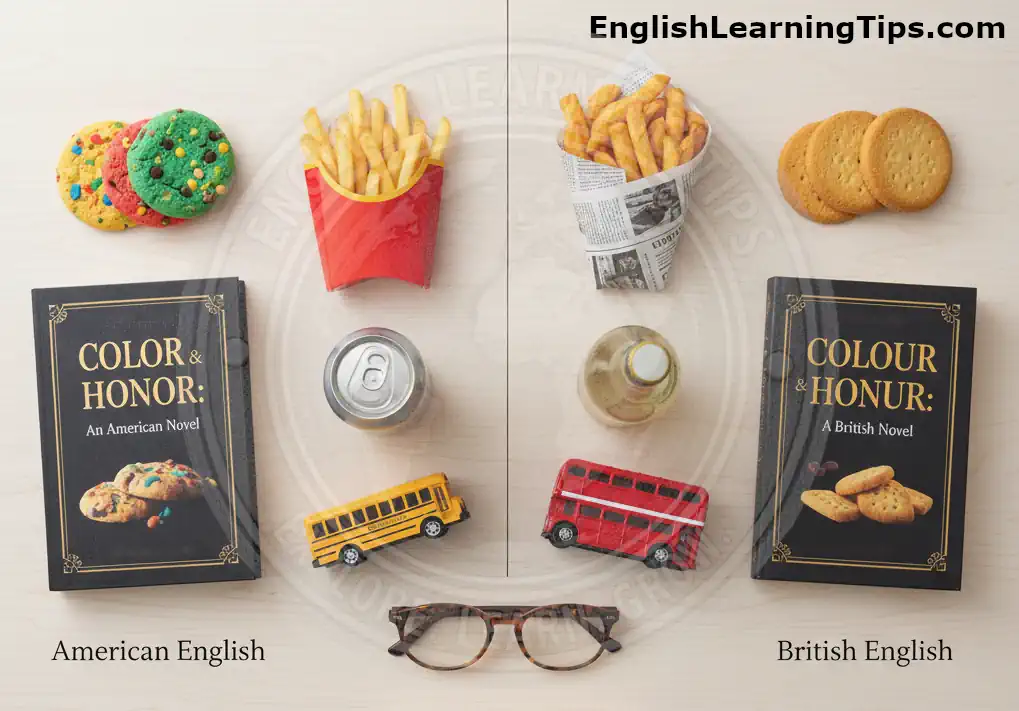
British vs American English vocabulary comparison
The most noticeable difference between these two dialects is the lexis or vocabulary. Often, two completely different words are used to describe the same object.
| Category | American English (AmE) | British English (BrE) |
| Food | French fries | Chips |
| Food | Cookie | Biscuit |
| Food | Eggplant | Aubergine |
| Clothing | Pants | Trousers |
| Clothing | Sneakers | Trainers |
| Clothing | Undershirt | Vest |
| Transportation | Subway | Underground (The Tube) |
| Transportation | Gasoline | Petrol |
| Transportation | Trunk (of a car) | Boot |
| Home/Living | Apartment | Flat |
| Home/Living | Yard | Garden |
| Home/Living | Elevator | Lift |
| Street | Sidewalk | Pavement |
Spelling variations in American and British English
Most spelling differences can be traced back to Noah Webster (of Webster’s Dictionary), who wanted to simplify American spelling. Here are the common patterns:
- -or vs -our: Americans dropped the “u” in words like color, flavor, and honor. The British retain it (colour, flavour, honour).
- -er vs -re: American English uses -er for centers of activity (center, theater), while British English uses -re (centre, theatre).
- -ize vs -ise: While both are used in the UK, British English leans toward -ise (organise, realise). American English exclusively uses -ize (organize, realize).
- Doubled consonants: In British English, the final consonant is often doubled when adding a suffix (e.g., travelling, cancelled). In American English, it usually remains single (traveling, canceled).
Key differences in grammar and usage
While the core structure of the language remains the same, a few grammatical “rules” differ across the Atlantic.
Collective nouns
In the US, collective nouns (team, group, government) are almost always singular.
- AmE: “The team is winning.”
In the UK, collective nouns can be singular or plural depending on whether you are referring to the group as a unit or as individuals.
- BrE: “The team are playing well.”
Auxiliary verbs and past tense
The British often use “shall” for future intentions or suggestions (Shall we go?), whereas Americans almost exclusively use “will” or “should.” Additionally, some past tense verbs in the UK end in “t” (learnt, dreamt), while Americans use the “ed” ending (learned, dreamed).
Prepositional changes
Small changes in prepositions can sound “wrong” to a native speaker if used incorrectly:
- The weekend: Americans stay “on the weekend,” while the British stay “at the weekend.”
- School: Americans are “in school,” the British are “at school.”
Did you know?
In the UK, a “biscuit” is what Americans call a “cookie.” But if you ask for a “biscuit” in the US, you’ll likely get a savory, fluffy scone-like bread often served with gravy!
Punctuation and formatting styles
Standardized writing styles differ significantly when it comes to the “look” of a page.
- Quotation marks: Americans use double marks (” “) as the primary style; the British often use single marks (‘ ‘).
- The Oxford comma: While debated in both countries, it is a standard requirement in most American style guides (APA, MLA) but is frequently omitted in British journalism unless needed for clarity.
- Dates: This is the most critical difference for travel and business.
- US: Month/Day/Year (03/25/2026)
- UK: Day/Month/Year (25/03/2026)
Want to learn more? See our guide on basic punctuation marks.
Bonus: 20 more common British vs American English terms
If you’ve mastered the basics like “chips” and “fries,” these 20 additional differences will help you navigate everything from a hardware store to a local pub.
| Category | American English (AmE) | British English (BrE) |
| Home | Trash can | Dustbin |
| Home | Comforter / Quilt | Duvet |
| Home | Flashlight | Torch |
| Home | Draperies / Curtains | Drapes / Curtains |
| Kitchen | Aluminum foil | Tin foil |
| Kitchen | Plastic wrap | Cling film |
| Kitchen | Skillet | Frying pan |
| Clothing | Bathrobe | Dressing gown |
| Clothing | Tuxedo | Dinner jacket |
| Clothing | Overalls | Dungarees |
| Automotive | Hood | Bonnet |
| Automotive | Windshield | Windscreen |
| Automotive | Turn signal / Blinker | Indicator |
| Automotive | Parking lot | Car park |
| City Life | Crosswalk | Zebra crossing |
| City Life | Pharmacy / Drugstore | Chemist / Pharmacy |
| City Life | Line (as in a queue) | Queue |
| Health | Band-Aid | Plaster |
| General | Pacifier | Dummy |
| General | Period (punctuation) | Full stop |
Frequently asked questions about British and American English
Embracing the evolution of English: Your turn to weigh in
Whether you prefer the crisp “t” in a British “cup of tea” or the rhotic “r” in an American “elevator ride,” both dialects offer a rich, evolving history. While the spelling and grammar differences might seem daunting at first, they are ultimately what make the English language so diverse and globally adaptable.
Remember, there is no “correct” version—only the version that best suits your location, audience, and personal style. As long as you remain consistent within a single piece of writing, you will communicate effectively on both sides of the Atlantic.
Join the conversation: Which English do you speak?
We want to hear from you! Linguistic differences often lead to the most hilarious misunderstandings or the most interesting cultural discoveries.
- Have you ever used a British term in America (or vice versa) and been met with a blank stare?
- Which spelling do you find more logical: “color” or “colour”?
- Is there a regional slang word from your hometown that we missed?
Drop a comment below and let us know your favorite “lost in translation” moment. If you found this guide helpful for your studies or travels, share it with a friend who is currently navigating the world of ESL or international business!
Discover more from English Learning Tips
Subscribe to get the latest posts sent to your email.


