
Is y a vowel or a consonant? The definitive guide

You’ve likely heard the phrase “and sometimes y,” but the rules behind it are more than just a catchy rhyme. It is one of the few letters that can function as both a consonant and a vowel, depending on its placement within a word. Because it bridges this gap, linguists often refer to “y” as a semi-vowel or a glide.
Understanding when “y” changes roles is essential for mastering English phonics, spelling rules, and pronunciation.
When is y a consonant?
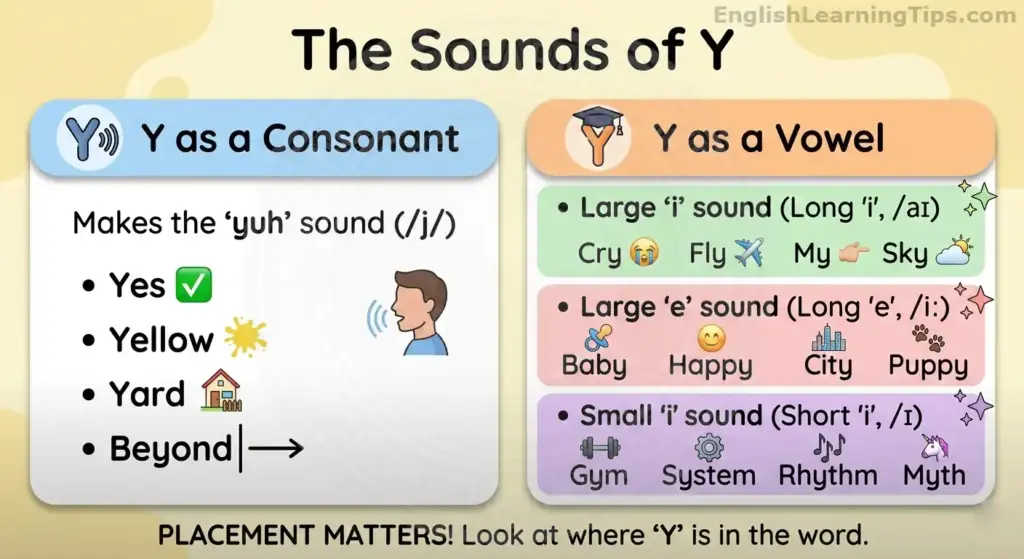
The letter “y” functions as a consonant when it appears at the beginning of a word or the start of a syllable. In these instances, it creates a distinct “yuh” sound (phonetically represented as /j/).
To produce the consonant y, your tongue moves close to the roof of your mouth, partially obstructing the airflow. This obstruction is the defining physical trait of a consonant. In linguistics, this specific phoneme is represented by the symbol /j/. In linguistics, this specific phoneme is represented by the symbol /j/ in the International Phonetic Alphabet (IPA).
Common examples of the consonant “y”:
- Yes
- Yellow
- Beyond (starts the second syllable)
- Young
If you are teaching these sounds at home, using tactile tools can help. I recommend using a Montessori Moveable Alphabet to physically move the ‘y’ from the beginning of a word to the end so students can see the transition.
When is y a vowel?
The letter “y” acts as a vowel when it is placed in the middle or at the end of a word. In these positions, the airflow remains unobstructed, and “y” takes on the sound of other vowels—specifically “i” or “e.”
The sound “y” makes as a vowel is determined by the length of the word and the surrounding letters:
| Vowel sound | Syllable type | Word position | Examples |
| Long i | Open syllable | End of 1-syllable words | Cry, fly, my, sky |
| Long e | Open syllable | End of multi-syllable words | Baby, happy, city, puppy |
| Short i | Closed syllable | Middle of a syllable | Gym, system, rhythm, myth |
Quick rule of thumb for “y” sounds:
- Start of word: Always a consonant (Yell).
- Middle of word: Usually a short “i” (Myth).
- End of 1-syllable word: Long “i” (Sky).
- End of 2+ syllable word: Long “e” (Candy).
Frequently asked questions about the letter y
Visual tools to help you learn
Video: The sounds of Y for teachers
If you’re a parent or a teacher, this video will help you learn how to teach the sounds of y.
Video: The sounds of y for children
This video is a great tool for kids or adults to learn the sounds of y.
Master the rules of the letter y
Once you recognize the pattern of where “y” sits in a word, you’ll never have to guess its pronunciation again. It’s a simple trick that makes spelling much more intuitive.
Master the next step: The ‘Y’ rule in spelling. Now that you know when y acts as a vowel and when it stays a consonant, you are ready to master its most common spelling challenge. When you add suffixes like -ed or -ness to these words, does the y stay or go? Check out our comprehensive guide to the Y rule in spelling to see how these vowel sounds dictate your spelling choices.
Join the conversation: What is your favorite “y” word?
Do you have a favorite example of “y” acting as a vowel, or perhaps a tricky word that always trips you up? English is full of unique exceptions like rhythm or syzygy that challenge these rules.
We want to hear from you:
- Drop a comment below with a “y” word that surprised you.
- Share this guide with a friend who is practicing their phonics.
- Let us know if there are other “rule-breaker” letters you would like us to cover next!
Discover more from English Learning Tips
Subscribe to get the latest posts sent to your email.


