


The Y rule: A guide to spelling words with suffixes

The Y rule is the easiest way to avoid common spelling mistakes when adding suffixes like -ed, -es, or -ness. Whether you’re pluralizing a noun or changing a verb tense, the secret lies in the letter directly before the final Y.
How the Y rule works: Consonants vs. vowels
The most important step in applying this rule is identifying the letter preceding the final Y.
When to change Y to I (Consonant + Y)
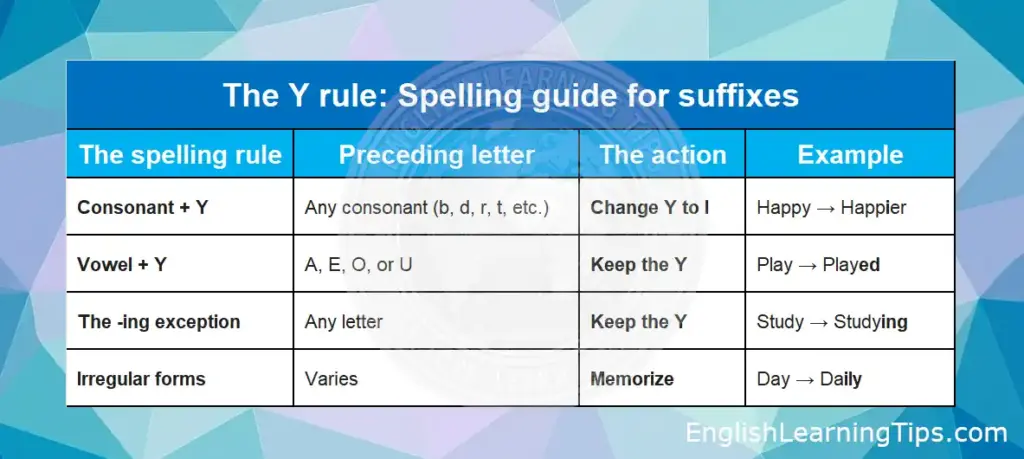
If a base word ends in a consonant + y, you must change the y to an i before adding a suffix. This applies to most endings, including -ed, -es, -er, -est, and -ness.
- Happy + -ness = Happiness
- Carry + -ed = Carried
- Reply + -es = Replies
- Dry + -er = Drier
The reason we keep the ‘y’ in ‘studying’ or ‘crying’ is actually a visual one. In my years of teaching, I’ve found that our brains naturally reject seeing two ‘i’s’ next to each other in English. If a word looks ‘ugly’ or ‘weird’ to you (like studiing), that’s usually your subconscious telling you that you’ve accidentally ignored the -ing exception.
When to keep the Y (Vowel + Y)
If a base word ends in a vowel + y (ay, ey, oy, uy), the spelling remains unchanged when adding a suffix. You simply tack the ending onto the word.
- Play + -ed = Played
- Enjoy + -ment = Enjoyment
- Boy + -s = Boys
- Buy + -er = Buyer
When modifying a base word, the inflectional ending (suffix) determines the transformation.
Quick reference: Y rule spelling table
| Base word | Ending (Suffix) | Preceding letter | New spelling |
| Rely | -ance | Consonant (L) | Reliance |
| Puppy | -es | Consonant (P) | Puppies |
| Stay | -ed | Vowel (A) | Stayed |
| Relay | -s | Vowel (A) | Relays |
| Funny | -est | Consonant (N) | Funniest |
Important exceptions to the Y rule
There are two main things to watch out for.
1. The -ing suffix exception
To prevent having a double “i” (which looks awkward in English), we never change Y to I when adding -ing. Even if there is a consonant before the Y, the Y stays.
- Study + -ing = Studying (Not studiing)
- Cry + -ing = Crying
- Fly + -ing = Flying
2. Irregular word forms
While the Y rule is consistent, these four common words are the outliers you simply have to memorize:
- Day + -ly = Daily
- Say + -ed = Said
- Pay + -ed = Paid
- Lay + -ed = Laid
Related reading
Confused about the letter Y? Before you master the spelling rules, make sure you understand the basics. Read our guide: Is y a vowel or a consonant? The definitive guide.
Frequently asked questions about the Y rule
Conclusion: Mastering the Y rule for better writing
Spelling in English doesn’t have to be a guessing game. By simply looking at the letter preceding the y, you can confidently decide whether to keep it or change it to an i. While the -ing exception and a few irregular words like daily exist, the consonant + y versus vowel + y logic remains one of the most reliable tools in your grammar toolkit. Consistent application of these rules will not only improve your spelling but also clarify your communication in every email, essay, and report you write.
Further reading for word nerds:
- The Merriam-Webster Dictionary of English Usage: Great for settling “monies vs. moneys” debates.
- Oxford Etymological Dictionary: To trace more “Old French” survivors in our language.
Join the conversation: What is your trick for remembering spelling rules?
Did this guide help clear up a “tricky” word for you? We want to hear from you!
- Leave a comment below: Is there a specific word that always trips you up, even with the Y rule?
- Share this guide: If you found these tables and FAQs helpful, share this article with a student, teacher, or fellow word-lover who wants to master English spelling.
- Save it for later: Bookmark this page as your quick-reference sheet for the next time you’re stuck on a plural or a suffix.
Discover more from English Learning Tips
Subscribe to get the latest posts sent to your email.


