
How to use context clues: A guide to improving reading comprehension

Hitting an unfamiliar word in the middle of a sentence is the fastest way to lose your momentum. Instead of pausing to grab a dictionary, you can use the surrounding text to solve the mystery yourself.
Learning how to use context clues is like having a built-in “decoder ring” for your brain. By identifying the hints an author leaves behind, you can unlock word meanings instantly, improving both your vocabulary acquisition and overall reading comprehension. Whether you are a student prepping for exams or an avid reader looking to sharpen your literacy skills, mastering these strategies is the most efficient way to handle unfamiliar vocabulary without skipping a beat.
If you’re studying for exams, using a dedicated SAT Prep Black Book can help you apply these context strategies to actual test questions.
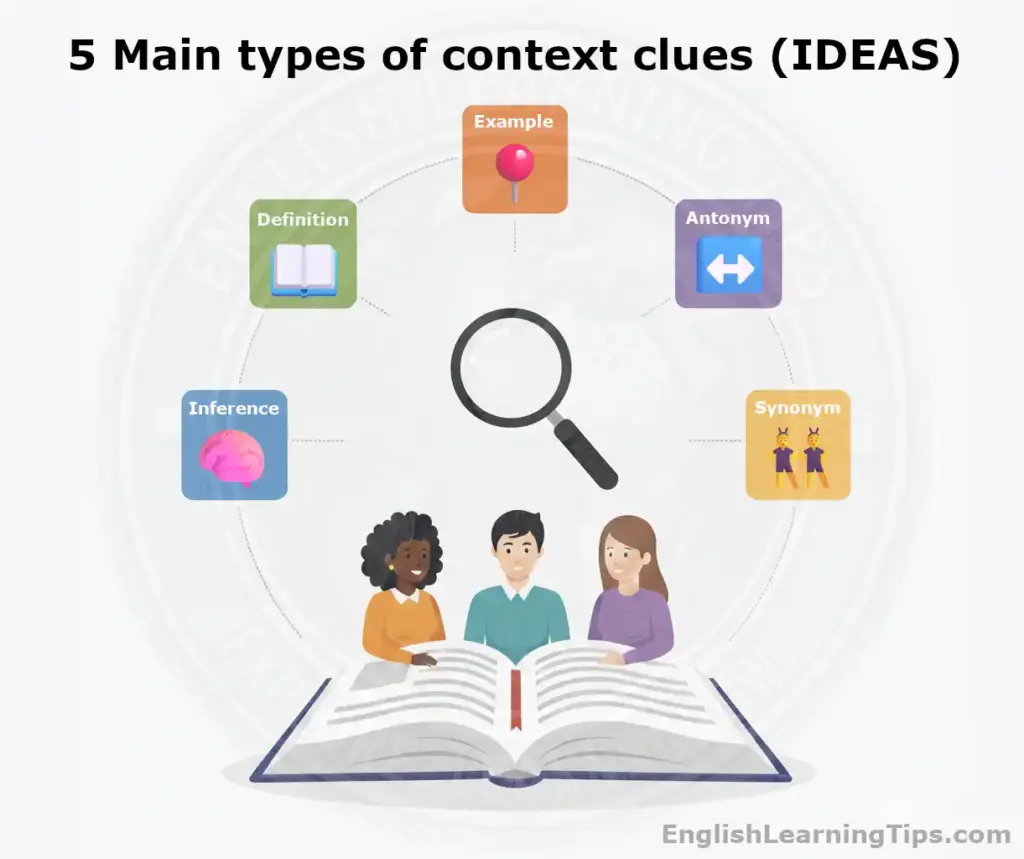
The 5 main types of context clues (IDEAS)
Authors naturally leave hints within their sentence structure. Recognizing these patterns—often remembered by the acronym IDEAS—is the fastest way to improve your literacy skills.
1. Inference
Sometimes, the meaning of a word isn’t explicitly stated. You have to look at the overall situation and use logic to fill in the blanks.
- Example: The somber atmosphere—the grey clouds, the weeping willow, and the quiet mourners—made everyone feel heavy-hearted.
2. Definition or restatement clues
The author defines the word immediately after using it, often set off by commas, dashes, or phrases like “that is” or “in other words.”
- Example: The manager’s brevity—his tendency to use very few words—was appreciated during the long meeting.
3. Example and illustration clues
Authors often provide specific instances to paint a picture of a word’s meaning. Look for signal words like “such as,” “for instance,” or “including.”
- Example: The store offers various confections, such as chocolates, hard candies, and pastries.
4. Antonym and contrast clues
You can often figure out a word by looking at what it is not. Contrast clues use transition words like “but,” “however,” “unlike,” or “despite.”
- Example: Unlike his gregarious sister, who loves parties, Arthur is quite shy and prefers to stay home.
5. Synonym and comparison clues
An author might use a more common word with a similar meaning near the difficult word. Look for words like “also,” “as,” or “similarly.”
- Example: The mountain path was treacherous; it was just as dangerous as the icy bridge we crossed earlier.
Quick reference: Context clue types and signal words
| Clue type | What it does | Signal words to look for |
| Inference | Requires a logical guess | Context of the situation |
| Definition | Explains the word directly | Is, means, known as, refers to |
| Example | Provides specific instances | Such as, for example, including |
| Antonym | Uses an opposite word | But, however, unlike, instead of |
| Synonym | Uses a similar word | Also, like, resembling, same |
The 3 “extra” clues found in the 8-type model
If you want to move beyond the basics, many literacy experts expand the standard list to include these three specific types. These are especially helpful for standardized test prep and high-level academic reading.
1. Cause and effect clues
This clue shows a clear relationship between an action and its result. If you understand the “why” or the “what happened,” the meaning of the unfamiliar word becomes clear.
- Keywords: Because, since, therefore, as a result.
- Example: Since the judge found the evidence inconclusive, the case was dismissed due to a lack of certainty.
2. List or series clues
Sometimes a word is tucked into a list of other words you already know. Since words in a series usually share a common theme, you can group the unknown word with its “neighbors.”
- Example: The vendor sold various textiles, including silk, wool, linen, and denim. (You can infer that textiles refers to fabrics).
3. Tone, mood, or punctuation clues
This relies on the “vibe” of the text or specific punctuation marks like parentheses and italics. An author’s mood—whether it is joyful, scientific, or angry—often dictates whether a word has a positive or negative connotation.
- Example: The austere room—with its bare white walls, hard wooden bench, and lack of any decoration—felt cold and unwelcoming.
Why the difference between 5 and 8 types?
Most introductory courses use the 5 types (IDEAS) because they cover roughly 80% of what you’ll encounter in daily reading. The 8-type model simply breaks down “Inference” into smaller sub-categories like Cause and Effect or Tone. If you are a teacher or a student aiming for a perfect score on the SAT or ACT, learning all eight will give you a significant advantage in reading speed and accuracy.
Advanced strategies for decoding text
Beyond looking at the words themselves, use these high-level strategies to boost your reading speed:
- Analyze word parts (Morphology): Break the word down. Does it have a prefix like un- (not), a root like bio- (life), or a suffix like -less (without)?
- Consider the tone: Is the passage happy, scientific, or angry? The “flavor” of the writing often dictates whether a word has a positive or negative connotation.
- Apply prior knowledge: Connect the text to your own life. If a text describes a “cacophony” in a busy city square, think about the sounds you usually hear in traffic.
To master morphology, I highly recommend keeping a copy of Merriam-Webster’s Vocabulary Builder on your desk—it breaks down Greek and Latin roots better than any other resource.
Frequently asked questions about context clues
Visual tools to help you learn
Video: What is a context clue?
This video is good for learners who are in the 6th grade to adults.
Video: Using context clues to understand
This video is geared toward teaching children, but is also good for adults who are visual learners.
Practice your skills: Context clues challenge
Read the following sentences and try to determine the meaning of the bolded word using the clues provided.
- The team felt jubilant after winning the championship; they cheered, hugged, and danced on the field for an hour.
- Unlike the garrulous talk show host who never stops speaking, his producer is famously quiet.
- The desert is a hostile environment where temperatures are extreme, and water is incredibly scarce.
- The scientist’s theory was corroborated by three independent studies that all found the exact same results.
- After the long hike, my legs felt enervated, as if all the energy had been sucked right out of my muscles.
- The diamond was flawless, meaning it had no chips, scratches, or internal cloudy spots.
- The principal’s voice was audible even at the back of the noisy cafeteria because he used a megaphone.
- She tried to mollify the angry customer by offering him a full refund and a sincere apology.
- The old map was obscure and difficult to read because the ink had faded over the last century.
- The sudden dearth of flour in the grocery stores made it impossible for anyone to bake bread this week.
- Jubilant: Extremely joyful or triumphant.
- Garrulous: Excessively talkative.
- Hostile: Unfriendly, harsh, or difficult to live in.
- Corroborated: Confirmed or supported by evidence.
- Enervated: Drained of energy or vitality.
- Flawless: Without any imperfections or defects.
- Audible: Able to be heard.
- Mollify: To soothe, calm, or reduce the anger of someone.
- Obscure: Not discovered or known about; hard to see.
- Dearth: A scarcity or lack of something.
Conclusion: Mastering the art of context clues
Building your reading comprehension doesn’t happen overnight, but using context clues is the single most effective way to improve your literacy skills without the constant need for a dictionary. By identifying synonyms, antonyms, and word parts, you transform from a passive reader into an active decoder of language.
Whether you are studying for the SAT, navigating complex academic texts, or simply enjoying a novel, these strategies will help you maintain your reading fluency and expand your vocabulary acquisition naturally.
Join the conversation: What is your strategy?
We want to hear from you! Which of the five context clue types do you find the most helpful when you encounter an unfamiliar word? Or, do you have a specific example of a “tricky” word you decoded recently?
Drop a comment below and share your favorite tips for staying focused while reading. If you found this guide helpful, share it with a friend or a fellow student who is looking to boost their reading power!
Continue learning:
- Personification: How to give human traits to objects.
- Parallelism in writing: Improve your sentence structure and flow.
Discover more from English Learning Tips
Subscribe to get the latest posts sent to your email.


