


Such as vs. like: How to choose the right word

Choosing between such as and like is one of the most common hurdles in English grammar. While they are often used interchangeably in casual conversation, using them correctly in formal writing clarifies whether you are providing examples or making a comparison.
Pro tip: For those aiming for professional-grade clarity, The Elements of Style provides timeless advice on being concise and choosing the right words for any occasion.
The quick rule: Inclusion vs. similarity
- Use such as when you are listing specific items that belong to a larger group (inclusion).
- Use like when you are comparing two different things that share a similar quality (resemblance).
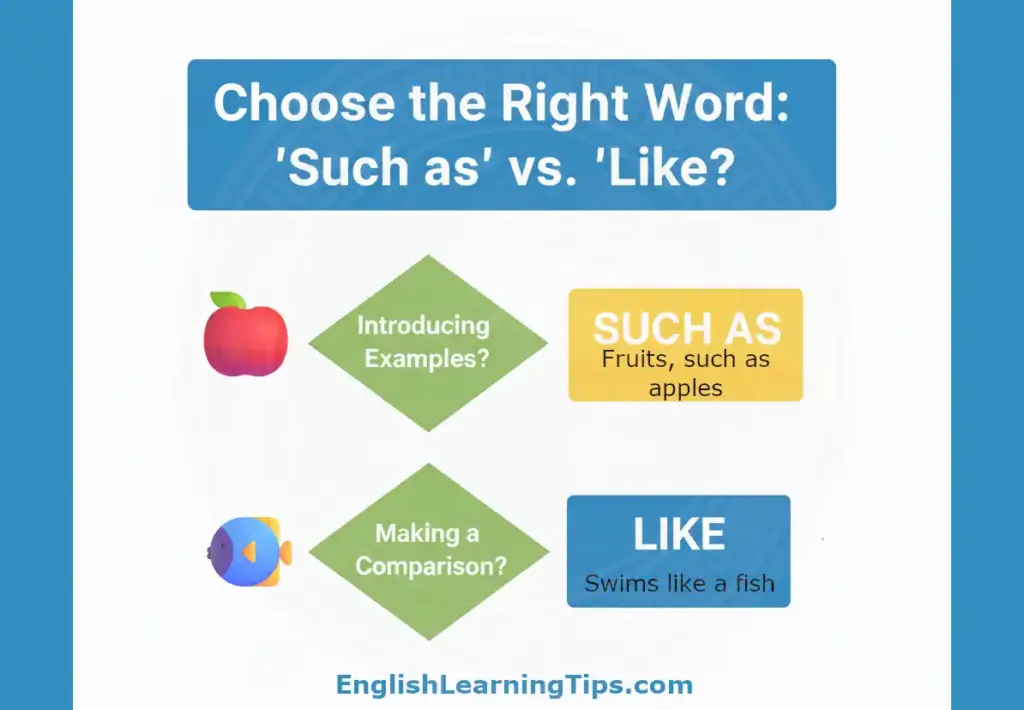
When to use such as: Introducing examples
In formal writing, such as is the preferred choice for introducing examples. It tells the reader that the items following the phrase are part of the category mentioned before it.
Examples of such as in a sentence
- “Citrus fruits, such as oranges and lemons, are high in vitamin C.”(Oranges and lemons are part of the citrus group.)
- “Academic subjects such as physics and calculus require strong logic skills.”(Physics and calculus are specific examples of the subjects.)
When to use like: Making comparisons
Like is a preposition used to show that one thing is similar to another. It does not imply that the following items are members of the group; rather, it suggests they are “comparable” to it.
Examples of like in a sentence
- “He runs like a cheetah.”(He is not a cheetah; he is being compared to one.)
- “I want a house like the one in the movie.”(You don’t want that exact house, but one similar to it.)
Comparison at a glance: Such as vs. like
| Feature | Such as | Like |
| Primary function | Inclusion / Exemplification | Comparison / Resemblance |
| Formal vs. informal | Preferred in formal/academic writing | Common in casual conversation |
| Logic | “Here are some examples of this.” | “This is similar to that.” |
| Grammar role | Introduces a non-restrictive phrase | Acts as a preposition |
If you find these distinctions tricky, we highly recommend keeping a copy of The Blue Book of Grammar and Punctuation on your desk. It’s our favorite physical reference for mastering common English usage rules.
Frequently asked questions about grammar usage
Video: Using such as vs like
Master the details of English grammar
Understanding the nuanced difference between such as and like is a simple way to elevate your writing from casual to professional. While “like” works well for creative comparisons and similes, “such as” is your go-to tool for providing clear, inclusive examples. By applying these rules, you ensure your message is both accurate and easy for your audience to follow.
Ready to practice? Grab a premium writer’s journal to jot down your daily writing exercises and keep your grammar sharp!
Join the conversation
Did this guide help clear up your grammar confusion? We want to hear from you!
- Leave a comment: Is there a specific sentence you’re struggling with? Drop it below, and we’ll help you decide which phrase fits best.
- Share this guide: If you found this helpful, share it with a colleague or student who wants to sharpen their writing skills.
- Subscribe: Sign up for more quick tips on mastering tricky English grammar and style.
Discover more from English Learning Tips
Subscribe to get the latest posts sent to your email.


