
Subject complements vs. object complements: A clear guide to sentence structure

Confused about the difference between a subject complement and an object complement? You aren’t alone. While both add essential detail to a sentence, they perform completely different jobs.
What is a subject complement?
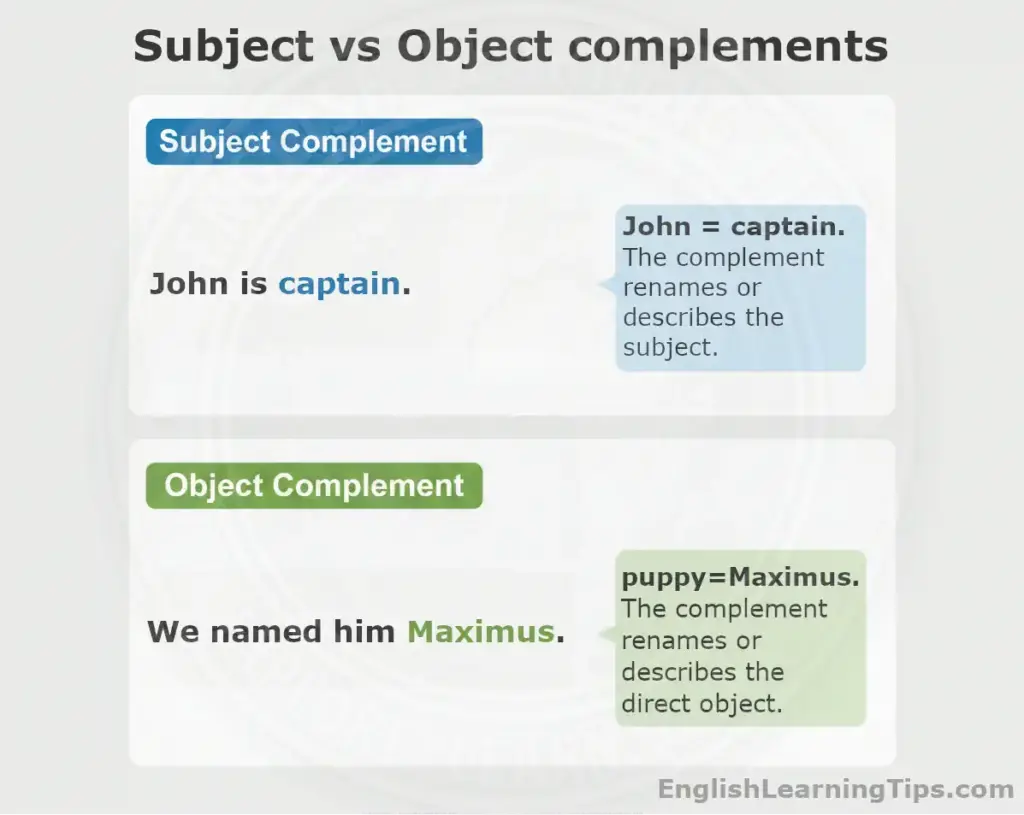
A subject complement is a word or phrase that follows a linking verb to rename or describe the subject. Without it, the sentence would feel unfinished (e.g., “The water is…” is incomplete without a complement like “cold”).
Types of subject complements
- Predicate nominatives: Nouns that rename the subject.
- Predicate adjectives: Adjectives that describe the subject.
Examples of subject complements in sentences
- The cake smells divine. (“Divine” describes the cake)
- Jeremy is the captain. (“Captain” renames Jeremy)
- The students seemed exhausted. (“Exhausted” describes the students)
Pro tip: Common linking verbs include be, become, seem, appear, feel, smell, and taste.
What is an object complement?
An object complement follows a direct object to describe or rename it. These follow verbs that ‘do’ something to an object—like naming it, painting it, or judging it. You can usually find them by asking: “The verb did [what] to the object?”
Examples of object complements in sentences
- The jury found him guilty. (“Guilty” describes the object “him”)
- We named the puppy Barnaby. (“Barnaby” renames the object “puppy”)
- The coach made me the starter. (“Starter” renames the object “me”)
Key differences: Subject vs. object complements
The easiest way to tell them apart is to look at what verb is being used and which noun is being modified.
| Feature | Subject complement | Object complement |
| What it modifies | The subject | The direct object |
| Verb type | Linking verbs (is, feel, seem) | Transitive verbs (make, call, find) |
| Sentence position | After the linking verb | After the direct object |
| Purpose | To rename or describe the subject. | To rename or describe the direct object after an action. |
Complements vs. objects: What is the difference?
It is easy to mistake a complement for a direct object because they both usually follow a verb. However, the relationship between the words is fundamentally different.
Subject complements vs. direct objects
A direct object is something “acted upon” by the subject. A subject complement simply describes or renames the subject.
- Direct object: “The chef made a pizza.” (The pizza is a separate entity being created).
- Subject complement: “The chef is talented.” (Talented is a quality of the chef).
Object complements vs. indirect objects
This is where some new learners get stuck. An indirect object is the person or thing that receives the direct object. An object complement describes the state of the direct object.
| Sentence | Role of the final word | The “Test” |
| “I called him a taxi.” | Indirect object | I called a taxi for him. (Two separate things) |
| “I called him a genius.” | Object complement | He = a genius. (The word describes ‘him’) |
Recommended resources for mastering sentence structure
If you’re serious about perfecting your grammar, having a physical reference on your desk is a game-changer. These are our top picks for 2026:
- Best for Practice: The English Grammar Workbook for Adults — Features bite-sized lessons specifically on complements and sentence patterns.
- Best Desk Reference: The Blue Book of Grammar and Punctuation — A concise, no-nonsense guide to every rule mentioned in this article.
Frequently asked questions about complements
Video: Using subject and object complements
Conclusion: Putting your grammar skills to work
Understanding the distinction between subject complements and object complements is more than just a classroom exercise; it’s about making your writing hit harder. These structures help you cut through the fluff and tell your reader exactly who is what and what happened to whom.
Now that you have mastered the “equals sign” test and can spot a linking verb from a mile away, you are ready to tackle even the most difficult sentence diagrams.
Join the conversation
Did one of these examples finally make the concept “click” for you, or is there a specific sentence that still has you stumped? We love a good grammar puzzle!
Leave a comment below with your toughest sentence, and let’s break it down together. If this guide helped you clear up the confusion, share it with a fellow writer or student who might be struggling with their syntax.
Discover more from English Learning Tips
Subscribe to get the latest posts sent to your email.


