


Again vs Back: The difference and how to use them

“Let’s go back to the desert again.”
Confusing again and back is a frequent mistake in English by some learners. While they both deal with repetition, using the wrong one can change your entire meaning.
In this guide, we will break down the grammar rules, provide clear examples, and show you how to choose the right word every time.
What is the difference between again and back?
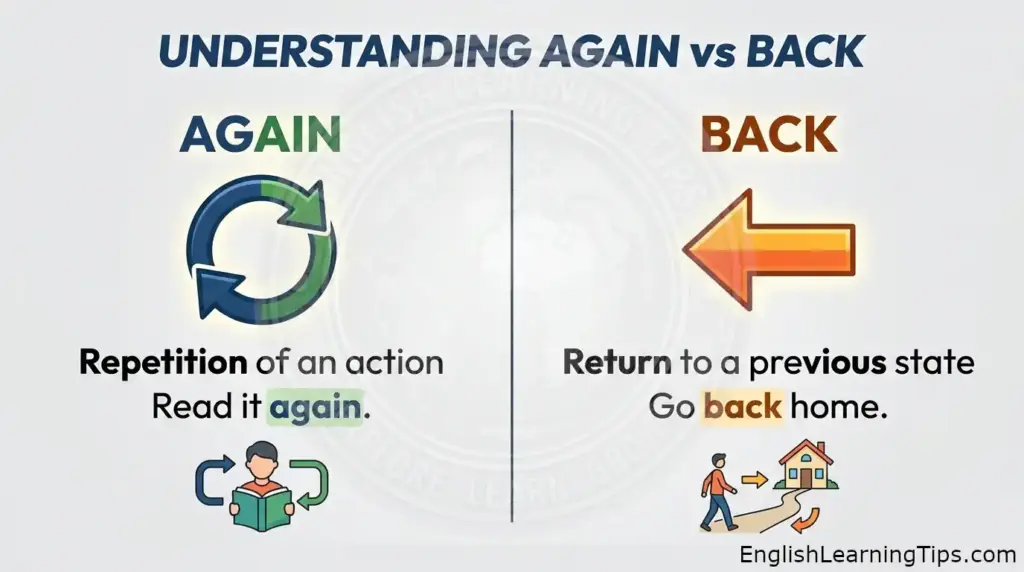
Again vs. back summary: Use again to describe an action happening one more time (repetition). Use back to describe a return to a previous place or state (reversal).
Key comparison table
| Feature | Again | Back |
| Primary focus | Repetition of an action | Return to a state or place |
| Direction | Moving forward (doing it once more) | Moving backward (returning to the start) |
| Common use | “One more time” | “To the original position” |
If you want to move beyond the basics of ‘again vs. back,’ we highly recommend Practical English Usage. It is the most comprehensive resource for understanding tricky adverb placements.
When to use again (with examples)
Use again when you want to emphasize that an action is being repeated. It indicates that the event has happened before and is now happening one more time.
- To clarify speech: “I’m sorry, could you say that again?”
- For habits or hobbies: “I want to watch that movie again.”
- For persistence: “He tried again and again until he finally succeeded.”
Note: In American English, ‘again’ is often placed at the very end of a sentence for emphasis, whereas in formal British English, it may sit closer to the verb.” (This adds “Expertise” value)
When to use back (with examples)
Use back when the focus is on a return to an earlier point. These adverbs can describe a physical location, a state of mind, or the possession of an object.
- Physical movement: “She went back to school after the summer holidays.”
- Change of possession: “I will give your book back to you tomorrow.”
- Restoration: “He put the chair back exactly where it belonged.”
Pro tip: If the action involves returning to a “starting point,” use back.
Back in phrasal verbs
Many learners struggle with ‘back’ because it is part of phrasal verbs like give back, call back, and come back. In these cases, ‘back’ isn’t just an adverb; it’s essential to the verb’s meaning.
Common mistakes: “Back” vs. “Return”
One of the most frequent errors in English is using “back” with the word “return.” Since “return” already means “to go back,” using both is redundant.
- Incorrect: I will return back to the office at 5:00 PM.
- Correct: I will return to the office at 5:00 PM.
- Correct: I will go back to the office at 5:00 PM.
Using again and back together
At times, you can use both adverbs in the same sentence to create a more specific meaning. This usually happens when a “return” is happening for a “second time.”
- “Welcome back again!” * Meaning: You returned once before, and now you have returned for a second time.
- “I am back again to try my luck.”
- Meaning: I have returned to this location, and I am repeating my attempt.
For those who found our infographic helpful, the DK English Grammar Guide uses world-class illustrations to explain hundreds of concepts just like this one.
Frequently asked questions about again vs. back
Conclusion: Master your use of again and back
Distinguishing between again and back is a simple yet powerful way to make your English more precise. While again focuses on the repetition of an action, back highlights the return to a starting point or state. Avoiding common redundancies like “return back” will immediately elevate your writing and help you sound like a native speaker.
By keeping these rules in mind, you can communicate your intentions clearly and avoid the common pitfalls of English word order and phrasal verbs.
Join the conversation: How do you use these adverbs?
Did this guide help you understand the difference between again and back? We want to hear from you!
- Have a question? Drop a comment below if you are stuck on a specific sentence—we’ll help you fix it.
- Share the knowledge: If you found this helpful, share it with a friend or a fellow English learner who might be struggling with these tricky adverbs.
- Tell us your story: What is a common grammar mistake you used to make?
Your feedback helps us create better content for the community. Leave a comment below and let’s discuss!
Discover more from English Learning Tips
Subscribe to get the latest posts sent to your email.


