

How to agree and disagree in English: A guide for ESL learners

Ever been in a conversation where you didn’t quite agree, but you didn’t want to be rude? Moving beyond a simple ‘yes’ or ‘no’ is the biggest step an ESL student can take toward sounding natural. For ESL students, moving beyond a simple “yes” or “no” is the key to sounding more natural and professional.
Whether you are sitting in a university seminar or having a casual coffee chat, using the right level of nuance helps you stay polite while standing your ground. This guide moves past the basics to give you the exact phrases you need to navigate English conversations with confidence.
Why nuance matters: From basic to fluent
Using the right “softening” phrases changes how people perceive you. Expressing agreement and disagreement is more than a linguistic exercise; it is a core component of communicative competence as defined by global language standards.
| Situation | Basic English (Can sound rude) | Fluent English (Professional) |
| Disagreeing | “You are wrong.” | “I see it a bit differently…” |
| Adding a point | “But I think…” | “I agree to an extent, but…” |
| Staying neutral | “I don’t know.” | “I can see the merit in both sides.” |
Recommended resources for mastering conversation
If you’re serious about sounding natural, these are the books I keep on my own desk for students:
- Oxford Word Skills: Best for learning “functional” English, like agreeing and disagreeing in context.
- English for Everyone Grammar Guide: A visual way to master the grammar rules behind these phrases.
Phrases for partial agreement: Finding common ground
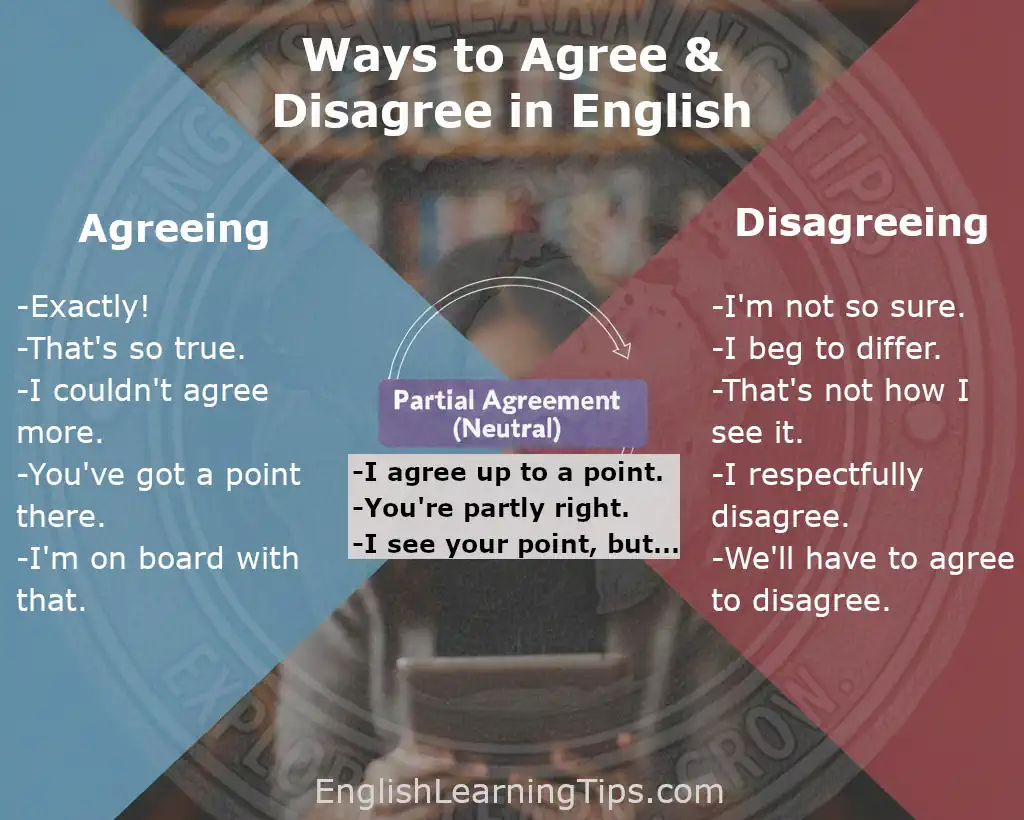
Sometimes, you don’t 100% agree with a statement. Using partial agreement shows the other person that you are listening but have your own perspective. These are excellent for “softening” a conversation.
- “I see your point, but I’m not entirely convinced.”
- “I agree up to a point, though I’d add…”
- “You’re partly right, but there’s another side to it.”
- “I’m with you on some of that, just not the whole picture.”
- “That makes sense in a way, but I’d tweak it a bit.”
- “I can go along with that to an extent, but…”
- “There’s some truth to what you’re saying, though I’d argue…”
- “I’m on board with parts of that, but not fully.”
Phrases for partial disagreement: Being polite but firm
In many English-speaking cultures, direct disagreement can sometimes feel too blunt. Using these polite ways to disagree helps you maintain the relationship while expressing a different viewpoint.
- “I get where you’re coming from, but I don’t fully agree.”
- “That’s not quite how I see it, though I understand your take.”
- “I’m not sure I buy that completely, but you’ve got a point.”
- “I’d push back a little on that—here’s why…”
- “Some of that holds up, but I’d argue against parts of it.”
- “I can’t totally disagree, but I’m leaning a different way.”
- “You’re onto something, but I wouldn’t go that far.”
- “I see it differently, even if I can follow your logic.”
Phrases for acknowledging both sides: Staying neutral
In professional settings or academic writing, you may need to show that you have considered multiple perspectives. These phrases demonstrate critical thinking and objectivity.
- “There’s merit to both perspectives, honestly.”
- “I can see why each side feels the way they do.”
- “Both arguments have their strengths, depending on how you look at it.”
- “It’s tricky—there’s something valid on either end.”
- “I get the appeal of both, even if they clash.”
- “Each side’s got a solid case, just different priorities.”
- “There’s truth in both, but it’s a matter of what you value more.”
- “I’m torn—both have good points, just not the full picture.”
Frequently asked questions about agreeing and disagreeing in English
Visual resources to help you learn
Video: How to agree or disagree – British Council
Video: Agreeing and disagreeing at work
Teacher’s tip: I love using a large magnetic whiteboard to draw a “Politeness Scale” for my students. It helps them visually see which phrases are “safe” and which are “risky.”
Finding your voice in English
Learning to agree and disagree isn’t just about memorizing a list of words; it’s about finding your voice. When you use these phrases, you stop being a passive listener and start becoming an active part of the conversation.
Don’t worry about being perfect right away. Even native speakers struggle to find the right words sometimes! The goal is to keep the conversation flowing and show respect for other perspectives while staying true to your own.
Join the conversation: What is your go-to phrase?
We want to hear from you! Is there a specific phrase you find most useful when you need to disagree politely? Or perhaps there is a common expression in your native language that you find difficult to translate into English?
Drop a comment below with your favorite phrase or a question you still have about these conversation tools. If you found this guide helpful, share it with a fellow learner or teacher—helping others find these resources is how we grow as a community!
Discover more from English Learning Tips
Subscribe to get the latest posts sent to your email.


