

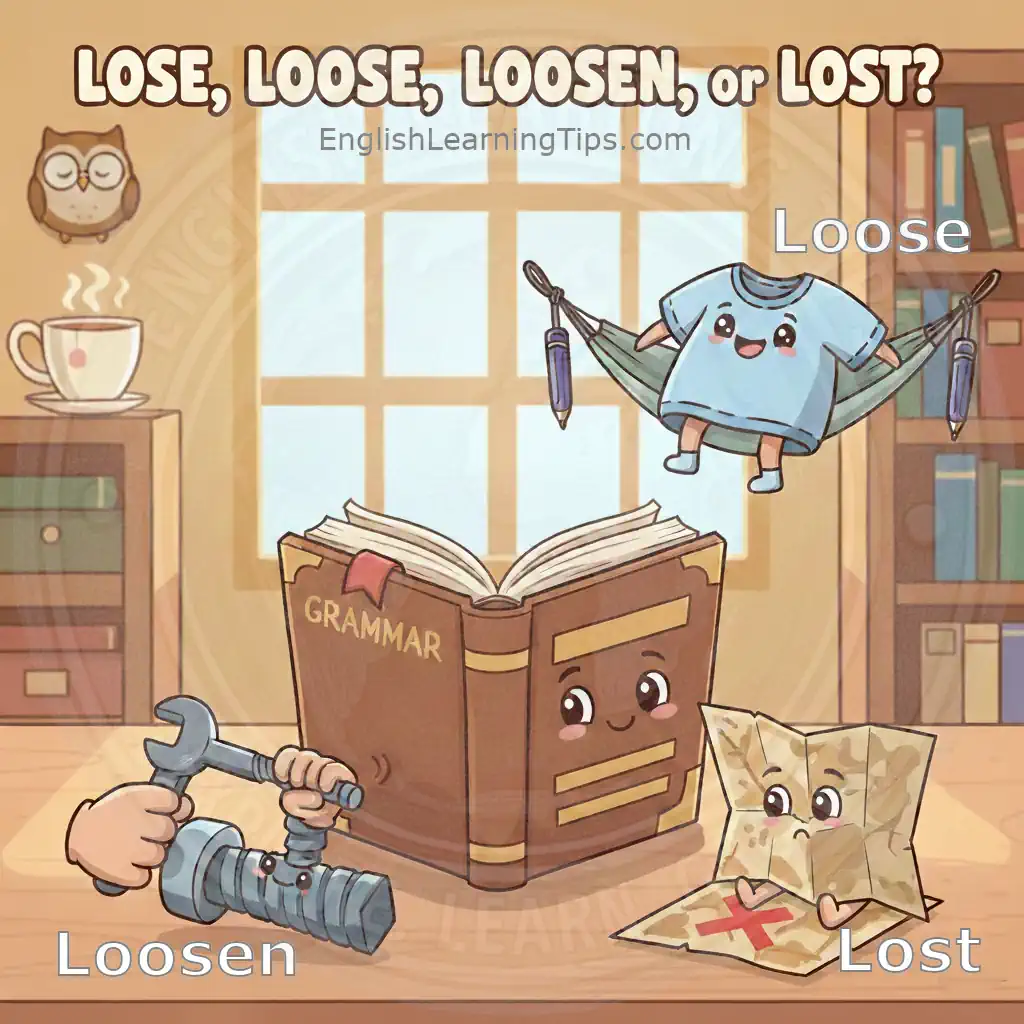
Lose, loose, loosen, or lost: How to choose the right word

The doctor told him to lose some weight, but now he has lost so much that his shirt is loose. He no longer has to loosen his belt.
Confusion between lose, loose, loosen, and lost is one of the most common grammar mistakes in the English language. While they look and sound similar, using the wrong one can change the entire meaning of your sentence.
I’ve seen even the most seasoned editors trip over these in a fast-paced group chat thread. It’s not just about knowing the rule; it’s about training your brain to see the ‘extra o’ before you hit send. This guide breaks down the four-way confusion between these words so you never have to second-guess your spelling again.
Lose vs. loose vs. lost: Key definitions at a glance
If you are in a hurry, use this table to identify which word fits your context.
| Word | Part of speech | Meaning | Pronunciation |
| Lose | Verb | To misplace; to fail to win | /looz/ (sounds like snooze) |
| Loose | Adjective | Not tight; not fastened | /loos/ (sounds like goose) |
| Lost | Verb/Adj | Past tense of lose; missing | /lost/ (sounds like cost) |
When to use lose
Lose is a verb, which means it describes an action. It refers to the act of misplacing an object, suffering a defeat, or being deprived of something.
- To misplace: “I always lose my car keys in the morning.”
- To fail to win: “The team worked hard because they didn’t want to lose the championship.”
- To be deprived of: “If you don’t follow the rules, you might lose your privileges.”
Grammar tip: If you can replace the word with “misplace” or “fail,” you should use lose.
When to use loose
Loose is primarily an adjective used to describe the state of an object. It is the opposite of “tight” or “contained.”
- Not tight: “After she lost weight, her jeans became too loose.”
- Not fastened: “Be careful; there is a loose floorboard on the stairs.”
- Not contained: “The neighbor’s dog is loose in the street again.”
Note on “loose” as a verb: While rare, “loose” can be a verb meaning “to release” (e.g., “to loose an arrow”). However, in modern English, “release” or “let loose” is more common.
Loosen: The verb form of loose
While lose is its own verb, loose has a specific verb form used when you want to describe the action of making something less tight: loosen.
- Definition: To make something less tight or less restrictive.
- How to use it: “You should loosen your tie if you’re feeling hot.”
- Past tense: Loosened (e.g., “He loosened the screws to remove the panel.”)
The bottom line: If you are talking about physically making a grip, a knot, or clothing less tight, the word you are looking for is loosen, not lose.
When to use lost
Lost is the past tense and past participle form of “lose.” It describes an action that has already happened or a state of being missing.
- Past action: “I lost my wallet at the concert last night.”
- A state of being: “We took a wrong turn and now we are lost.”
- No longer possessed: “He mourned the lost opportunity.”
Memory tricks to never forget the difference
If you still find yourself second-guessing your spelling, try these three simple mnemonic devices:
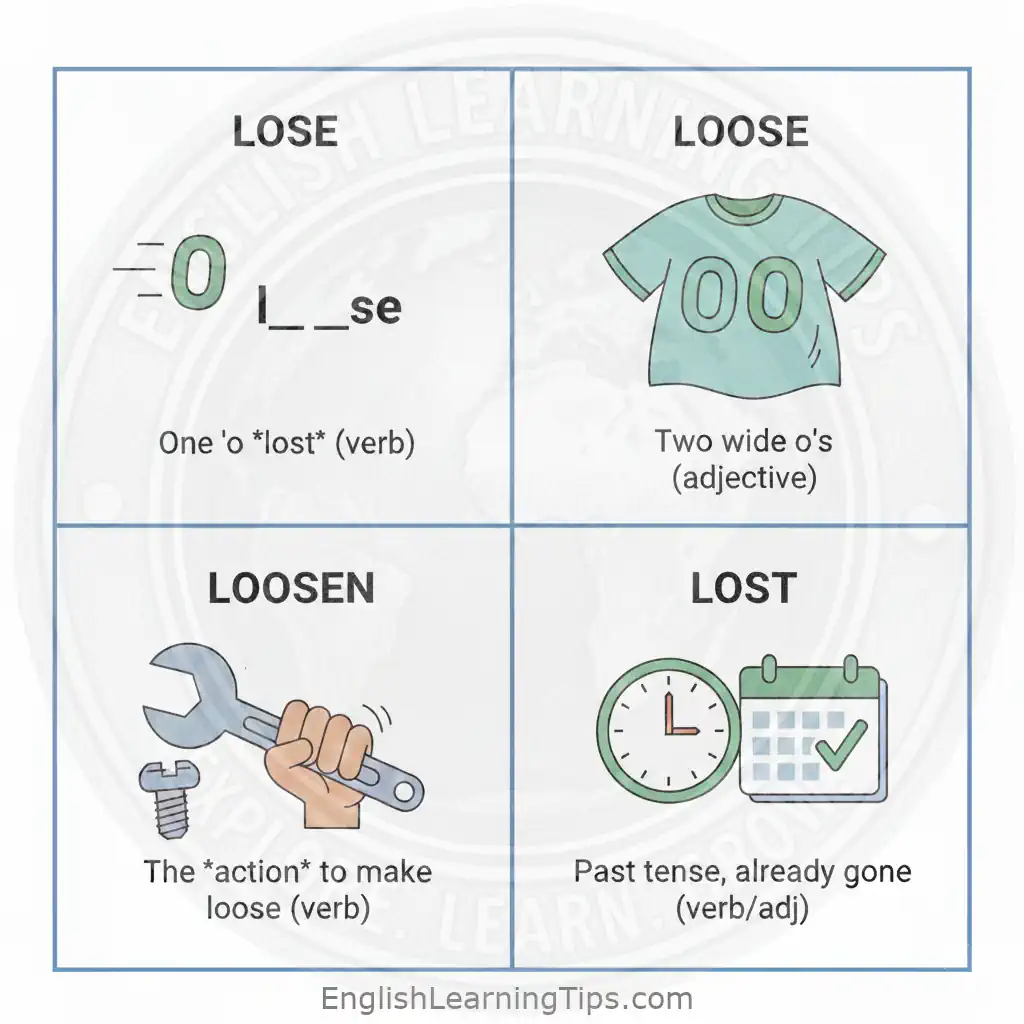
- The “o” trick: Lose has lost an “o.” It only has one. Loose has an extra “o,” making it wide and roomy—just like a loose shirt.
- The sound trick: Lose rhymes with choose (both are actions). Loose rhymes with goose (a loose goose is on the run!).
- The “t” trick: Lost ends in “t” for time. It refers to something that happened in the past.
Frequently asked questions about lose, loose, and lost
Visual tools to help you learn
Video: Lose, lost, & loose
This visual guide will give you an exhaustive primer on how to use these words.
Video: Lose, loose, & loosen
This video lesson uses acting and visuals to help you understand the difference between using these words.
Take the lose, loose, and lost quiz
Test your knowledge by choosing the correct word to complete each sentence. (Scroll to the bottom for the answers!)
- “Make sure you tie your shoelaces tightly; you don’t want them to come ______ while you’re running.”
- A) Lose
- B) Loose
- C) Lost
- “I am so frustrated! I always ______ my sunglasses when I go to the beach.”
- A) Lose
- B) Loose
- C) Lost
- “The captain felt terrible after the team ______ the final game of the season.”
- A) Lose
- B) Loose
- C) Lost
- “If you ______ your grip on the rope, the bucket will fall down the well.”
- A) Lose
- B) Loose
- C) Lost
- “Is the screw on that chair ______? It feels like it’s about to fall apart.”
- A) Lose
- B) Loose
- C) Lost
Answer key:
- B (Loose) — Describes the state of the laces (not tight).
- A (Lose) — The action of misplacing something.
- C (Lost) — The past tense of failing to win.
- A (Lose) — The action of letting go or being deprived of a grip.
- B (Loose) — Describes the physical state of the screw (unfastened).
Conclusion: Tighten up your writing
Learning the difference between lose, loose, and lost is one of the quickest ways to polish your professional or academic writing. By remembering that lose is an action (to misplace), loose is a description (not tight), and lost is the result (already gone), you can avoid the common pitfalls that trip up even native speakers.
Using these words correctly ensures your message is clear and your credibility remains intact. Whether you are shedding weight, loosening a knot, or finding a lost item, you now have the tools to choose the right word every time.
Want to stop second-guessing every sentence? I highly recommend keeping a copy of The Elements of Style on your desk. It’s the ultimate ‘cheat sheet’ for every confusing word in the English language.
What is the hardest word for you to spell?
Did these tricks help you finally settle the lose vs. loose debate? Grammar can be tricky, and we all have that one pair of words that always seems to cause a “brain fog.”
- Tell us in the comments: Which of these three words was the hardest for you to remember?
- Share this guide: If you found this quiz and these memory tricks helpful, share this article with a friend or colleague who wants to level up their writing skills!
Discover more from English Learning Tips
Subscribe to get the latest posts sent to your email.


